Controversial initiatives to curb worker fatalities appear to be effective. Alan Austin reports.
A YOUNG SUBCONTRACTOR was crushed and killed on a factory driveway in suburban Melbourne in 2021, when a forklift carrying a precarious elevated load suddenly tipped over.
Victoria’s Public Prosecutor then charged the company director with industrial manslaughter, a criminal offence with a maximum penalty of 25 years in prison. This law came into effect in 2020, despite objections from the State Opposition and employer groups.
Because of his early guilty plea, genuine remorse and good record, the director avoided the gaol time prosecutors had sought. Instead, he was sentenced to 200 hours of community work, compulsory forklift operation training and fined $1.3 million.
"Not enough!" declared the prosecution, who lodged an appeal. When this was heard last July, the Court of Appeal agreed and increased the penalty to $3 million.
Whether or not time in prison might have served better to discourage repetition of such negligence, the message appears to have gotten through.
Company directors now understand they face serious personal legal risk for workplace deaths. Outcomes suggest they are taking the necessary precautions.
Fatalities steadily declining
The bad old days of Australia accepting as normal that 25 workers in every million across the nation are killed each year are gone. That was the regime through the Howard era — at the end of which, in 2007, 310 employees lost their lives. That’s according to comprehensive data provided by Safe Work Australia.
Workplace safety improved rapidly through the Rudd years, as a result of safety education, tighter regulations and stiffer penalties for breaches. From the excessive 2007 level, fatalities tumbled in every Labor year bar one, hitting fresh all-time lows each time. By 2013, the number was 203, less than two-thirds of the Coalition’s final tally. See chart below.
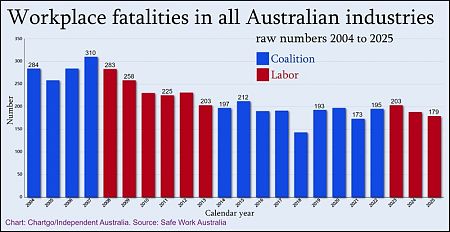
Tragically for Australia’s workers, the Coalition was re-elected in 2013 and the trajectory plateaued. The incoming Government under Tony Abbott sidelined workplace safety, with him famously declaring that “a more productive economy is a less-regulated one”.
Workers killed jumped to 212 in 2015, then fluctuated until reaching 195 in 2022, only two fewer than in Abbott’s first year in 2014.
The average deaths over the last four years under Scott Morrison were 190. That is exactly the average over the three calendar years since Labor regained office in 2022, although the trend has now shifted in the right direction.
Rates show greater improvement
While the above chart shows the raw numbers of fatalities declining very gradually, we must also examine deaths per million workers, given that the workforce has expanded from just over ten million in 2004 to 15.4 million today.
This reveals a more encouraging decline. (See chart below).
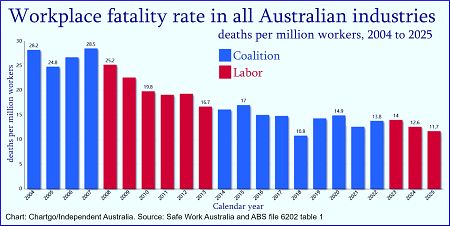
The Howard years ended with more than 28 deaths per million, a level fortuitously now abandoned forever. The rate declined significantly in every year of the Rudd/Gillard period, except 2012, and ended at 16.7 fatalities per million workers. The rate then fluctuated through the Coalition period, with a more gradual decline, ending at 13.8 deaths per million in 2022.
The trajectory since Labor returned in 2022 has been steadily downwards.
Penalties imposed
Industrial laws enforced in 2023 resulted in 293 successful prosecutions, 45 related to fatalities. Fines collected totalled $39.95 million. That’s up from $32.24 million in penalties in 2022.
Successful prosecutions in 2024 increased to 317 with fines totalling $37.08 million. National data is not yet available for 2025, but we know Victoria alone successfully prosecuted 137 cases and collected $17.4 million in penalties. Of those, 17 related to fatalities.
Measures to cut the toll
Besides stiffer penalties, recent federal and state initiatives include better education, more detailed data provided by Safe Work Australia, and an expanded list of events reportable to regulators.
Employers must now notify authorities of incidents of personal violence, work‑related suicides and attempted suicides and absences of 15+ consecutive days due to injury or illness.
Psychosocial risks, such as bullying, fatigue, stress and personal violence are now formally recognized as health and safety issues in most states. Directors must respond to psychological hazards with the same rigor as the dangers from toppling forklifts.
All-time low construction death rate
The industry with the worst performance under the Coalition was the construction sector, as IA has reported frequently since 2015.
This is no surprise given Tony Abbott’s enthusiastic backing for a gung-ho construction sector:
"I absolutely hope that in four or five years’ time, people will say ‘Yes, that Tony Abbott, he did all sorts of things but, by God, he was an infrastructure Prime Minister. He was a builder’.”
If fact, Abbott built very little. But, by God, he increased construction deaths. See chart below.
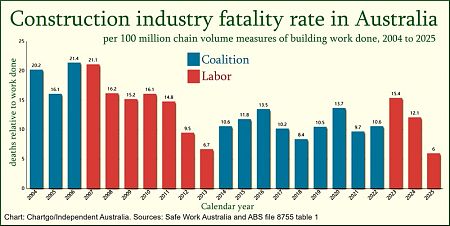
Construction workers killed soared after Abbott’s election, from 6.7 per $100 billion of building activity in 2013 to 10.6 in 2014. This leapt again in 2015 and 2016, to an appalling 13.5 deaths per $100 billion of output. This peaked higher still in 2020 at 13.7, more than double Labor’s final level in 2013.
The 2023 surge appears aberrant, given the much lower rates in the two years before and after. We know this was the result of exceptionally high driving accidents and falls from heights, although why these occurred that year is unclear.
The last two years show a trend in the right direction, with a surprisingly positive result last year — down to an all-time low of six fatalities relative to work done.
It is possible 2025 was aberrantly low. We will see in due course if that number is revised in coming months and if the improvement continues in the years ahead.
This requires ongoing attention of lawmakers, Safe Work Australia, the courts, all corporate managers and all workers — especially operators of those bloody forklifts.
Alan Austin is an Independent Australia columnist and freelance journalist. You can follow him on Twitter @alanaustin001 and Bluesky @alanaustin.bsky.social.
 This work is licensed under a Creative Commons Attribution-NonCommercial-NoDerivs 3.0 Australia License
Support independent journalism Subscribe to IA.