The lesson from London is not that Albanese is Starmer. It is that a large mandate without a clear governing purpose is a wasting asset, writes Professor Vince Hooper.
BRITAIN'S GOVERNING PARTY polls at 17 per cent. Its Prime Minister records the worst approval ratings since polling began in 1978. The populist Right is projected to win the next election with a three-figure parliamentary majority. If this is a Left-wing coup, the revolutionaries appear to be governing as though they owe an apology for existing.
Australian readers should pay close attention — not because the same fate awaits Canberra, but because the consequences of British collapse are already arriving on our doorstep.
The accusation that UK Labour’s return to power constitutes a creeping ideological seizure of the state has emotional force and no evidentiary basis. What it obscures is more dangerous than what it asserts. Britain has not been captured by the Left. It has been paralysed by a government that won a 172-seat majority and then could not decide what it was for.

The numbers are damning. Reform UK, Nigel Farage’s populist vehicle, has led every published poll since April 2025. Morin in Common's January 2026 MRP poll projected Reform winning 381 seats with a majority of 112, while Labour would collapse to 85 — a loss of 326 from its July 2024 landslide.
A separate Electoral Calculus projection put Reform at 335 seats, with Labour falling to sixth place behind the Greens and the SNP. The left-of-centre bloc — Labour, Greens, and Liberal Democrats combined — musters roughly 195 projected seats. Reform alone commands over 300. The Centre has not been captured. It has been hollowed out.
The Starmer Government’s record explains why. Labour’s £28 billion (AU$54 billion) Green Prosperity Plan was abandoned before it could be tested. The agricultural inheritance tax was hastily revised from £1 million to £2.5 million (AU$4.3 million). Winter fuel payments were cut for pensioners, then became an albatross. Chancellor Rachel Reeves reportedly prepared a manifesto-breaking income tax rise before scrapping it under pressure from her own backbenchers.
In financial economics, we describe this through real options theory: a large majority is a portfolio of options – legislative capacity, political capital, agenda-setting power – whose value decays over time. Every U-turn accelerates the decay. The May 2026 Election will function as a mark-to-market event and the portfolio is deep out of the money.
The Mandelson-Epstein affair reveals something worse than poor judgment. Starmer appointed Peter Mandelson as Ambassador to Washington despite a vetting process that flagged his post-conviction relationship with Jeffrey Epstein as a “general reputational risk” and a National Security Adviser who reportedly called the process “weirdly rushed”.
Mandelson was sacked in September 2025, arrested in February 2026 on suspicion of misconduct in public office, and has since resigned from both the Labour Party and the House of Lords. What the affair exposed was not radicalism but dependency — a government still tethered to New Labour’s factional networks at the very moment it needed the credibility to govern on its own terms. That credibility is now spent.
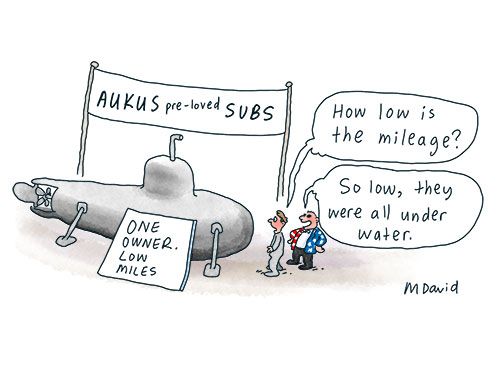
For Australia, this is not spectacle. It is a strategic problem. AUKUS – the trilateral pact that underwrites our submarine deterrent and Indo-Pacific posture – depends on Britain as a functioning pillar. When HMS Anson was pulled early from HMAS Stirling this month, almost certainly redeployed as the Strait of Hormuz closed under Operation Epic Fury, it demonstrated a reality that Canberra has been slow to internalise: Britain cannot serve two strategic masters simultaneously.
A Royal Navy stretched to breaking point by a Middle Eastern crisis it did not choose cannot also sustain the rotational submarine commitments that AUKUS requires. Every month of British political paralysis is a month in which Australia’s most consequential defence partnership loses credibility.
The parallel closer to home deserves honest examination.

Anthony Albanese won 94 seats last May — the largest haul in Labor’s history, on 55 per cent of the two-party-preferred vote. Like Starmer in 2024, he received a mandate of historic proportions. Unlike Starmer, he has – so far – avoided the catastrophic policy reversals and institutional scandals that have gutted British Labour. But the structural similarities are uncomfortable.
Albanese’s first term was widely described as cautious and the second term’s policy ambition remains unclear. His net approval has deteriorated since the 2025 Election. One Nation has surged to 22 per cent in Newspoll, pushing the Coalition to third — an echo of Reform’s fragmentation of the British Right.
The lesson from London is not that Albanese is Starmer. It is that a large mandate without a clear governing purpose is a wasting asset. The time decay is identical whether you are in Westminster or Canberra.
And the geopolitical exposure is shared. Pine Gap’s 45 satellite radomes continue feeding real-time intelligence into the Iran campaign. Australian submariners are embedded in U.S. vessels. Canberra has deployed an E-7A Wedgetail and personnel to Al Minhad. We import 90 per cent of our refined fuel and hold just 36 days of strategic reserves against an IEA benchmark of 90. A one-month Hormuz disruption lifts the Australian CPI by a percentage point; a three-month closure spikes it by 1.5 points and shaves half a point off GDP.
These are the fat-tailed risks that neither Starmer nor Albanese has priced into their governing models — because both have operated as though the geopolitical environment would remain benign long enough for cautious domestic management to deliver results. It has not.
Nearly 70 per cent of the British public now tell Ipsos that Britain is broken. They are not describing a Left-wing coup. They are describing a vacuum. The question for Australia is whether we recognise the pattern before it becomes our own: a mandate mistaken for permission to defer, alliances assumed to be self-sustaining and a strategic environment that punishes indecision with compound interest.
The electorate voted for change in July 2024 in Britain and May 2025 in Australia. In neither case did they vote for the absence of everything that preceded it.
Professor Vince Hooper is a proud Australian-British citizen and professor of finance and discipline head at SP Jain School of Global Management with campuses in London, Dubai, Mumbai, Singapore and Sydney.
 This work is licensed under a Creative Commons Attribution-NonCommercial-NoDerivs 3.0 Australia License
Support independent journalism Subscribe to IA.