NSW Parliament will begin hearings on 8 September 2026 on the management of dingoes in national parks. Dr Jeff McMullen reports on what is at stake for this iconic Australian animal.
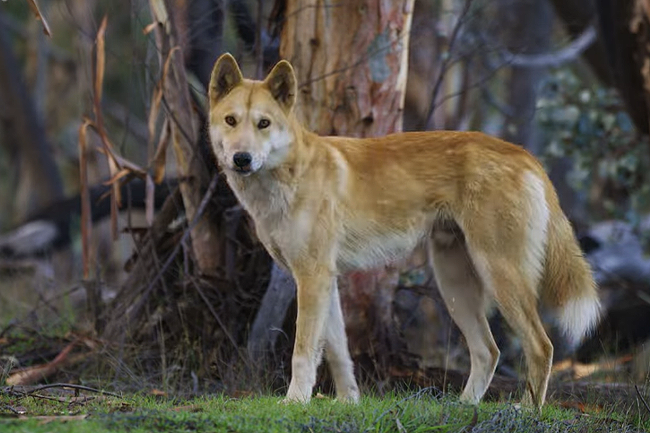
THE MASS KILLING of dingoes, including in many national parks around Australia, continues a familiar pattern of the past two and a half centuries.
The culling through “1080” poison baits, trapping and shooting, is regarded by some, especially in the pastoral industry, as a valid effort at control and coexistence.
Others, including Indigenous park rangers, DNA scientists and animal protection organisations, contend that the dingo’s role as Australia’s apex terrestrial predator is so important that we must shift our thinking to non-lethal methods of conservation.
The upcoming inquiry by the NSW Parliament has drawn more than 1,300 submissions, many of them highly charged and reflecting the furious disagreement and inconsistent policies on the treatment of dingoes around the country.
After several meetings with some of the key parties in this national debate, I suggest that it would be wise for the politicians to first examine the longer timelines of the dingo’s journey.

Any species, including the dingo, present in Australia before AD 1400, is classified as “native” under the federal Environment Protection and Biodiversity Conservation Act 1999 (EPBC Act).
Advances in DNA science, explained to me by Dr Kylie Cairns of the University of NSW, indicate that the dingo species of canids arrived on this continent about 10,000 years ago.
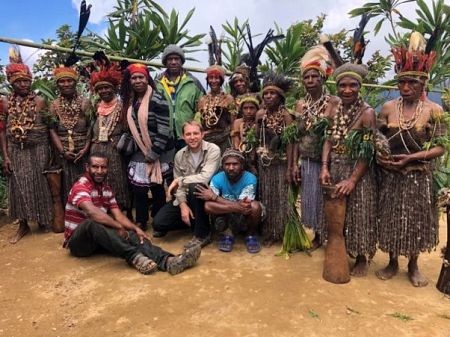
The Australian animals are genetically linked to Papua New Guinea’s Highland Dogs and the now rarely-sighted New Guinea Singing Dogs that I heard about as an ABC correspondent reporting in the remote highlands in the 1960s.
The common belief is that dingo pups travelled with humans on rafts, outrigger canoes or small sailing boats. Perhaps they utilised the land bridge between PNG and the Australian continent.
This link disappeared approximately 8,000 to 10,000 years ago with the slow melting from the last Ice Age. Rising sea levels had earlier isolated Tasmania about 12,000 years ago, which may explain why there is no evidence of dingo packs ever wandering on their own to our southern island state.
What I know about dingoes on mainland Australia was hugely enriched by the celebrated educator, Dr Ernie Grant, a Jirrbal Elder from the Tully rainforest in Northern Queensland.
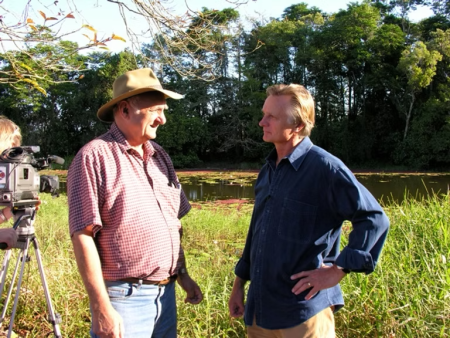
In My Land, My Tracks, Ernie Grant’s holistic teaching framework (which I helped present when it was adopted by Queensland Education), this highly cultivated man explains the dynamic relationships between Australian animals and different Indigenous clans, on different lands, at different times.
This is a sophisticated worldview, presented to the NSW Dingo Inquiry by Dr Grant’s daughter, Sonya Grant, founder of Dingo Culture, an organisation committed to the protection of these animals on public and private lands:
“Across Australia, dingoes have been companions and hunting partners; raised within camps and families; woven into kinship and totemic systems; present in creation narratives, ceremony, song, dance, art and language; as understood as knowledgeable beings with their own agency and role in keeping Country healthy.”

Sonya Grant’s northern rainforest people were among 20 First Nations Groups who joined in the First Nations Dingo Declaration in 2023. It states that dingoes should not be poisoned, trapped and shot, but protected as important apex predators helping balance the natural system.
The Declaration reads:
‘Dingoes are the Boss of Country. They belong in the landscape. Their presence in the ecosystem ensures natural systems remain in balance. This role is greatly under-appreciated. The direct and indirect effects of the Dingo on native and pest species are clear and apparent.’
In Ganibarra, a short documentary film now touring the country, Sonya Grant and Indigenous kin explore these ancient and enduring cultural perspectives. The elders express their deep hurt experienced during centuries-old clashes with farmers who kill dingoes to protect their herds of sheep.

Co-directed by Alix Livingstone, founder of the campaigning conservation group Defend the Wild, Ganibarra urges Australians to adopt a more appreciative view of the much-maligned dingo.
First Nations people have a wealth of environmental knowledge and want to be far more involved in the management of dingoes.
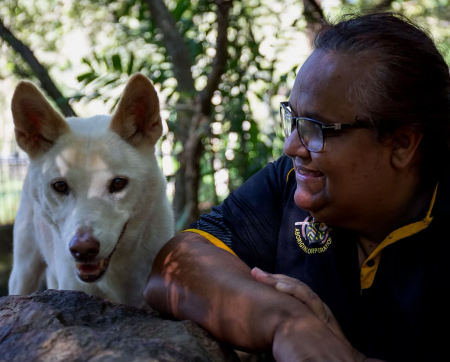
I met Indigenous rangers from the Minyumai Protected Area on Bundjalung Country in Northern NSW, where killing dingoes is banned.
Maitland Wilson, Ian Yuke and Harry Wilson use hidden cameras to track and study a small population of local dingoes. Scat analysis indicates that these dingoes feed on kangaroos and wallabies, but do not hunt small threatened species in this area such as grey-headed flying foxes and greater gliders.
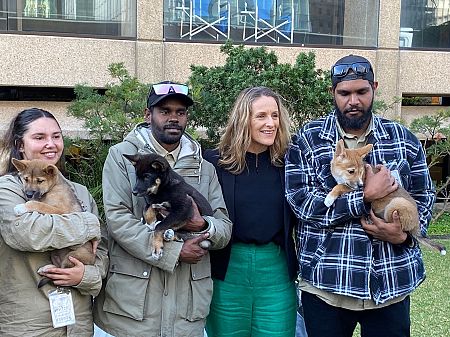
It is when the dingoes leave protected Indigenous areas that they are in greatest danger. Government regulations expose them on farmland and in national parks.
Although classified by the NSW Biodiversity Act 2016 as native wildlife, dingoes are managed as wild dogs and branded as pests to be regularly shot and poisoned.
Humane World for Animals, which coordinates more than 1,000 wildlife protected areas around Australia, cites evidence that poisoning dingoes and other carnivores with 1080 (sodium fluoroacetate) causes severe dysfunction and distress. The animals run manically, retch, vomit and experience convulsions before dropping into unconsciousness.
The NSW Farmers Federation presents the counterargument in its submission to the Dingo Inquiry that these “wild dogs” cost pastoralists too much money, as well as the pain of seeing their sheep, goats and calves killed or mauled by dingoes:
‘In NSW alone, wild dog predation has been estimated to cost agricultural producers many millions of dollars annually in lost production, in addition to the substantial costs of control. The Australian Bureau of Agricultural and Resource Economics and Sciences estimates wild dogs cost Australia's agricultural sector up to $302 million per year, primarily due to stock losses.’
It is not clear, however, what real benefit farmers achieve by the poisoning of dingoes inside national parks, even when they border agricultural lands.
Information obtained under the Government Information (Public Access) Act 2009 shows that ‘more than 1.5 million 1080 poison baits targeting dingoes were deployed across NSW national parks between 2020 and 2025’ at an annual cost of $2.7 million.
‘The measurable benefits [of poisoning dingoes in national parks] are limited,’ according to UNSW researcher Dr Kylie Cairns.
In 2024-2025 approximately 1,759 sheep deaths were reported as attributable to canines across NSW, representing less that 0.007 per cent of the state’s sheep flock.
It is unclear what proportion of these losses occur in close proximity to national parks, are attributable to dingoes living in national parks or are directly attributable to dingoes rather than other canids (stray or owned domestic dogs, or foxes).

The environmental historian, Dr Justine Philip, points out:
In the 21st Century, more vertebrate poisons are dispensed by air in national parks than on private land.
Applying more vertebrate pesticides to the environment to try and solve the problem is arguably an extreme case of mistaking the poison for the cure.
It would not be the first time we have made such a mistake.
Every schoolchild learns that the planting of sugar cane in Queensland led to the introduction of the cane toad to try to stop native greyback cane beetles ruining the sugar trade.
The result of this mistake is described by former forester, Robert Onfray, as an environmental apocalypse still spreading south in NSW and west into the Kimberley region of Western Australia.
Our history suggests, in fact, that human beings clearly top the dingo as Australia’s most devastating terrestrial predator.
The slaughter of dingoes here began soon after the arrival of European settlers.
The Reverend Samuel Marsden – missionary, flogging magistrate and keen farmer – joined a few other colonial landholders in offering a bounty of a gallon of grog for every complete dingo hide.
Without enough convicts to flog into labour as shepherds, the squatters deemed it better to declare war on the dingo.
In her submission to the Dingo Inquiry, Dr Justine Philip draws on her PHD thesis and concludes:
‘The past 200 years of government and industry-driven persecution of the dingo has caused immense cultural and environmental harm in south-eastern Australia and beyond.’
The English squattocracy created still more havoc in Australia’s natural environment by introducing rabbits.
Although a few rabbits came in cages for food on the First (English) Fleet, it was a wealthy settler at Barwon Park, Victoria, Thomas Austin, who released European rabbits into the wild for a “spot of hunting” on his estate in 1859.
This folly led to the fastest colonisation by a voracious mammal observed anywhere in the world:
‘... the spread of rabbits over Britain took 700 years while the colonisation of two thirds of Australia, an area 25 times the size of Britain, took only 50 years.’
After rabbits ran amok in Victoria, devastating grasslands and other vegetation in NSW and Queensland, they spread across the Nullarbor Plains to Western Australia.
Settlers then scrambled to build the infamous rabbit-proof fences.
These wire barriers have killed numerous native animals but barely slowed the damaging invaders until the introduction of poisons and viruses in our lifetime.
As sheep spread across the fertile pastures of south-eastern Australia and dingoes started attacking vulnerable herds, farmers once more resorted to fences.
De-fence versus the dingo is an old joke in the bush. But the world’s longest wire fence is really no joking matter.
For more than 5,600 kilometres, wire fencing buried 30 centimetres underground and reaching 1.8 metres in height stretches from Queensland’s Darling Downs, across New South Wales until it ends on the cliffs above the Great Australian Bight in South Australia.
We don’t know for certain how many dingoes live today on either side of the Great Dingo Fence. We also don’t know how many survive in our national parks around the country.
Across some 85 per cent of the continent, there may be an estimated 26,000 to 52,000 mature dingoes, according to Dr Benjamin Allen, a veteran adviser to the Queensland, NSW and South Australia governments.
A staunch advocate for controlled culling of dingoes, the Ben Allen philosophy can be summed up as the "circle of life" view:
‘People are conditioned to think that everything must live when everything will eventually die. It’s the circle of life and we are an integral part it. Humans are predators and competitors. When we eat meat, we kill animals. When we farm vegetables, our agriculture outcompetes other wildlife for space.’
In South-Eastern Australia, Dr Allen admits, some small, distinct dingo populations are under threat inside fenced areas where eradication by farmers is more intense.
Nonetheless, Dr Allen urges the NSW Parliamentary Inquiry not to categorise dingoes as a threatened species, arguing that the idea that dingoes are declining, going extinct, or are a threatened species is a furphy.
A far greater number of environmentalists are most concerned about a greater danger known as “trophic cascades”.
If you cull an apex predator such as the dingo, Professor Mike Letnic argues, you will see a huge surge in numbers of kangaroos, emus and feral goats. This can lead to drastic overgrazing, dramatically depleting ground cover during dry periods, especially in the era of climate change.
As a conservationist for more than 30 years, including experience as a Pest Management Officer with NSW National Parks and Wildlife Service, Professor Letnic concludes in his submission:
‘... classifying dingoes as wild dogs and killing them in national parks is detrimental to the health of these ecosystems and goes against one of their core objectives, the conservation of biodiversity.’
Ultimately, it is surely wiser to see the dingo as the “boss dog on country”, to underscore the words of Jirrbal woman, Sonya Grant:
‘Killing a Dingo may affect Land, silence Language, interrupt Culture, sever intergenerational Time, damage a significant Place and fracture Relationships — all through one management action.’
I would wrap up the NSW Inquiry into the future of the dingo by spending some valuable time looking over our dismal record of the past two and a half centuries.
Since European colonisation began in Australia, at least 34 unique mammals have gone extinct, more than on any other continent.
More than 100 of our plant and animal species are officially listed as gone forever.
A more recent assessment by Australian universities and museums calculates that there has been a ‘catastrophic under-recording of Australia’s species extinctions’. If we include invertebrates, around 9,000 species have disappeared since 1788.
Australians clearly have made more than a minor contribution to what Richard Leakey famously termed the Earth’s “Sixth Extinction”.
Despite having the most wondrous diversity in the world with over a million plant and animal species, in many ways we are still behaving like natural-born killers.
With the intensification and frequency of disastrous bushfires, storms and floods, as well as our slow awakening to the multiple threats of climate change, it is essential that on our public and private lands we find the right balance for long-lasting usage, conservation and co-existence with other species.
We need to apply the precautionary principle and act like custodians as well as consumers.
Dr Jeff McMullen AM is a journalist, author and filmmaker, former ABC foreign correspondent and Four Corners and Sixty Minutes reporter, and recipient of the United Nations Media Peace Prize.
 This work is licensed under a Creative Commons Attribution-NonCommercial-NoDerivs 3.0 Australia License
Support independent journalism Subscribe to IA.