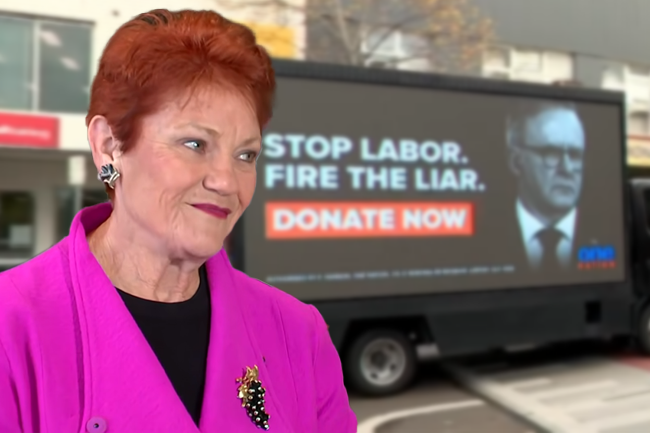
The Senator who just raised $2.7 million to “Fire the Liar” and has her eyes on the Lodge has never had to negotiate a lease renewal she might lose, writes Wayne Hawkins.
ONE NATION SENATOR Pauline Hanson is addressing the National Press Club on 17 June, positioning herself – as she has for 30 years – as the authentic voice of the small business battler.
This week, Hanson is also celebrating a rather different kind of achievement: her “Fire the Liar” online fundraising blitz raised more than $2.7 million in under two days, attracting some 28,000 donors and prompting Prime Minister Anthony Albanese to question its legitimacy. One Nation brought in an independent auditor and declared the money ‘ridgy didge’.
The National Press Club’s own introduction describes her as someone who has ‘owned several small businesses’ and therefore ‘knows what it means to struggle’. The fundraising machine operating beneath that claim is worth examining.
This is not a minor party senator content with the crossbench. One Nation recently pulled ahead of Labor to become the country’s most popular party in primary vote polling — 31% to Labor’s 30%, with the Coalition sinking to 18%. In May, its candidate David Farley won the Farrer By-election — the first time One Nation has held a lower house seat in its 30-year history.
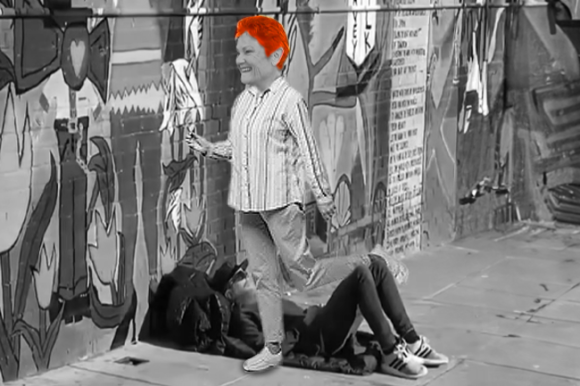
Hanson has since declared the party will now target Labor-held lower house seats. She is, in short, moving toward the Lodge and she is doing it on the back of the battler vote.
Which makes the question of what Hanson has actually done for the battler rather more urgent than a Senate curiosity.
Senator Hanson is also, as it happens, currently under scrutiny for failing to declare her business interests in A Super Progressive Movie — a film she holds a financial stake in through A Pauline Production Pty Ltd, a company undisclosed on the parliamentary register for nearly five years.
The same undisclosed interests include Small Batch Brewing Pty Ltd, a craft beer venture. Corporate records show both companies are co-run with a party official who has previously pleaded guilty to electoral fraud.
The “Fire the Liar” campaign, bankrolled by 28,000 outraged battlers at an average of $59 a head, also sits in interesting company: Hanson accepted a $2.1 million light plane from a company linked to mining magnate Gina Rinehart in April.
When Albanese pointed this out, Hanson said the PM was “jealous” of One Nation’s popularity. The plane came from Australia’s richest person. The fundraiser came from people at the bottom of the income distribution. Hanson’s genius has always been to gather the latter to serve the interests of the former.
That is Hanson's business model in miniature: use the platform to build the brand, use the brand to monetise the audience, use the audience to accumulate the kind of capital and political leverage that no small business operator will ever access. The rest of Australia calls that a grift. Small business owners call it something they could never get away with.
Consider a typical independent café operating inside a major shopping centre — the kind of business that anchors local precincts across every state. It uses milk at volume. Thirty or so three-litre bottles a day. And in a dynamic that would astonish most people if it were explained clearly, the wholesale price available to that business as a commercial food operator is frequently higher than the retail price on the shelf of the supermarket sharing the same car park.
So the café buys its milk at the supermarket. As a retail customer. Because the market that exists to serve commercial operators has been structurally undercut by the same duopoly that is nominally the café’s downstream competitor.
The farmer is squeezed at the farm gate. The small business is squeezed at the wholesale counter. The duopoly captures the middle. Coles and Woolworths reported combined profits of $2.7 billion in the 2023 financial year. The independent café operator does a click-and-collect order.
This is not a red tape problem. This is a market power problem.
Now put that café next to a national franchise in the same precinct. The customer sees two coffee shops. They may notice a small price difference and draw a reasonable conclusion — the independent charges more because it can, or because it is less efficient. What is invisible to them is the structural reality underneath.
The franchise’s input pricing is not a single-store negotiation. It is a national-network negotiation. The volume brought to that supply agreement is the aggregate of every outlet in the country and the price secured flows to every location, including the one next to the independent. The independent negotiates alone, as a single operator, against suppliers who already know what the franchise pays. The gap in purchasing power is structural. It exists before either business opens the door.
And the lease makes it worse. Standard commercial leases in shopping centres increasingly include turnover clauses — above a revenue threshold, a percentage of every dollar above that line flows to the property owner. A business succeeds, builds its customer base, earns more and the reward is extracted upward by a landlord who bore none of the risk.
Commercial rents near CBDs are rising sharply as landlords tighten their leverage. And unlike a decade ago, leases no longer come with renewal options as standard — every expiry is now a fresh negotiation between an operator with everything tied to a location and a property company with lawyers and time on their side.
The Institute of Public Affairs’ April 2026 research documents a net loss of nearly 33,500 small employing businesses between June 2022 and June 2025 — three consecutive years of net closures, which it attributes to red tape, energy costs and Labor Government regulation. The data is real. The diagnosis is not.
Deregulation does not fix the wholesale pricing inversion. Cutting red tape does not rebalance a sole operator’s position in a lease negotiation against a billion-dollar property company. Lower taxes do not change the fact that a national franchise accesses input pricing through corporate supply agreements that no individual operator will ever be offered.
The IPA’s own researcher concedes that without radical change, ‘we are going to see even further entrenchment of economic power among large corporates and multinationals’ and then prescribes deregulation, which would accelerate exactly that outcome.
The Right uses small business suffering to argue for policies that benefit large capital. That is not a coincidence. It is the function.
What small business actually needs is structural intervention in the mechanisms doing the damage: genuine anti-monopoly enforcement that prevents the wholesale pricing inversion from being a permanent feature of the food economy; commercial tenancy reform that restores lease options and caps turnover clauses that transfer the upside of success to asset holders; and a cooperative purchasing framework that lets independent operators aggregate buying power the way national franchises take for granted.
None of this features in Pauline Hanson’s platform. None of it ever has. Because none of it serves the interests of the capital that funds the political ecosystem she operates in — whether that capital arrives as $2.7 million from online donors or as a $2.1 million plane from a mining billionaire.
The Senator knows what it is to own a fish and chip shop, which she sold in 1997. She knows what it is to hold undisclosed shares in a production company. She knows very well what it is to convert the economic anxiety of ordinary Australians into fundraising momentum — and then do nothing structural with it.
Now she is positioning for the biggest prize in Australian politics. The “Fire the Liar” war chest, the lower house push, the polling surge that has the Coalition panicking about seat carve-up deals: this is not the behaviour of a crossbench senator. This is a party making a run at government.
Small business in this country deserves better than a performance. It deserves someone who understands the difference between a red tape argument and a market power argument — and knows which one actually pays the milk bill. The Senator who just raised $2.7 million from the battlers she claims to represent has had 30 years to demonstrate she is that person. The record speaks for itself.
Wayne Hawkins is the owner of Crisp N Sweet bakery and café in Claremont, Tasmania, and an independent candidate for the federal seat of Clark at the 2028 Election.
 This work is licensed under a Creative Commons Attribution-NonCommercial-NoDerivs 3.0 Australia License
Support independent journalism Subscribe to IA.


Related Articles
- What Hanson should be asked at the National Press Club
- A day in the life of Pauline Hanson
- CARTOONS: Pauline Hanson is gaga for Trump and MAGA
- EXCLUSIVE: Meta and Murdoch make AI pact and push Pauline's polls
- Pauline Hanson corrects her immigration arithmetic