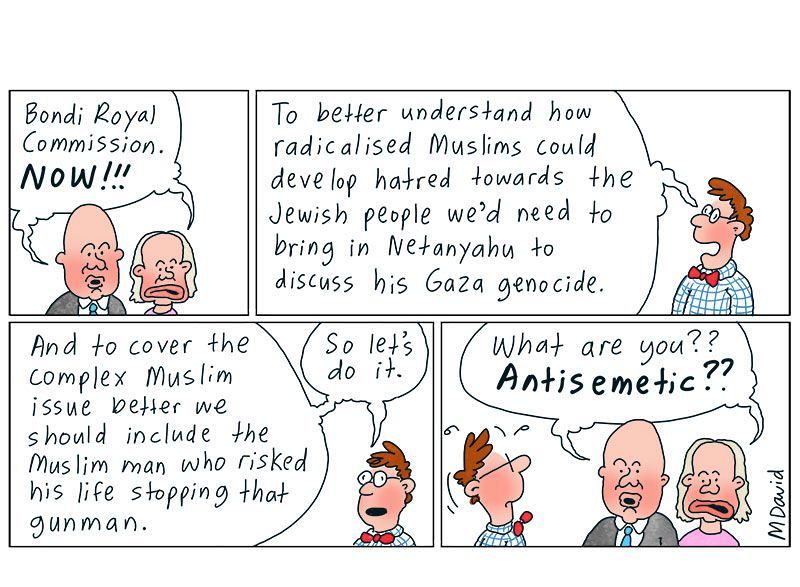
Will the Royal Commission into Antisemitism end up with a full explanation of that social problem and provide workable solutions?
Dr Lee Duffield questions whether it will help settle differences, or set up forums for more conflict — especially over the crisis in Gaza.
TWO OBSTACLES stand in the way of the “antisemitism” Royal Commission achieving its objectives: mental blockages about the causes of antisemitism in Australia and the definition of antisemitism itself.
The Commission is charged with investigating ideologically and religiously motivated extremism and radicalisation, and also strengthening social cohesion.
From pogrom in Israel to “Jew hatred” everywhere — how?
The most common theme in the Royal Commission debate has been that antisemitism has steadily increased in Australia since the massacre on the Israeli border on 7 October 2023. It is said to have been on a constant increase.
Here is the mental or intellectual problem:
How does it work that news of the pogrom could have set off a “wave of antisemitism”, as is claimed, within the Australian community? What could be the dynamic for that? How would it work, that Jewish people in Israel being savagely attacked would cause an upsurge of hatred towards the victims across the world?
Is there a psychological or criminological argument that it is a “copycat” feeling, or an event that has stirred up latent hatreds?

What links to Gaza?
It seems entirely reasonable to look at another leading prospect, that in certain quarters, bad feelings against Israel and, by extension, against Jews, come from the massacre in Gaza.
The bombardments of the Gaza Strip were ordered by Israel’s Prime Minister, Benjamin Netanyahu, immediately after the October attacks and have continued with only a temporary pause early this year.
So, both happening at the same time: the mounting death toll in Gaza, currently over 50,000 civilians killed – 40 per cent being children – and increasing antisemitic incidents in Australia.
Fly the Royal Commission to Gaza?
If the Royal Commissioner, Justice Virginia Bell, perceives links between the conflict in Australia and the conflict in Palestine and Israel, it might be valuable for her to go there. (Royal commissioners have often taken their work into the field. Justice Philip Morgan Woodward armed himself with a revolver and went to oversee attempts to find bodies set in concrete, in Griffith, NSW, during his 1977-79 Royal Commission into Drug Trafficking).
It is easily grasped that across the Middle East, Israel is equated with “the Jews” and with the Gaza crisis developing, bad feelings were going to intensify in sectors, or pockets of the Australian Islamic community.
Leaders of that community have been counselling restraint and peaceful behaviour — and some refuse to listen. In the radical Islamist attack on innocents at Bondi Beach on 14 December, 40 Jewish people were shot in cold blood, 15 of those killed.
The Royal Commission may identify what kind of dangerous minority is being harboured in this country. There will be no excuses for entertaining hatreds that set off such barbarous acts, but the RC might also do some good work diagnosing causes.

Gaza protests: Humanitarian? Anti-Jewish?
An antisemitic reaction is not to be equated with objections and demonstrations of feeling by thousands of Australians appalled by Israel’s actions in Gaza.
Where those protests will continue to include the organised “Free Palestine” movement, and even radical Islamists, many other participants have been professing to an uncomplicated compassion and concern for justice. There will be animosity towards the reactionary Likud coalition running Israel under Netanyahu, but it is drawing a long bow to translate that into a wave of antisemitism.
Vigilance versus human rights
The Royal Commission is bound to hear that Australians across a broad range want full protection for their Jewish neighbours and friends, as for everybody.
That concern would not sanction rubbing out “Palestinians” and their supporters through suppression of rights, including free speech:
- no censorship of persons for lawfully criticising Israel;
- no outlawing of such expressions;
- no defamation of them or lobbying to get them cancelled or sacked from their jobs;
- no extrajudicial screening of migrants or harassment of communities; and
- no American-style “I.C.E.” operations to yank Arabs or Muslims off the street and summarily kick them out of Australia.
The Jewish Council, which emerged as an antidote to conservative groups claiming to represent all Jews, has prepared its proposals on the lines of general working-together.
It has criticised a political “weaponising of the Bondi massacre”, stating:
‘Jewish safety and the safety of every other marginalised group go hand in hand. Pitting Jewish safety against Palestinians, Muslims and migrant communities, and eroding all of our civil liberties, doesn't make Jews safer.’
What “definition” of antisemitism?
Prime Minister Anthony Albanese has been inveigled into accepting that the Royal Commission will use the International Holocaust Remembrance Alliance (IHRA) definition of antisemitism, which reads as exacting and fair, except that it comes with a set of “examples” wrapped in one-eyed argumentative constructs and double-think.
Here is the definition itself:
‘Antisemitism is a certain perception of Jews, which may be expressed as hatred toward Jews. Rhetorical and physical manifestations of antisemitism are directed toward Jewish or non-Jewish individuals and/or their property, toward Jewish community institutions and religious facilities.’
If the Royal Commission takes up contentious “examples” that work to shift criticism of Israel or its government into the “antisemitism” column, its goal of strengthening social cohesion will be jeopardised.
Albanese is aware of the problem, at a media conference, pointing to a softener in part of the text attached to the core definition:
‘Manifestations might include the targeting of the state of Israel, conceived as a Jewish collectivity. However, criticism of Israel similar to that levelled against any other country cannot be regarded as antisemitic.’
Examples of the “examples”
To give some examples of the “examples” provided by the IHRA for application of its definition:
- Criticising the orchestrated campaign for a Royal Commission, which had Jewish interests involved, might be construed, disingenuously, as a case of ‘stereotypical allegations about... the power of Jews... controlling the media’.
(Such an accusation of antisemitism actually was attempted against the Cathy Wilcox cartoon showing the campaign as a right-wing partisan operation, marching to a drum beaten by Netanyahu.)
- Arguing the point with Jewish Australians who support certain Israeli policies might be named as ‘accusing Jewish citizens of being more loyal to Israel... than to the interests of their own nations’.
Some of the “examples” are still more interpretative and proscriptive, setting up small thickets of dispute of no use for understanding what antisemitism is:
- In one “example”, expecting Israel to show ‘behaviour not expected or demanded of any other democratic nation’, would be classed as discriminatory antisemitism. Which expectations are referred to, and exactly what behaviours might be exempted from criticism, is unstated — and would start a lot of argument.
- A further “example” says that claiming the existence of Israel is a ‘racist endeavour’, would be ‘denying the Jewish people their right to self-determination’. Arguing that such a claim would threaten self-determination for Jews is a red flag for opponents. “What about the Palestinians?” someone would say.

Another definition
A statement on racism and antisemitism by Australian universities has adopted a different definition to the IHRA one and takes the opposite approach to equating criticism of Israel with antisemitism:
Antisemitism is discrimination, prejudice, harassment, exclusion, vilification, intimidation or violence that impedes Jews’ ability to participate as equals in educational, political, religious, cultural, economic or social life. It can manifest in a range of ways including negative, dehumanising, or stereotypical narratives about Jews. Further, it includes hate speech, epithets, caricatures, stereotypes, tropes, Holocaust denial, and antisemitic symbols. Targeting Jews based on their Jewish identities alone is discriminatory and antisemitic.
Criticism of the policies and practices of the Israeli Government or State is not in and of itself antisemitic. However, criticism of Israel can be antisemitic when it is grounded in harmful tropes, stereotypes or assumptions and when it calls for the elimination of the State of Israel or all Jews or when it holds Jewish individuals or communities responsible for Israel’s actions.
It can be antisemitic to make assumptions about what Jewish individuals think based only on the fact that they are Jewish.
All peoples, including Jews, have the right to self-determination...
The universities are included in the brief of a task force on dealing with antisemitism at all levels of the education system. It is chaired by the businessman and university Chancellor David Gonski, and Antisemitism Envoy Jillian Segal has a seat, along with representatives of several government departments.
Segal authored a document requesting authority to keep watch on any antisemitism in the universities (and at the ABC and SBS), and be able to impose sanctions on the organisations or personnel. Publication of the document followed a push in 2024 against the Palestine movement, running protests on campuses.
Amongst Dr Lee Duffield’s vast journalistic experience, he has served as ABC's European correspondent. He is also an esteemed academic and member of the editorial advisory board of Pacific Journalism Review, and an elected member of the University of Queensland Senate.
 This work is licensed under a Creative Commons Attribution-NonCommercial-NoDerivs 3.0 Australia License
Support independent journalism Subscribe to IA.


Related Articles
- EDITORIAL: Antisemitism, extremism and the case for a cautious Royal Commission
- Erasing Israel: Jewish Council’s antisemitism report misses the point
- If Einstein spoke today, he would be accused of antisemitism
- Weaponising outrage: The hidden hands behind Australia's antisemitic attacks
- Antisemitic bomb threat was a hoax — the political overreaction was real