
Choosing the best ISO 27001 software comes down to finding a platform that matches how an Australian organisation actually runs compliance: juggling the Australian Privacy Principles, providing security to global customers and keeping an information security management system audit-ready year-round.
The reformed Privacy Act 2024, the updated Australian Privacy Principles and the Notifiable Data Breaches scheme have raised the bar on the governance Australian buyers expect, and ISO 27001 maps cleanly onto those expectations. For a growing Australian company, the right ISO 27001 software turns that governance from a manual scramble into a continuous operating motion.
This guide compares ten leading platforms for Australian organisations, lays out the features worth prioritising and answers the questions Australian teams ask before they commit. Australian spelling, certification bodies and regulatory context run throughout, because a generic global roundup skips the parts that decide a purchase here, from JAS-ANZ accreditation to onshore data residency.
Here are the ten platforms this guide explores:
- Scytale
- Sprinto
- Vanta
- Drata
- Secureframe
- ISMS.online
- Thoropass
- Scrut Automation
- AssuranceLab
- ISMSCopilot
At-a-glance comparison of the best ISO 27001 software for Australian organisations
Use this breakdown to see how each compliance automation platform lines up on framework coverage, model and Australian fit before reading the detail.
|
Platform |
Primary model |
Framework coverage |
Australian fit |
Best for
|
|
Scytale |
AI GRC platform plus tailored GRC expert support |
80+ including ISO 27001, SOC 2, GDPR, HIPAA, NIST, SOX ITGC |
ISO 27001 + SOC 2 cross-mapping for global sales; APP and Essential Eight governance base |
Australian organisations wanting hands-on, service-led certification |
|
Sprinto |
Compliance automation |
ISO 27001, SOC 2, GDPR, HIPAA, PCI DSS |
Broad coverage, no Australian-native framing |
Growth-stage tech teams wanting deep automation |
|
Vanta |
Compliance automation |
35+ including ISO 27001, SOC 2 |
Optional EU residency, no confirmed onshore Australian residency |
Cloud-first teams prioritising integration breadth |
|
Drata |
Automation-native GRC |
ISO 27001, SOC 2, HIPAA, PCI, GDPR, SOX |
No confirmed Australian or EU residency |
Larger teams comfortable with a per-framework model |
|
Secureframe |
Compliance automation |
40+ including ISO 27001, SOC 2 |
No Australian presence; suits international sellers |
Teams consolidating ISO 27001 and SOC 2 |
|
ISMS.online |
Documentation-first ISMS |
100+ including ISO 27001, ISO 27701 |
UK-native, strong ISO specialisation, no APP framing |
Teams wanting a structured documentation approach |
|
Thoropass |
Software plus in-house audit |
SOC 2, ISO 27001, HIPAA, PCI DSS |
No Australian presence; single audit firm |
Teams wanting one vendor for software and audit |
|
Scrut Automation |
Risk-led GRC |
60+ including ISO 27001, SOC 2, NIST AI RMF |
Risk-visibility angle, not Australian-native |
Teams wanting real-time risk posture |
|
AssuranceLab |
Audit and assurance firm |
SOC 2, ISO 27001 audits |
Australian-native auditor (now part of Sensiba) |
Buyers needing the auditor side of certification |
|
ISMSCopilot |
AI documentation assistant |
70+ including ISO 27001, SOC 2 |
EU residency via Mistral; documentation layer only |
Consultancies and teams drafting ISMS documents |
Information is based on publicly available product documentation and vendor sites as of June 2026.
Best ISO 27001 software for Australian organisations in 2026
1. Scytale
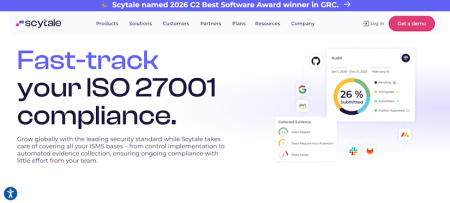
Scytale suits Australian organisations pursuing ISO 27001 alongside SOC 2 for global customers and it's the platform Australian publishers single out as the hands-on, service-led pick. It brings controls, risks, policies, and evidence into one workspace and holds them in sync across 80+ frameworks, letting a lone control answer ISO 27001, SOC 2, and Australian Privacy Principles obligations together. That cross-mapping is the practical enabler for an Australian company expanding into the US, UK, or wider APAC, because it removes the duplicate work of running each standard on its own.
Two capabilities carry weight for Australian buyers in particular. A built-in Trust Center publishes a live view of security posture, pre-filled from compliance data, so prospects and partners can verify trust without a drawn-out questionnaire cycle. Vendor risk management then automates supplier onboarding, risk scoring and ongoing checks, which matters as the reformed Privacy Act 2024 sharpens expectations around third-party oversight. Certification itself runs through a JAS-ANZ-accredited body and the platform's bundled audit hands you over to that body without a separate scramble.
Selected features
- ISO 27001 plus SOC 2 cross-mapping: One control set satisfies both standards, the dual-compliance combination Australian companies need to sell globally.
- Trust Center: A live, auto-populated posture page that shortens customer security reviews.
- Vendor risk management: Automated supplier onboarding, risk scoring and continuous checks aligned to Australian third-party expectations.
- AI GRC agents: Help with work like monitoring control gaps, checking evidence, drafting policies and answering security questionnaires.
- 150+ integrations: Evidence gathered on its own and controls watched around the clock across cloud, identity, code and HR tooling. Includes custom integrations.
- Built-in audit and integrated penetration testing: Audit coordination with auditor matching and penetration testing in one workspace.
- GRC expert support: Hands-on guidance that helps Australian teams keep certification on schedule.
Best for
- Australian organisations pursuing ISO 27001 and SOC 2 together to win international deals.
- Teams that want a service-led route to certification rather than a self-serve tool.
- Companies that need a Trust Center and vendor-risk automation to evidence governance under the Privacy Act 2024.
Limitations
- Pricing stays off the website, so a like-for-like shortlist starts with a demo.
- A few capabilities live in higher-tier plans only.
Pricing: kept private but flexible; plans tier from startup-friendly up to enterprise and the full toolkit ships together instead of being billed framework by framework.
2. Sprinto
Sprinto earns a spot in the Australian search results through its own ISO 27001 roundup and its pitch is automation depth, not a local footprint. Aimed at quick-moving tech firms, it keeps controls under continuous watch through 200+ native connectors and covers ISO 27001, SOC 2, GDPR, HIPAA and PCI DSS via adaptive mapping.
Selected features
- Continuous oversight of every ISO 27001 control.
- AI helpers that triage gaps and field auditor questions.
- 200+ native connectors paired with adaptive mapping.
- Native device and MDM health checks, an uncommon inclusion.
- Mapping that lets standards stack on shared controls.
Best for
Sprinto fits growth-stage Australian tech teams that want deep automation and fast implementation. Each extra framework layer carries its own charge that lifts the bill, Australian write-ups warn that early setup and mapping can baffle first-timers and the audit itself sits outside the product, so you bring your own auditor.
Pricing: undisclosed; quotes are custom and added framework layers cost extra.
3. Vanta
Vanta ranks first organically in the Australian SERP with its product page and dominates the People-Also-Search box for this term. The biggest name in compliance automation, it handles ISO 27001, SOC 2, HIPAA, PCI, GDPR, and 35+ frameworks via a broad connector catalogue and steady control testing.
Selected features
- 375+ connectors that keep control tests running often.
- 35+ frameworks linked by cross-mapping.
- An AI-backed trust page and an in-app assistant.
- Ready-made policy templates plus staff security training.
- Supplier-risk tracking and access reviews, with EU residency as an option.
Best for
Vanta suits cloud-first Australian teams that prize integration breadth. Price tops the list of gripes, steep for small companies and pricey on the whole; reviewers also flag connectors that still demand hand-work and there's no default onshore Australian residency, a sticking point for sovereignty-minded buyers.
Pricing: undisclosed; custom quotes that reportedly climb sharply with headcount, plus charges per added framework.
4. Drata
Across Australian roundups Drata shows up as an automation-first GRC tool driven by autonomous agents, spanning ISO 27001, SOC 2, HIPAA, PCI, GDPR and SOX through cross-mapping. Australian pieces repeatedly flag one caveat worth weighing up front.
Selected features
- An AI-first build powered by autonomous agents.
- 300+ connectors that keep controls monitored continuously.
- Wide framework reach linked by cross-mapping.
- Supplier-risk tracking and an outward-facing trust page.
Best for
Drata fits larger Australian teams comfortable with a per-framework model. Reviewers point to thin coverage of certain third-party tools, asks to smooth out configuration and the auditor flow and an interface a few find muddled. For Australian buyers, the standout gap is data sovereignty, since Drata has no confirmed onshore Australian or EU residency.
Pricing: undisclosed; custom quotes that reportedly tack on a fee per framework with yearly step-ups.
5. Secureframe
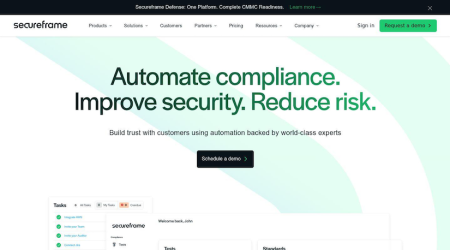
Secureframe folds a sprawling control set into guided steps that handle policy writing, training, cloud security and risk work across 40+ frameworks, with AI helping gather evidence. There's no Australian presence, but its ISO 27001 plus SOC 2 consolidation suits Australian companies selling internationally.
Selected features
- 150+ connectors that drive control testing.
- 40+ frameworks kept under continuous watch.
- A trimmed-control model that eases overlapping rules.
- AI lending a hand on evidence and gap analysis.
- A dedicated audit-support line.
Best for
For Australian teams folding ISO 27001 and SOC 2 into a single hands-off workflow, Secureframe earns a look. Reviewers note thin support for niche tools like Azure DevOps and Stripe, little room to tune timing and follow-ups and audit features that still need polish.
Pricing: undisclosed; quotes are bespoke and audit-bundled packages shift with scope.
6. ISMS.online
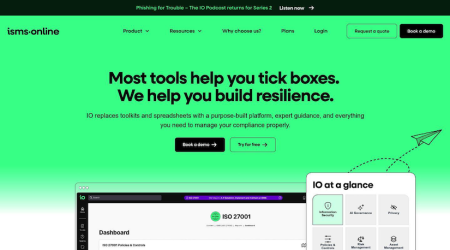
ISMS.online leads with documentation and workflow for ISO 27001 and the wider ISMS, shipping a deep bank of ready-made policies and a coached path to certification. UK-headquartered and itself ISO 27001 certified, it brings deep ISO specialisation, though Australian regulatory context such as the Essential Eight and the Australian Privacy Principles isn't built in.
Selected features
- A ready-built ISO 27001 ISMS that ships with a head start of content.
- Statement of applicability output plus risk-treatment workflows.
- A coached, step-by-step path aimed at first-time certifiers.
- More than 100 frameworks, among them NIS 2, SOC 2, ISO 42001and ISO 27701.
- A support team holding lead-auditor credentials.
Best for
ISMS.online fits Australian teams that want a structured documentation-led ISMS and don't mind handling more evidence work by hand. Reviewers raise navigation that puzzles on day one, a sharp learning curve for ISO newcomers and missing bulk export or cloud sync. It also lacks the Australian-native regulatory framing the local pieces value.
Pricing: tailored annual plans that grow with headcount and chosen modules; figures shared on request.
7. Thoropass
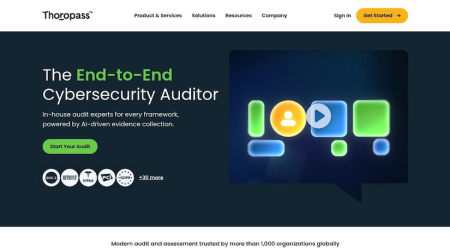
Thoropass bolts an in-house audit team onto its compliance-automation product, letting one supplier run readiness then sign off the attestation for ISO 27001, SOC 2, HIPAA and PCI DSS. Australian listicles position it as the all-in-one compliance-and-audit option.
Selected features
- Software and audit firm sitting under a single brand.
- AI lending a hand on control and evidence mapping.
- An audit you run collaboratively inside the tool.
- A steady, all-in spend model.
Best for
Australian buyers who prefer a single supplier handling both the tooling and the attestation will find Thoropass a match. Reviewers describe a patchy experience with awkward navigation, connector hiccups that throw exceptions and dim visibility into audit progress, and the bundled auditor is the only auditor on offer. That last point carries extra weight in Australia, where audits run through JAS-ANZ-accredited bodies and auditor selection matters.
Pricing: undisclosed; bespoke quotes that sit higher at the start because the audit is baked in.
8. Scrut Automation
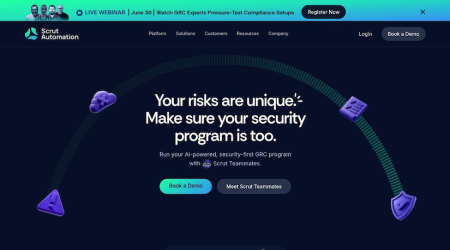
Scrut Automation is a security-first, risk-led GRC platform that aligns controls with actual risk exposure and gives teams real-time visibility into risks, controls and posture. It earns the highest satisfaction rating in this pool and ranks as a "best for risk-led compliance visibility" pick in an Australian listicle.
Selected features
- 70+ cloud, identity and SaaS integrations for continuous monitoring.
- Real-time risk visibility with automated testing, misconfiguration detection and remediation tasks.
- Centralised evidence management across multiple frameworks.
- Bundled audit support, including annual penetration tests, plus an AI GRC assistant.
- Coverage of SOC 2, ISO 27001, HIPAA, GDPR, PCI DSS, NIST AI RMF and 60+ others.
Best for
Scrut fits Australian teams that want a real-time risk posture front and centre. Reviewers note the UI and overall functionality need work, with slow GUI performance, occasional bugs and workflow breakages and a learning curve on the platform's complexity. It isn't Australian-native and no onshore-residency claim surfaces in the local coverage.
Pricing: not publicly disclosed; custom pricing.
9. AssuranceLab
AssuranceLab is the one Australian-native name on this list, an audit and assurance firm specialising in SOC 2 and ISO 27001 audits for technology companies, now combined with Sensiba's global practice. It belongs here because it represents the auditor side of certification that software alone can't provide.
Selected features
- SOC 2 and ISO 27001 audit and assurance services.
- GRC and security advisory for technology companies.
- Partnerships with compliance-automation platforms for evidence intake.
- Australian roots with global assurance capability through Sensiba.
Best for
AssuranceLab fits Australian organisations that need an auditor or assurance partner rather than a platform. It isn't a compliance-automation tool, so it has no continuous monitoring, integrations, or evidence automation and buyers still need software to prepare and maintain the ISMS between audits. Think of it as the audit partner that pairs with a platform, not a replacement for one.
Pricing: not publicly disclosed; engagement-based audit and assurance pricing.
10. ISMSCopilot
ISMSCopilot currently holds the top organic position in Australian search results for AI assistants focused on compliance work, although it occupies a different niche from the broader compliance automation platforms listed above. Rather than gathering evidence from systems or monitoring controls, the platform acts as a specialist AI assistant designed to support ISO 27001 programmes through policy drafting, risk management guidance, gap assessments and framework-specific questions.
Selected features
- AI assistant designed specifically for compliance teams working with ISO 27001, SOC 2, NIS 2, GDPR and more than 69 additional frameworks.
- Automated policy drafting alongside document review and gap identification capabilities.
- Support for multi-client environments used by consultancies and advisory firms.
- European data hosting through Mistral for organisations with data sovereignty requirements.
- Clear and publicly available pricing with self-service onboarding.
Best for
ISMSCopilot is best suited to Australian consultancies and internal teams looking to speed up document creation and ISMS preparation work. It does not position itself as a full GRC platform and therefore lacks infrastructure integrations, automated evidence collection, continuous control monitoring, Trust Centre functionality and audit support services. Its third-party validation footprint is also relatively limited, with no presence on G2 at present. For most organisations, it makes more sense as a supporting tool alongside a dedicated compliance platform rather than a replacement for one.
Pricing: Public plans start at approximately the Australian dollar equivalent of USD 24 per month and extend to around USD 250 per month. A free tier is available, alongside discounted annual billing options.
5 features to prioritise in ISO 27001 software for Australian organisations
When you evaluate tools, weigh the features that shape audit readiness, dual compliance and the daily load on control owners.
Cross-framework mapping for ISO 27001 and SOC 2
If you sell internationally, ISO 27001 alone rarely closes the deal and SOC 2 follows close behind. Prioritise platforms that let one control satisfy both standards so you test once and apply results everywhere relevant. This dual-compliance reuse is the single biggest time-saver for Australian companies expanding abroad.
Automated evidence collection and continuous monitoring
Strong platforms connect to your cloud, identity, and code systems to pull evidence on a schedule and test controls continuously, rather than gathering screenshots before each audit. Continuous monitoring keeps the ISMS current between surveillance audits and flags drift before an auditor does.
Vendor risk management
The reformed Privacy Act 2024 sharpens expectations around third-party oversight, so vendor-risk automation, supplier onboarding, risk scoring and ongoing checks, has moved from nice-to-have to core. Look for a centralised vendor register tied back to your controls.
A Trust Center for customer reviews
A live Trust Center publishes your security posture so prospects can self-serve their due diligence. For Australian companies selling globally, this shortens the questionnaire cycle that otherwise stalls deals, and the best versions pre-fill from existing compliance data.
Data residency and sovereignty
More and more Australian buyers ask where their data lives. Confirm onshore or EU residency rather than assuming it, since several global platforms have no confirmed Australian instance. Treat residency as a buying criterion, not a footnote.
How to choose ISO 27001 software in Australia
Before shortlisting, align internally on who owns controls, how evidence is collected and which Australian obligations matter most to your buyers. These questions sharpen the requirements before you book demos.
Key questions to ask
- Framework scope: Do you need ISO 27001 alone, or ISO 27001 plus SOC 2 for international customers and how critical is control reuse across them?
- Australian regulatory fit: How will the tool help you evidence the Australian Privacy Principles, the Privacy Act 2024 and an Essential Eight maturity story?
- Audit path: Which JAS-ANZ-accredited body will run your audit and do you want the software to coordinate that handover or stay separate?
- Data residency: Does your buyer base require onshore or EU data residency and has the vendor confirmed it?
- Implementation capacity: Do you have in-house security capacity, or do you need GRC expert support to carry the certification?
Evaluation matrix
Sort your context into a category first, then weigh vendors on Australian fit, automation depth and audit support.
|
Dimension |
Examples |
Better-suited tool types
|
|
Organisation maturity |
Early-stage startup; mid-market adding frameworks; established security function |
Sprinto or Vanta for lean automation; Scytale for service-led mid-market and enterprise; Scrut for risk-led teams |
|
Primary goal |
First ISO 27001 certificate; ISO 27001 plus SOC 2; documentation help |
Scytale or Thoropass for end-to-end; ISMS.online for documentation; ISMSCopilot for drafting |
|
Australian fit |
Privacy Act and APP evidence; onshore residency; local auditor |
Scytale for APP and Essential Eight framing; AssuranceLab for the auditor side |
|
Audit support |
Bundled audit; auditor choice; assurance partner |
Scytale for bundled audit with auditor matching; AssuranceLab for JAS-ANZ assurance |
Choosing ISO 27001 software that fits the Australian compliance reality
Which ISO 27001 software wins for an Australian organisation turns on how much load you hand the tool and how international your customers are. ISMS.online brings documentation depth, Scrut leads on risk visibility, AssuranceLab covers the auditor side and ISMSCopilot helps draft the paperwork. For an Australian company that needs ISO 27001 and SOC 2 together, a Trust Center and vendor-risk automation to evidence the Privacy Act 2024, and a service-led route to a JAS-ANZ-accredited audit, Scytale covers the most ground in one platform. Fit the platform to your team's bandwidth and what your buyers ask for, and the certificate flips from a deal-blocker into the credential that lands overseas contracts.
Frequently asked questions
What's the difference between IRAP and ISO 27001 for Australian companies?
IRAP, short for the Information Security Registered Assessors Program, evaluates systems against the Australian Signals Directorate's Information Security Manual and is generally required for organisations that process or store Australian government information. ISO 27001 serves a different purpose. It is an internationally recognised framework for building and maintaining an information security management system and is widely requested by commercial customers and overseas buyers.
Leading AI GRC platforms such as Scytale help organisations establish and maintain the ISO 27001 management system that often forms a strong foundation for future IRAP assessments and broader Australian security initiatives, including alignment with the Essential Eight maturity model.
Which certification bodies conduct ISO 27001 audits in Australia?
ISO 27001 audits in Australia are carried out by certification bodies accredited by JAS-ANZ, the Joint Accreditation System of Australia and New Zealand. The software you use prepares and maintains the ISMS, but it doesn't issue the certificate; a JAS-ANZ-accredited body audits your management system and makes the certification decision. Scytale's built-in audit coordinates that handover so the preparation and the audit don't sit in separate silos.
How does ISO 27001 support compliance with the reformed Privacy Act 2024 and the Australian Privacy Principles?
The controls inside ISO 27001 line up with the security duties set by the Australian Privacy Principles and the reformed Privacy Act 2024, so a properly maintained ISMS already produces much of the governance evidence a privacy review asks for, breach-response duties under the Notifiable Data Breaches scheme included. When a tool cross-maps frameworks the way Scytale handles it, a single control covers ISO 27001 and APP-aligned duties in one pass rather than being kept up twice.
How does ISO 27001 relate to the ASD Essential Eight?
The Essential Eight is a set of prioritised mitigation strategies from the Australian Signals Directorate, focused on technical hardening. ISO 27001 is the broader governance framework that sits around those controls, defining how risks are assessed, owned and reviewed. Running ISO 27001 gives an Australian organisation the management system that makes Essential Eight maturity easier to evidence, because the governance, risk assessment and monitoring are already in place.
Do Australian companies still need SOC 2 if they already have ISO 27001?
Often, yes. ISO 27001 is the recognised standard in much of the world, while many US buyers specifically request a SOC 2 report. Australian companies expanding into the US or selling to US-headquartered customers frequently need both. The efficient path is cross-mapping, where one control set evidences ISO 27001 and SOC 2 together, which is exactly the dual-compliance reuse Scytale is built around.
Does onshore data residency matter when choosing ISO 27001 software in Australia?
For many Australian buyers it does, especially those handling regulated or government-adjacent data, since data sovereignty expectations push toward onshore or at least clearly disclosed residency. Several global platforms have no confirmed Australian instance, so confirm residency directly rather than assuming it. Treat it as a shortlist criterion alongside framework coverage and audit support.
How does continuous monitoring keep an ISO 27001 certificate audit-ready between surveillance audits?
ISO 27001 certification isn't a one-off; certification bodies run surveillance audits in the years between full recertification. Ongoing surveillance of each control catches a slipped setting the moment it occurs, so every surveillance audit lands on a living, maintained ISMS instead of a last-minute rebuild. Scytale's continuous control monitoring and automated evidence collection keep that readiness current without a manual scramble before each visit, ensuring continuous ISO 27001 compliance.