Australia is no longer a colony, but still behaves like one — paying tribute to its so-called “allies”, writes Dr Evan Jones.
AUSTRALIAN ELITES have a problem with the concept of sovereignty. Comfort resides in giving it up, in both the political and economic domains.
White Australia's character was nurtured on the teat of Mother England. Sydney University’s motto (1857) is ‘Sidere mens eadem mutato’ – the constellation changes, the mind remains the same. Quite. See the Australian flag.
The Australian Constitution was passed by the British Parliament in 1900. Australian troops were at that moment dying in Britain’s second Boer War and assisting in quenching the Boxer Rebellion in China.
Australia went off to War in 1914 under the British flag, much to the disdain of Irish-born residents. The military was for a long time an arm of the British forces. Australia's foreign policy was essentially a derivative of Britain’s until an embassy was established in Washington, DC (the first outside the British Commonwealth) in 1940.
The post-World War II Labor Government's attempt to nationalise the commercial banks (which resisted financial regulatory reforms) was decided in the British Privy Council, a judicial lineage not abolished until 1975.
After 1945, Australia duly and dually accommodated both British and American imperatives. The Australian Security Intelligence Organisation (ASIO) was created in March 1949 under Allied pressure to hunt down leaks flowing to wartime ally the Soviet Union, and to inhibit “communist subversion”. Mao’s China was not recognised on cue.
Australian forces were sent to Malaya (1950-63, 1973), Korea (1950-53), Vietnam (1962-72) and later to Iraq (2003-13) and Afghanistan (2001-14, 2015-21) at the behest of its imperial masters. Lawyer and geopolitical analyst James O’Neill elaborates (July 2021). There has been no official reckoning for the merits or folly of these outings.
There was an increasing tilt towards the U.S. after the anglophile Robert Menzies’ retirement from the Prime Ministership (1949-66) and increasing U.S. private investment into Australia.
In the 1960s, three intelligence bases were placed on Australian soil – North West Cape (1963, naval communications station, for submarines and surface fleet), Pine Gap (1966, near Alice Springs, Soviet nuclear capabilities surveillance) and Nurrungar (1969, near Woomera, early warning of Soviet attack; functions transferred to Pine Gap in 1999) – of enormous significance for snooping on the Eastern hemisphere and facilitating the U.S.’ global interventions. All three facilities were, from the beginning, prime nuclear targets.
Bolshie labour leaders were the subject of special attention by U.S. attachés. Key union leaders were invited to attend the Harvard Trade Union Program for purposes of re-education as to what constitutes responsible and “effective” union leadership. The trial of CIA contractor and message decoder Christopher Boyce in 1977 disclosed evidence of the CIA’s interference in Australian labour movement activities to inhibit militancy.
The Whitlam Labor Government, elected in December 1972, looked dangerously independent in spirit. It immediately recognised the People’s Republic of China. It withdrew the remaining forces in Vietnam. In 1974, the anthem ‘God Save the Queen’ was replaced by ‘Advance Australia Fair’. It abolished the British-derived Honours award system. It made attempts (tragically via deeply flawed means) to bring economic development under greater local control.
The intelligence bases were up for renewal, and Labor in Opposition had previously questioned their operational secrecy. Labor was naturally concerned that it could be brought into a war without its involvement, without “power of decision”. The Government later discovers that the North West Cape was used by the U.S. in its involvement on Israel’s side in the October 1973 Yom Kippur War without Australian authorities being informed.
The Americans sent in the enforcer Marshall Green as ambassador, fresh from keeping the lid on subversion in Indonesia. In November 1975, the Whitlam Government was overthrown in a U.S.-led coup, via our Monarch’s representative (doubling as the CIA’s “Our Man”), Governor-General Sir John Kerr, with Buckingham Palace’s evident approval (vide Jenny Hocking’s exposé). The public was outraged, but the Labor Party pulled its head in.

As John Pilger noted succinctly in 2014 on the occasion of Whitlam’s death:
‘The “Whitlam problem” was solved, and Australian politics never recovered, nor the nation its true independence.’
Precisely at this time, Robert J Hawke, contemporaneously President of the Australian Council of Trade Unions (ACTU) and President of the Australian Labor Party (and Australian go-between at the ILO), was secretly informing U.S. officials of internal union and Labor Party affairs. Hawke subsequently became Prime Minister, 1984–1991.
Hawke did oversee arrangements for the Australian Government to be “better informed” and to have Australian personnel elevated in situ. The reality is that Australia remained a bystander to U.S. war-making deliberations on Australian soil. Without consultation, the gung-ho Hawke threw Australia into involvement in the first Gulf War in August 1990.
During this war, the Nurrungar facility was integrated into the early warning system for Israel (it was from this source that Israel was advised that Iraq had launched Scud missiles in its direction) — again, unknown to Australian authorities.
Small beginnings towards a less dependent and Asia-focused foreign and military policy were developing under Labor Prime Minister Paul Keating (1991-96), but this was snuffed out with the election of the Howard Government in 1996. The 1997 White Paper, In the National Interest, provided an immediate pointer to the Coalition’s renewed American embrace (hence the lapdog role in Iraq and Afghanistan).
Chinese Reds under the bed
More craven bipartisanry, the Gillard Labor Government announced in 2011 the establishment of the Force Posture Agreement, cemented in 2014 under the Abbott Coalition Government. This meant 2,500 U.S. military boots on the ground in the Northern Territory. Also planned is infrastructure for nuclear-capable B-52s.
The subjugation has been reinforced in the materiel domain. The Howard Government purchased 59 Abrams M1A1 tanks in 2004. Tanks? Each weighing 60 tonnes? A friend, an international security expert, has filled me in on details. Dodgy to begin with, they were soon mothballed, with a couple used for training.
Past their use-by date (no spare parts as the U.S. has long since ceased production), the current Albanese Labor Government sent 49 of them to Ukraine to “assist” in the U.S.-led war against Russia on Ukrainian soil. This “taking out the garbage” (George Miller could have better used them in a Mad Max reprise) was praised in glowing terms in official Australian Defence Department propaganda.

Bizarrely (or perhaps not), the Morrison Coalition Government ordered replacement Abrams M1A2 tanks (75 at AU$3.5 billion) in early 2022. Equally useless. Do authorities think that a Chinese Rommel is going to invade the Simpson Desert on his way to urban Australia?
Then there’s the F-35 aircraft. Disparaged globally for its dysfunctionality (including by the U.S.’ own Government Accountability Office), Australia was a natural sucker for this expensive rubbish, initiated by the Howard Coalition Government in 2006 (the Joint Strike Fighter Program).
Howard was mercifully turfed out of office in November 2007, but what do we get? The Rudd Labor Government approved the first purchases of 14 aircraft in 2009, making the affair bipartisan (albeit the fulfilment of the order was put in mothballs). The Abbott Coalition Government, elected in 2013, made the big purchases in 2014, with final delivery in 2024, making 75 planes for a bill of $13 billion. The Coalition wants to round off the numbers to 100 when it returns to office (thankfully not tomorrow).
Then there’s AUKUS. The Turnbull Coalition Government signed a deal with the French in September 2016 for 12 conventional submarines (the Future Submarine Program) at an estimated cost of $90 billion. Prime Minister Malcolm Turnbull was rolled by his caucus. The replacement Prime Minister, Scott Morrison, a man without qualities, went behind everybody’s back and arranged a submarine deal with the U.S. and the UK, announced in September 2021. This time it’s nuclear.
The AUKUS “fact sheet” claims:
- Submarines. AUKUS will provide Australia with a conventionally armed, nuclear-powered submarine capability at the earliest possible date, while upholding the highest non-proliferation standards.
- Advanced capabilities. AUKUS will develop and provide joint advanced military capabilities to promote security and stability in the Indo-Pacific region.
Complete blather. And the money? First off, compensating the French comes in at €555 million (AU$835 million). As for the nuclear submarines, it’s pure boondoggle. No contractual obligations, delivery date uncertain; they may never arrive at all.
Nuclear capacity in Australia sums to a small reactor at Lucas Heights outside of Sydney, used for medical and industrial products. And a depository for nuclear waste? What is certain is the billions – hundreds of billions – destined to flow overseas as the price of allegiance. Albo has just signed up for the first tranche of a $30 billion submarine shipyard in South Australia of massive proportions, with the usual super-inflated job promises.
The whole thing is preposterous. Curiously, the Australian political Right and its media counterparts, endlessly haranguing Labor over supposed spending profligacy, have nothing to say about this madness on an industrial scale.
AUKUS payments (add the Abrams tanks, the F-35 aircraft, and so on) are pure tribute to Australia’s overlords. Shades of the East India Company and British government extraction from India, estimated by Utsa Patnaik at £9.2 trillion (AU$17.5 trillion) for the period 1765 to 1938. Shades of Haiti’s “independence debt” of 150 million francs imposed by France in 1825. Shades of Bismarck’s extractions from France after Prussia routed French troops in 1870-71. These financial barbarisms were supposed to be a thing of the past.
An implicit alliance of ASIO, think tanks (vide Australian Strategic Policy Institute) and the mainstream media reinforces the thrust to subjugation. China is seemingly an immediate threat to Australia’s interests. There’s a (Chinese) Red under every bed. As Australia’s interests are made to equate with American interests, then naturally, China is the enemy.
Meanwhile, the 26 January 1788 invasion by the First Fleet and the raising of the Union Flag is still being celebrated as Australia Day. The Union Jack still adorns the Australian flag (Canada’s equivalent was replaced in 1965, a mere 60 years ago). Replacement of the ludicrous monarchy remains on the back burner.
Albanese toes the line
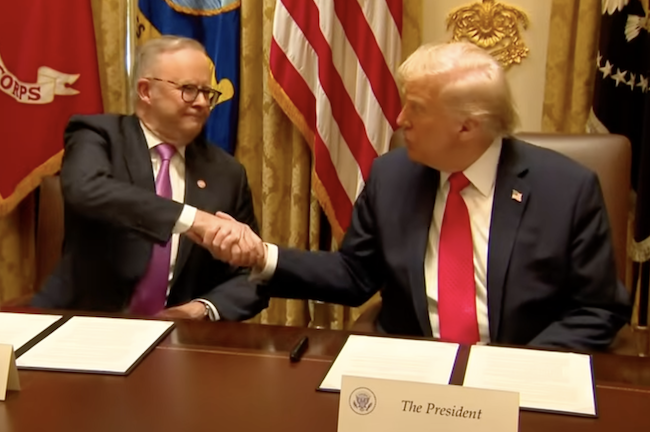
Anthony Albanese, ex-student radical and long-prominent figure of the Australian Labor Party Left wing, became Prime Minister in May 2022 (and was re-elected in May 2025). While pursuing some progressive policies domestically, in almost all of his and his Government’s foreign policy actions, he has merely sought to reinforce Australia’s colonial cringe.

The day after assuming office, Albanese (and foreign minister Penny Wong) travels to the Quadrilateral Security Dialogue meeting in Tokyo. The entire concept of the Quad was to contain China on the U.S.’ terms. A diplomatic difficulty, first day on the job.
Albanese and Wong brought forth the usual waffle, but the essential was to reassure the country’s betters.
As reported in The Guardian:
‘Albanese said he wanted to use the trip to showcase his new government’s commitment to the U.S. alliance, which he said remained Australia’s “most important”...’
Albanese then went to the NATO Summit in Madrid, late June 2022 — a presence utterly unwarranted (memo: Australia is not in the North Atlantic).
In July 2022, Labor’s Defence Minister Richard Marles delivered a speech to the Washington, DC-based Centre for Strategic and International Studies (CSIS) in which he flagged the move from “interoperability” on Australian soil of U.S. and Australian forces and materiel to “interchangeability”. Effectively, Australia’s entire defence modus operandi is to be organised within U.S. interests.
According to Marles:
“…the Alliance has far surpassed its origins. It is now a unique and thriving project: driven not only by our nations’ geopolitical interests, but also by our profound commitment to democracy, open economies, free and just societies.”
Pure blather.
More:
“And we will ensure we have all the enablers in place to operate seamlessly together, at speed.”
Sure. How this is supposed to work in conjunction with the impossibly unworkable AUKUS project is anybody’s guess. Irrepressible blogger Dr Binoy Kampmark labels Marles ‘a fool of Chaucerian proportions’.
Regardless, subordination to U.S. imperatives is what matters. It transpires that an “Australia Chair” was established at CSIS in December 2021, assisted by private funding.
There we read:
‘The Chair works to broaden the reach and impact of the U.S.-Australia alliance and Australian ideas, influence and capacity’.
More blah.
One of the most craven decisions of Albanese’s leadership was to arrest Daniel Duggan, a sometime U.S. Marine pilot and Australian citizen since 2012, in October 2022 at the behest of the U.S.
Duggan was claimed to be traitorously consorting with the Chinese devil in giving flight training to Chinese nationals. He has since been incarcerated in intolerable conditions. The mainstream media ignores his plight and the travesty of his arrest.
This. after successive Australian governments sat back while the U.S. and a compliant British judiciary incarcerated Australian Julian Assange in intolerable conditions.
This is the first part in a series of three by Dr Evan Jones. The second will be published tomorrow, 27 Friday February.
Dr Evan Jones is a political economist and former academic.
 This work is licensed under a Creative Commons Attribution-NonCommercial-NoDerivs 3.0 Australia License
Support independent journalism Subscribe to IA.