A new policy analysis finds One Nation's platform falls well short of the future Australians say they want, raising questions about the party's promise of hope and national renewal, writes Dr Bronwyn Kelly.
IT IS DIFFICULT to know whether One Nation’s recent surge in the polls will be anything more than temporary.
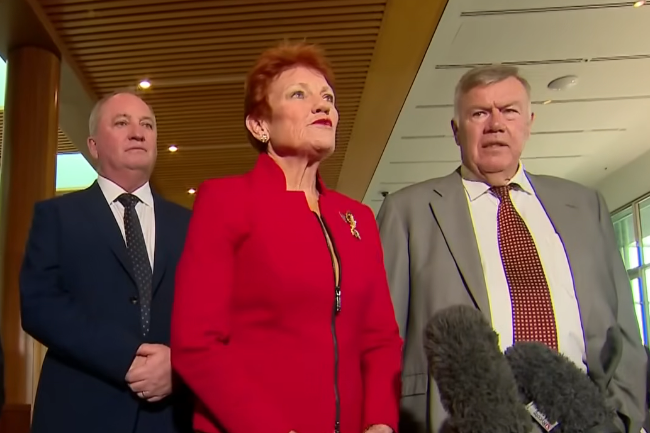
But now that Senator Pauline Hanson is rating herself as an able candidate for the job of prime minister of Australia and One Nation as a viable “party of government”, it’s worth pausing to ask whether she and her party can take us towards a better Australia.
As Hanson has said:
“I want people to feel that they've, you know, got some hope for the future.”
But what type of future would her party deliver? Will we get what we might be hoping for? Perhaps. But if the policies currently published by One Nation on its website are anything to go by, it would seem that we are very likely to end up with a future that many – or even all of us – would not hope for.
At least, this is the conclusion that has emerged from a detailed analysis recently published by Australian Community Futures Planning (ACFP).
ACFP’s 'Assessment of Major Party Policies' is a report that looks at whether the policies on offer from Labor, the Liberals, the Greens and One Nation have the potential to result in the sort of future Australians have said they want.
To measure this potential, it uses a yardstick called 'The Vision for Australia Together'. This is a one-page vision statement with 17 elements (see them below) that summarise the preferences for a better society, natural environment, economy and democracy Australians have spoken of whenever they’ve been asked in the 21st Century in surveys, other research and community engagement programs about what they want for their future.
The report looks, firstly, at what Australians have said they want for themselves and their country over the longer term and, secondly, at what politicians have offered in policies. And then it looks to see whether, if at all, the latter might lead to the former.
And the results? In brief, it is not evident from the analysis that the policies of either the Liberal or One Nation parties will help Australians travel toward the future they have said they would prefer. Nor would the policies of the Labor Party, although they would help us get somewhat closer to the ideals expressed in the Vision, than would the policies of the Liberals and One Nation.
This doesn’t mean that every policy these three parties have offered us would drag us away from a better future as we have imagined and expressed it. But it does mean that when each party’s total policy offerings are considered together and the plusses and minuses of the policies – relative to the aims of the Vision – are added up, there are more minuses than plusses in the Liberal and One Nation and, to a lesser degree, Labor party platforms.
Put another way, there are more policies that drag us away from the better future we have said we want than those that would propel us towards it. The combination of each party’s policies when consolidated into their platforms does not constitute a path to a better future — certainly not a safer one.
Doubtless, it will irk many members of One Nation, Liberal and Labor that the Greens' policies largely have the opposite effect. It will be doubly irksome to realise that Greens' policies arc strongly towards the sustainable future of safety, security, wellbeing and fairness implied in the Vision for Australia Together, while those of the Liberals and One Nation arc strongly away from it.
This in itself may bring on some complaint that ACFP has chosen the wrong yardstick or has not accurately summarised the aspirations of Australians. By extension, that complaint would imply that if the analysis has demonstrated that Labor, Liberal and One Nation policies are unlikely to take us where we want to go, it must be the fault of our aspirations — a conclusion suggesting it’s like our cheek to want to be safe, secure, healthy and lead lives of dignity, and that we should shut up and be satisfied with the lot they are prepared to let us have rather than the one we need.
So it is that Labor, the Liberals and One Nation may call the findings unjust. But what is really happening is simply that the Greens have selected policies which fit with Vision for AustraliaTogether and will pull the country towards it, while Labor, the Liberals and One Nation have selected policies which pull us away from making that vision a reality.
And in the case of the Liberal and One Nation Parties, their policies will pull us so far away from it that we couldn’t reasonably expect to achieve any of Vision’s 17 elements.
This conclusion arises from the way the yardstick has been expressed in the 17 one-line statements of the Vision — statements that simply specify that by 2050 (or sooner) we aspire to be living a fulfilling life where:
- we are all safe;
- we have achieved a lasting reconciliation between First Nations peoples and non-Indigenous Australians, based on our shared values of justice and self-determination;
- everyone is welcome to participate positively in community life;
- we are inspired and able to renew our physical and spiritual wellbeing;
- we act together as a compassionate society;
- equality is valued as enriching human community, cultural harmony and social progress;
- diversity is positively appreciated as the basis for a successful Australian society;
- everyone can realise their full potential in life, as individuals, members of a family and citizens through unlimited opportunities in education and employment of choice;
- vital services are fully accessible for all;
- scarce resources are conserved and fairly shared;
- national wealth is fairly raised and fairly shared;
- our economy is sustainable and supports rewarding opportunities and continuous improvements in living standards, wellbeing and security for everyone;
- as a nation, we have the courage to take a leading place in achieving the environmental aims of a global society;
- stewardship of ecology is affirmed as fundamental to planetary and human survival;
- democracy is assured by a well-informed and engaged community of political equals;
- we can confidently trust our parliaments, governments and courts to act fairly and justly in accordance with the rights and interests of the public and future generations; and
- we take pride in Australia as a responsible international citizen, active in building a safe, peaceful and united world.
These aspirations might seem unrealisable, but they are no more than what we have been able to articulate about our hopes. And they are not at all unreasonable. They are an expression of what we instinctually understand to be essential for survival and a decent life, and so there can be no argument that we should want to settle for less. They boil down to a simple picture of our elemental desire for safety, security, wellbeing, dignity, fairness and political equality, freedom from fear and want, and to have more control over our own future.
ACFP’s research shows that these aspirations are generally common to all voters, although some voters may not be quite so keen on fairness and political equality.
We could pick a different yardstick, of course. But the fact remains that for the Liberal Party and One Nation to get a good score, we would basically have to reject the entire Vision. We would have to prefer the opposite of the future it describes.
There is no evidence that Australians want a future that looks like the opposite of the Vision for Australia Together. But the report shows that this is what will come about with Liberal and One Nation policies.
Still, the report itself also offers Australians hope, which Pauline Hanson claims she wants us to have. It shows that policies can be designed to lead us away from dystopia. If the Greens have mastered that in policy design, so can any other party.
In that light, Labor might pause to consider whether its policies need a makeover. Labor could do itself and everyone a favour by re-designing its policies so that they push us towards the sort of future described in 'The Vision for Australia Together'.
Dr Bronwyn Kelly is the Founder of Australian Community Futures Planning (ACFP). She specialises in long-term integrated planning for Australia’s society, environment, economy and democracy, and in systems of governance for nation-states.
 This work is licensed under a Creative Commons Attribution-NonCommercial-NoDerivs 3.0 Australia License
Support independent journalism Subscribe to IA.


Related Articles
- News Corp jumps on One Nation bandwagon
- FLASHBACK 2019: Put Gun Nation last!
- One Nation's poll surge and the politics of prediction
- Farrer falls: One Nation crashes the Coalition fortress
- How the media legitimise Barnaby and Pauline's PHONies