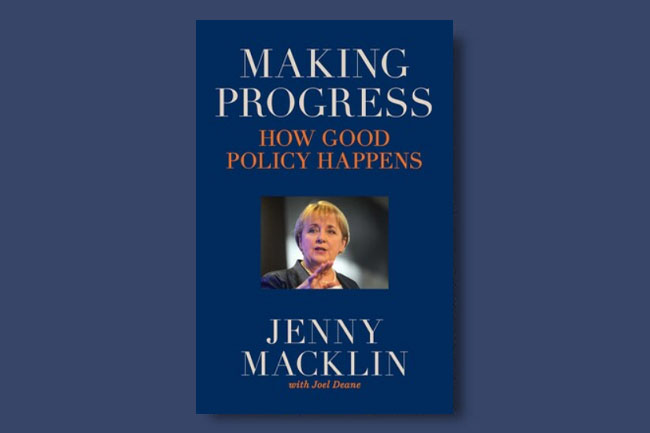
To turn a great idea into a change in the real world, you need effective policy.
Author Jenny Macklin has a wealth of experience in the development and implementation of public policy. She spent 15 years as a researcher, 11 on the opposition benches and six as a Labor government minister.
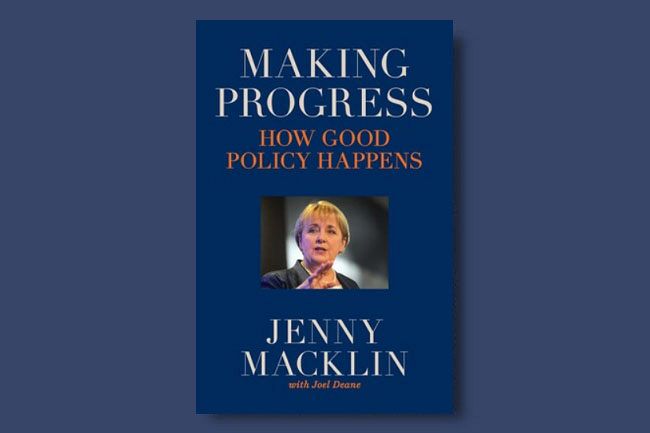
In Macklin's book Making Progress: How good policy happens, she offers lessons she has learned over those years for the benefit of anyone interested in the process of policy development and its implementation.
The first half of this book is a memoir: born in Brisbane, Macklin grew up in country New South Wales and Victoria, then spent a year in Japan as an exchange student before heading to Melbourne for a degree in economics. The following decades were spent as either a researcher or an MP.
It struck me that while a common criticism of the Labor party is that MPs haven’t spent enough time in the “real world” – which typically means private-sector employment – it’s hard to imagine a better preparation for the work of government than time spent in policy research.
In the second half, Jenny presents a series of interviews with individuals who offer their own particular insights, some of which I’ve summarised below.
Big ideas are all very well, but translating them into the real world requires the development of policies covering legislation, administration and budgets. Really challenging problems are typically those that have developed over decades; it’s unrealistic to expect them to be turned around during a single electoral cycle.
The opportunity for real, transformative change arises when three things come together: a problem to solve, a policy to address it and a conducive political setting. Retired former Parliamentarian Brian Howe, a mentor, taught Macklin the importance of having policy well developed and ready to go, waiting for the political moment when it could make its way into legislation.
Sometimes a change introduced by one government is watered down or reversed by the next. Bringing people with you – essential in a democracy – takes time. Former PM Bob Hawke (according to economist Ross Garnaut) had ‘supreme self-confidence that he was the leader of a good government that will be re-elected and re-elected. And, so, you could do long-term things...’
And politicians can’t make changes stick simply by changing legislation or handing out cash:
‘Transformative change... requires sustained coordinated effort by battalions of connected people – researchers, advocates, administrators, politicians – over a generation or more. It’s hard work that requires strong leaders with the ability to tell a story that explains what they are going and why.’
Telling that story comes across as critical, whether it’s talking to coal miners about the Clean Energy Bill or engaging with groups representing disabled Australians and their carers about the National Disability Insurance Scheme (NDIS).
As a retired public servant, I was unsurprised to read journalist Laura Tingle’s view of the current state of the public service: “The whole contracting-out thing has made it worse.” Labor Party president Wayne Swan more sympathetically recognised that “it’s harder to make [real change] happen at the beginning, when you’re dealing with people who are exhausted and demoralised from working for people who think that the public sector is just a waste of space”.
Future Fund chairman Greg Combet noted that you “don’t want [the public service] to be your mates... they need to give you fearless good advice based upon sound policy principles”.
Former PM John Howard’s strong electoral wins of 2001 and 2004 – and, I think, Bill Shorten’s loss in 2019 – promoted the belief that good policy was bad politics. Laura Tingle recounts being told by an old National Party lobbyist, “the difference between lobbying the [Hawke/Keating] Labor Government [and] Howard’s government was that you didn’t take in econometric modelling, you took in polling”.
I have to wonder what lobbyists are taking to the Albanese Government.
Macklin writes:
‘Show me a lucky politician and I’ll show you someone who’s done the work.’
Whether or not you agree with Jenny Macklin’s politics, if you have a big idea that you want to see turned into reality, read this book.
Making Progress: How good policy happens by Jenny Macklin is available from Melbourne University Publishing.
This book was reviewed by an IA Book Club member. If you would like to receive free high-quality books and have your review published on IA, subscribe to receive your complimentary IA Book Club membership.
Elizabeth Spiegel is a freelance editor and retired public servant.
 This work is licensed under a Creative Commons Attribution-NonCommercial-NoDerivs 3.0 Australia License
Support independent journalism Subscribe to IA.


Related Articles
- 'Locust and Other Poems' finds beauty, warning and wonder in everyday life
- More than words: One man's journey through dyslexia
- X Rubicon: The hidden casualties of secret wars
- BOOK REVIEW: Albert, Alan and the Guṯkuṯ
- BOOK REVIEW: 'Domination – The Fall of the Roman Empire and the Rise of Christianity'