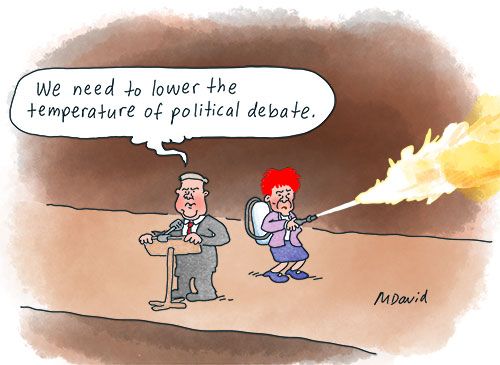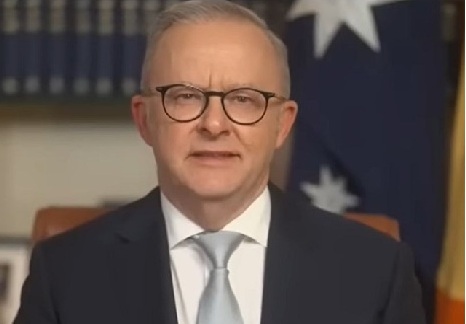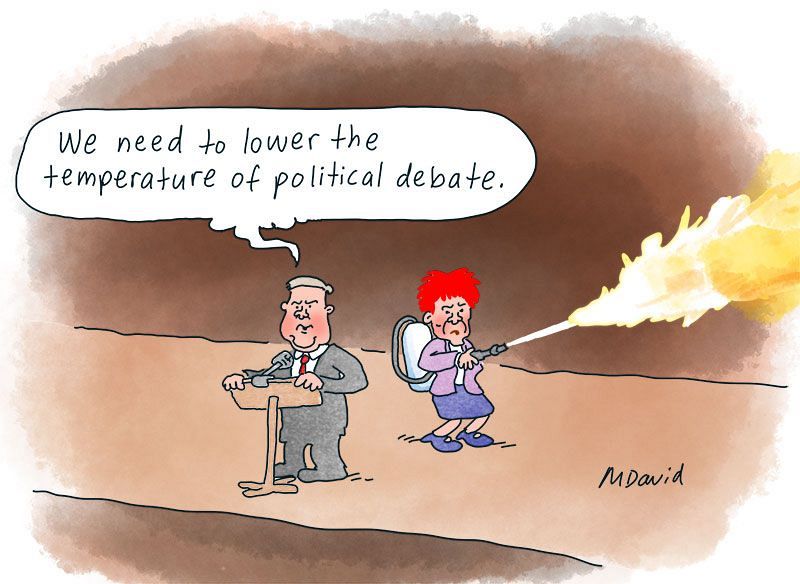
As Donald Trump reshapes the global political order, Anthony Albanese risks being left behind by clinging to outdated notions of political civility. Dr Michael Galvin writes.
THIS ARTICLE is not an attack on Anthony Albanese as a decent human being, a formidable politician, and someone who really does manage to shift a few crumbs from rich people’s tables and give them to the hungry poor.
This article is about how well Albanese is coping with the new world order that U.S. President Donald Trump is both a symptom of and a willing participant in bringing into being. Simply put, the politics of civility (even if it was mostly a sham civility) has morphed into a politics of cruelty, not just in America, but globally.
In this writer’s opinion, Albanese is not coping very well. Most of what he says and does suggests he still believes we are living in the politics of civility — the same status quo in which he has lived most of his life.
Other world leaders acknowledge that the fundamentals have changed and require changes on their own countries’ parts.
“We are living in a new world, where the assumptions and rules of the last 80 years no longer apply. The dysfunctions and insecurities we see all around us are features of this new world order, not bugs.”
If this quotation looks familiar, it is because it is a potted summary of a speech now famous for the clarity and courage shown by the Canadian Prime Minister when he delivered it in January this year at the World Economic Forum in Switzerland.
Clearly, some leaders have made it clear that we are living in a new world more akin to a jungle than a regulated farmyard. That these new threats and choices are features, not bugs, of this new system, as Mark Carney put it in his Davos speech. But other leaders? Not so much. For some, it would seem that the old order still applies, that Trump and his nightmarish consequences are bugs, not features and will go away one day.
Consider these four politicians:
Mark Carney and Andy Burnham on the one hand.
Anthony Albanese and Keir Starmer on the other.
Carney and Burnham already have shown that they understand this paradigmatic shift. Starmer, on the other hand, showed no sense that this was a new world and had to be named and treated as such.
It soon became obvious that Starmer was incapable of recognising or responding to this seismic shift and just two years after a massive election victory, Starmer, despite all his admirable qualities, found himself in the dustbin of history.
And Albanese? Does he understand these changes and call a spade a spade, as the Canadian Prime Minister has done? Or does he really believe the old way of doing things still applies, and there are just a few bugs in the system (like a Netanyahu or a Putin) that need fixing and all will be well?

I believe the latter is closer to the truth and goes a long way to explaining the rise of One Nation. It is, therefore, a clear and present danger to his current position, which was so dominant even a year ago. Senator Pauline Hanson is prepared to say what she thinks, no matter how distasteful and cruel it might be, and both her friends and foes see this as an asset for her.
Can anyone point to a speech of Albanese where he has articulated the threats to world security that the United States has wrought, including for obvious allies like Australia, Britain and Canada? I don’t think so. With embarrassingly few exceptions, this Labor Government speaks with one voice about AUKUS: the project is intact; nothing has changed; all the old reassuring realities still apply.
After the experiences of countries like Ukraine, Denmark, Norway, South Africa, Greenland and Canada, not to mention Taiwan and the various Arab allies of America in the Middle East, it seems madness to pretend nothing has changed. And to think the best course is to do or say nothing just in case it might upset one of the most destabilising presidents in American history.
Meanwhile, the AUKUS ship steams ahead, thinking it is still in the same calm seas it was in when Morrison, Biden and Johnson (what an accident-prone three amigos!) launched it in 2021.
What could go wrong? Consider these three facts for starters:
- ‘When Starshield Cut Out, Ukrainian Drones Fell From the Skies.’ Someone in the American Government with the power to do so stopped the Starlink satellites that their nominal ally, Ukraine, depends on for defence and offence. For a few days this month, the drones stopped working. More civilians are killed, including schoolchildren.
- Canada announced that it must build its own satellites to remove strategic reliance on Elon Musk’s Starlink service. Carney stated that his country needed to stop relying on American satellites for its own security.
- The United States does not share access to the software that is now essential in the military hardware it sells to other countries, including the F-35s that are the cornerstone of Australia’s air combat capability.
Does this mean that the United States will effectively control any new submarines that it supplies via AUKUS? That they can be turned off at any time, if the powers that be in Washington wish to do so?
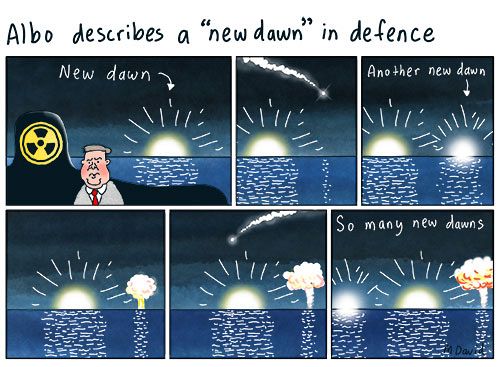
Now, in light of the above facts, ask the question: In the extremely unlikely event that Australia was to face a direct military threat from China, would American forces come to our defence? Given that China, Russia and North Korea have leaders that our great American Friend admires far more than countries like Australia, no positive answer to that question is a sure thing.
Albanese’s public statements about AUKUS address none of the concerns raised by the above three facts. Indeed, he continues to go out of his way to say that it is business as usual with the United States, as if it is 1966 or 1996, not 2026.
As recently as last August, he assured us that AUKUS was “full steam ahead”. This reassurance came after a phone call he had with Trump — the Truman or Eisenhower of our age (not). Does he not realise that the detail about the Trump call makes his confidence even less reassuring?
The question I hope our Prime Minister mulls over is this. That the more he speaks and acts like Starmer and the less he emulates Carney and Burnham, the more likely he will suffer Starmer’s ignominious fate.
Another example where plain-speaking is needed but none is forthcoming is Israel’s continuing destruction of Palestinian lives and land.
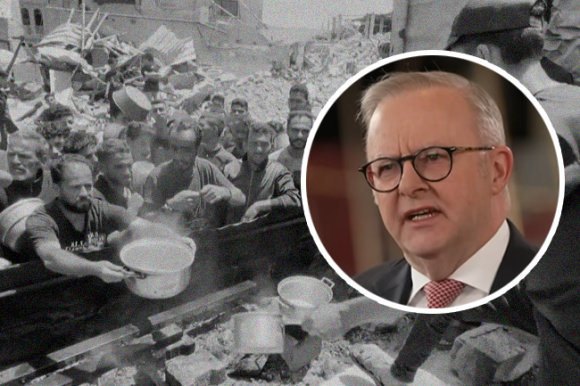
Why is it so hard for the PM and the Foreign Minister to say what most Australians are thinking: that Israel’s behaviour in Gaza and the West Bank goes beyond any standard of human decency, and involves probable war crimes and genocidal consequences?
Yes, there is a Zionist lobby in Australia that spooks the PM at every turn and forced him into a farcical Royal Commission that has provided nearly a year of publicity for Israel’s Zionist supporters. But millions of Australians have made up their own minds about what the state of Israel is now, no matter how often Zionists insist that to be anti-Israel is to be anti-Jew.
Meanwhile, within less than a month of taking office, the British PM had taken concrete steps, publicly, to condemn what is happening to Palestinians living on the West Bank. Burnham did not go very far – it takes courage to take on the Zionist lobby and its friends in the mainstream media – but our timorous government could not even go that far. We withheld support for Britain’s new position, despite many other Western countries having the clear-headedness to do so.
Another fact that Albanese should note about Starmer versus Burnham: The former refused to countenance any admission that Brexit was a mistake. The latter said as much as soon as he became PM. The sky did not fall in.
If anything, by admitting the obvious but previously unspeakable, Burnham settled people’s nerves. Relief, not anxiety, ensued, if you can believe the recent dramatic improvement in UK Labour’s fortunes, and the consequent decline of Nigel Farage and One Nation fellow-travellers.
Finally, some of Albanese’s aphorisms about Australian society are further evidence that he still thinks we are living in the old age of civility, not the new age of cruelty.
After the recent horrific attack on MP Helen Haines, Albanese resorted to variations of the refrain that goes: “This is not who we are”, “This is not us” and so on.
I beg to differ. This violence is who we are. We are a nation born in violence and maintained by violence. Racism and sexism are at the heart of the Australian ethos. And will probably remain so, as long as our leaders encourage such deplorable cognitive dissonance.
One good old Aussie had his ten seconds of fame shortly after the horrendous attack, putting on an orange T-shirt, orange being Helen Haines’ branding colour and writing on it: ‘Wangaratta, this is not us!!’
And then he cheerfully told the world that he is a One Nation supporter. Yes, the party that turns its back on Indigenous people, literally, in the Federal Parliament; that vilifies Muslims at every turn.
O tempora, o mores!
Dr Michael Galvin is an adjunct fellow at Victoria University and a former media and communications academic at the University of South Australia.
 This work is licensed under a Creative Commons Attribution-NonCommercial-NoDerivs 3.0 Australia License
Support independent journalism Subscribe to IA.


Related Articles
- Australia’s political leaders are failing democracy
- Albanese’s springboard for even greater triumphs
- Grading Albanese’s address to the nation: A fail, must do better next time
- Albanese, your moment of truth is now
- Albanese's victimisation of "ISIS brides" and innocent children is appalling