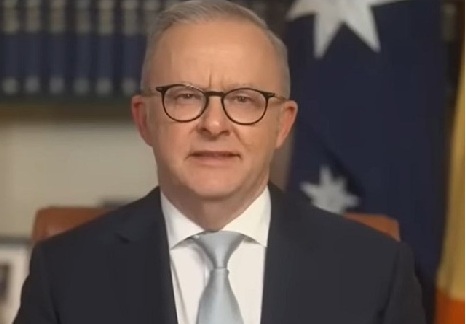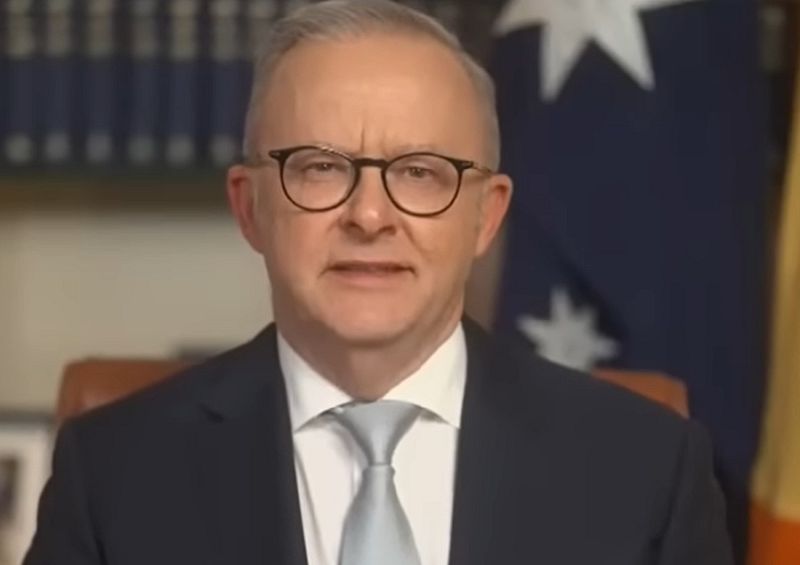
Universities have taught rhetoric since Ancient Greek times, persuasive or dissuasive oratory skills being an essential part of the successful leader's tool kit. Alas, Anthony Albanese's underwhelming Address to the Nation failed to hit its mark. Dr Michael Galvin explains how the PM and his speechwriter got it so wrong.
THERE IS A REASON why rhetoric has been taught in universities since Ancient Greek times. Persuading people of your point of view, or dissuading them of theirs, is a more durable way of getting things done in public life than killing them or being taken out oneself.
Oratory has always been an essential part of the successful leader’s tool kit, and still is. Witness the dozens of articles analysing the brilliance of Barack Obama’s rhetorical style in his speeches.
Alas, Albanese is no Obama, and nowhere was this more obvious than in his underwhelming Address to the Nation the other night. The purpose of this article is to offer a close and critical reading of Albanese’s speech. Those of us who want him to succeed for however long he stays Prime Minister also need him to make better speeches. Repelling the rancid jingoism of Far-Right populism will demand arguing persuasively in the public square, not dismissing One Nation's voters as “deplorables”.
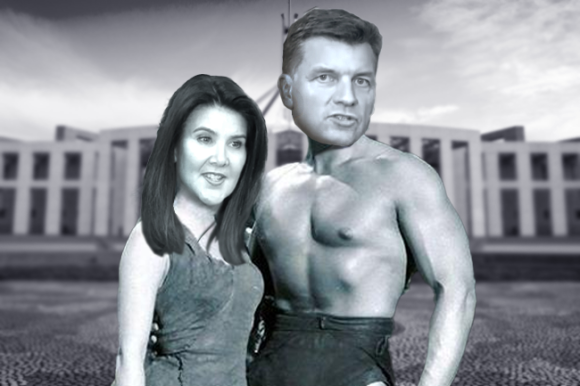
Lest this negative review of Albanese’s speech be seen as a tacit sign of support for the orange autocrat in the White House or Tarzan Angus Taylor closer to home, it is enough to say that Trump’s speech is execrable, and the latter is so addicted to out of date cliches and nostrums that the possibility that Taylor will ever utter a thought of either subtlety or originality seems more remote with every passing day.
But that does not mean that the standards of a Trump or Taylor should measure Albanese. He needs to be far better.
A careful reading of the PM’s address shows that it flouts nearly every rule of rhetoric evident in the Obama playbook. While each of these “faults” in themselves might be seen as trivial, even nitpicking, the cumulative effect was there for all to see: a message that was not inspiring, not motivational, not very clear or coherent, at times disingenuous, and, as an event of public importance, extremely dull and forgettable.
Here are some of the ways that Albanese’s speechwriters let him down.
Word repetition for emphasis. In the first sentence, "we are an optimistic country”. In the second sentence, “…now it’s hard to be positive”. By not repeating the word “optimistic”, the speaker raises the possibility of a different point being made, which is to show awareness that the Australian Government is aware that most Australians are anxious and/or affected adversely by this evolving crisis. This is a distraction because the whole point of the two lines is to stress the same point. A rookie error because the aural, memorable value of repetition of important words for emphasis has been lost.
The third sentence is no better, but for other reasons.
“The war in the Middle East has caused the biggest spike in petrol and diesel prices in history.”
Firstly, using the words “Middle East” is too lazy, disingenuous and euphemistic. It is the American and Israeli attack on Iran that has caused this particular fuel crisis. Or if those truthful words were too direct and courageous to say out loud, he could have at least named the cause as a military conflict between Iran and the United States/Israel. Why not say so? It’s what everyone knows anyway. And finishing the sentence with “in history” might be true, but so what? The phrase carries no emotional or substantive weight, and also gestures, wrongly, towards the many thousands of years of “history” when the price of oil would have been meaningless.

A couple of sentences later, the PM says that we are seeing these higher prices “at the servo and at the supermarket”. Why this lapse into Aussie slang?
This, and the use of “truckies” and “doing it tough” in the next sentence, suggests a desire to identify with the common man (and woman), which feels forced and not entirely genuine. Stressing his old-style Aussie working-class credentials might be appropriate in some circumstances, but not when speaking to and on behalf of the whole nation in an extraordinary moment of crisis.
Yes, Albanese might prefer to ape the style of “unvarnished speech” as part of his identity, but he is a graduate of Sydney University, not a truckie from Temora living in the 1950s.
There is also sloppy logic evident throughout the whole speech, such as this sentence:
“And I understand farmers and truckies, small businesses and families are doing it tough.”
This sentence offends against a basic law of rhetoric when it comes to using or naming lists. The principle with lists is to only use commensurate entities. For example, “apples, oranges and pineapples” is coherent; but “apples, oranges and fruit” or “potatoes, peas and vegetables” are incoherent, for obvious reasons. In the PM’s sentence, this illogicality occurs not once but twice in the same four-item list. Both “small businesses” and “families” are categories that also include many, if not most, farmers and truck drivers.
Another failure in the speech is the high number of incomplete sentences. Take the pseudosentence:
“Leaders from both sides of politics, from right around the country, working together to keep Australia moving.”
A sentence requires a principal clause because, without such a clause, the meaning of the words is not complete in itself. A sentence is meant to be a group of words that makes sense on its own. This example does not make sense because it points to an assertion that is not there. Working at what exactly? The point is left hanging, even if implied.

In a very short speech, there are no fewer than nine examples of such non-sentences. Such carelessness is a major contributor to why it is very hard to know what the point of the speech was, and why it was immediately panned, not just by Albanese’s opponents, but by anyone hoping to take away both some confidence in his leadership and a clear message about the facts of the matter.
Another problem. The careless references to time frames added to this lack of clarity about basic facts. Are we talking about the present, the short term, the medium term, or the long term? Or all of the above? Who would know?
Some of the time frame references in the speech include: "…for months”; “in these uncertain times”; “in the period ahead”; “over the long term”; “the next three months”; “over coming weeks”; “the months ahead”; “uncertain times”; and in the final clause, “always”. Not a single formulation is used more than once.
Jumbled on top of one another, these time references suggest a refusal to think through the details of future planning and scenarios or a deliberate attempt to remain opaque about plans for the future. The takeaway is that it was a bit of both: a carelessly constructed speech, nevertheless intended to set the scene for a much more draconian one in the next month or two.
There are several more ways the PM’s address fails the basic standards of speechwriting but does this really matter? Yes. The oratorical ability of our leaders does matter. Their words matter immensely. After all, it’s all they really have at their disposal. Words either precede their actions or must come after to explain them.
It is hoped that Albanese’s office takes on board fair criticism of his seriously underwhelming address to the nation, and adjusts accordingly and quickly.
He will need every possible oratorical skill to inform and persuade the new legions of One Nation voters of the errors of their ways. Ridiculing them, ignoring them or thinking it is just a Coalition problem is not going to cut it. As SA Premier Malinauskas was acutely aware on the night of the recent SA Election, Labor may have won by a country mile, but the biggest swings to One Nation occurred in the poorest suburbs of Adelaide and regional areas.
Incidentally, Malinauskas won widespread praise for his speech in part because, unlike the PM, he got the rhetorical style and substance right.
 This work is licensed under a Creative Commons Attribution-NonCommercial-NoDerivs 3.0 Australia License
Support independent journalism Subscribe to IA.