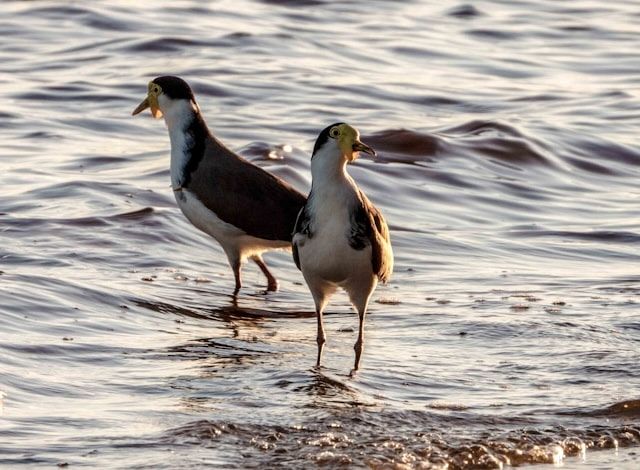
Everything Australians need to know about plovers: why they swoop, when swooping season peaks, what the law says and how to handle nesting birds safely.
AUSTRALIA is home to some of the world's most assertive wildlife and the masked lapwing, known colloquially as the plover, ranks among the most encountered. Each spring, thousands of Australians report being swooped while walking, cycling, or simply crossing a car park. Understanding why plovers behave the way they do makes the experience significantly less alarming and, in most cases, entirely manageable.
What is a plover in Australia?
The bird most Australians call a plover is the masked lapwing (Vanellus miles). It is a medium-sized ground-dwelling bird found across the continent, particularly in open grassy areas, suburban parks, oval edges and airport surrounds. Two subspecies exist: the northern subspecies, which has a large yellow wattle covering much of the face, and the southern subspecies, which has a smaller wattle and a black shoulder marking.
Masked lapwings are not migratory. They are year-round residents in most parts of Australia and are among the few native birds that have thrived in urbanised environments rather than retreating from them.
Why do plovers swoop?
Swooping is defensive behaviour triggered by perceived threats to a nest or chicks. Plovers are ground nesters, meaning their eggs and young are laid directly on open ground with no structural protection. A nest can be in a park, a school oval, a highway median strip, or a shopping centre car park.
When a person or animal comes within roughly 50 to 100 metres of an active nest, the adult plovers will call loudly and, if the perceived threat continues to approach, swoop repeatedly. The birds have a small spur on each wing, which they can use to strike, though actual contact is relatively uncommon. The primary tactic is intimidation through noise and close passes.
Swooping season in Australia runs from approximately July to November, peaking in September and October, which corresponds to the main nesting period across southern and eastern states.
Are plovers dangerous?
For healthy adults, plovers are startling rather than genuinely dangerous. The risk is primarily indirect: being startled while cycling or walking near traffic, or children being frightened and running into hazards.
Plovers are a protected species under the Environment Protection and Biodiversity Conservation Act 1999. It is illegal to harm them, destroy their nests, or interfere with their eggs without a permit. This protection means the options available when dealing with swooping plovers are limited by law.
What to do when a plover swoops you
The most effective strategies are also the simplest.
Avoid the area if possible. Plovers will stop swooping once the chicks are mobile, which typically takes four to six weeks. If there is an alternative route, use it for the duration of the nesting period.
Walk, don't run. Running triggers a stronger defensive response. Maintain a calm, steady pace and move away from the nest area without making sudden movements.
Make eye contact or wear "eyes" on the back of your head. Plovers are less likely to strike when they believe they are being watched. Wearing sunglasses on the back of your head, or attaching a pair of eyes to a hat, has been reported to reduce swooping frequency.
Use an umbrella. Holding an open umbrella creates a physical barrier and reduces the plover's ability to make a close pass.
Do not retaliate. Beyond being illegal, attempting to chase or frighten a nesting plover typically intensifies the behaviour rather than discouraging it.
Plovers across Australian states
Masked lapwings are present in every Australian state and territory. Population density and behaviour vary slightly by region.
In Queensland and the Northern Territory, the northern subspecies is dominant. In Victoria, New South Wales, South Australia and Western Australia, the southern subspecies is more common. Tasmania has a significant masked lapwing population concentrated in agricultural and coastal areas.
Urban sightings are increasingly common across all major cities. Brisbane, Melbourne, and Sydney residents regularly report nesting plovers in school grounds, sports fields and suburban parks.
Plovers and Australian wildlife tourism
For international visitors, encountering a swooping plover is often one of the more memorable wildlife interactions of a trip, second perhaps only to spotting a kangaroo at close range. Australia's unique fauna is one of the primary drawcards for tourists and knowing how to behave around native wildlife is practical preparation before arrival.
Staying connected while exploring regional areas and national parks makes a genuine difference, whether for identifying species, accessing trail maps, or navigating unfamiliar roads. Travellers who want to get unlimited data with Holafly can activate an eSIM before departure and maintain reliable connectivity across Australia without the cost of international roaming.
Frequently asked questions about plovers in Australia
Is it legal to move a plover nest in Australia?
No. Masked lapwings are protected under federal and state legislation. Moving a nest or interfering with eggs requires a permit from the relevant state wildlife authority. In most cases, permits are not granted simply for the convenience of humans.
How long does swooping season last?
Swooping typically lasts four to six weeks per nesting pair, corresponding to the incubation and early chick stage. The broader season runs July to November across most of Australia.
Do all plovers swoop?
No. Only nesting adults with eggs or young chicks exhibit swooping behaviour. Plovers outside nesting season are generally docile and show little interest in humans.
What do plovers eat?
Masked lapwings feed primarily on insects, worms, and other invertebrates found in soft soil and grass. They forage by walking slowly across open ground and probing with their bills.
Why do plovers nest in such exposed places?
Ground nesting is the species' natural behaviour. Open, flat areas provide clear sightlines for detecting approaching predators, which is an evolutionary advantage despite the conflicts it creates in suburban environments.
Are there other plover species in Australia?
Yes. Australia has several lapwing and plover species, including the banded lapwing (Vanellus tricolour) and the red-kneed dotterel (Erythrogonys cinctus), though the masked lapwing is by far the most commonly encountered in urban and suburban settings.