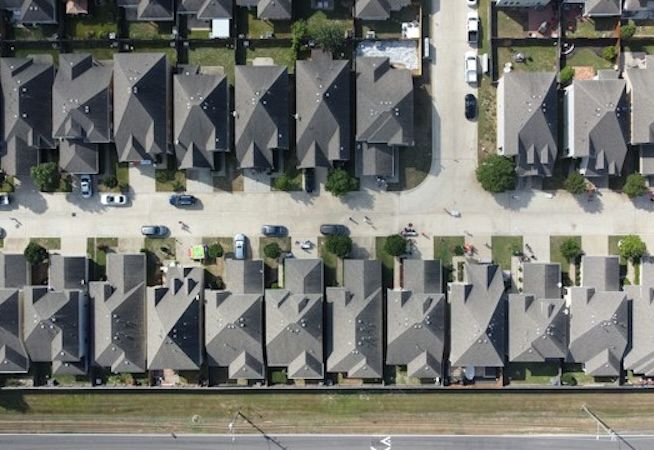
Drive through Armstrong Creek, Lara or Bannockburn and the pattern is clear. New streets fill with new homes, and each home arrives with a driveway, a garage slab and often a patio. The housing debate tends to stop at the front door. What happens to the rain that lands on all that new concrete gets far less attention.
Hiring a Concreter Geelong is often one of the last big jobs on a new block, after the keys and the stamp duty. It looks like a private choice about finish and cost. Yet every square of paving changes where water goes, and Victorian law gives owners real protections when they pay for the work.
Why does paving matter so much around Geelong?
Rain that falls on soil soaks in slowly. Rain that falls on a roof or a driveway does not. The Corangamite CMA puts it simply: hard surfaces like roofs, driveways and roads cannot let water soak into the ground.
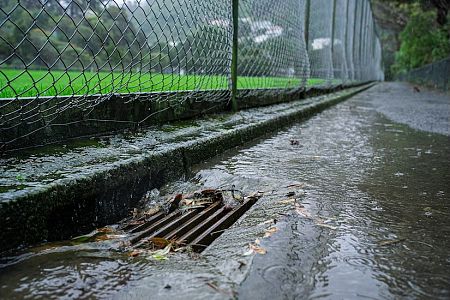
That water has to go somewhere. Urban drains gather it and send it quickly into creeks and rivers. The authority describes these sudden surges as "flashy" flows. They scour banks, erode creek beds and carry plastics and heavy metals downstream.
The authority says the risk is especially high because of the pace of urban growth. It names the Geelong and Bannockburn growth areas as the places most exposed. It also notes that the Moorabool and Barwon rivers already show flow stress from upstream uses.
Its comparison sticks in the mind. Think of a fire hose full of polluted water for 30 seconds, set against a gentle sprinkler over 30 minutes.
What do the regional stormwater targets say?
The CMA sets out clear figures for runoff from new hard surfaces. Five points stand out for anyone building or paving locally:
- Geelong and Bannockburn receive an average of 500 to 600mm of rain a year.
- In priority areas, the target is to harvest and infiltrate 82% of runoff from new hard surfaces.
- Priority areas are those where extra stormwater is most likely to harm downstream waterways and wetlands.
- In other areas, the target is 35% of runoff from new hard surfaces.
- Household rainwater tanks are listed as one way to capture it and cut demand on drinking water.
These are regional goals rather than rules for a single driveway. Still, they show the direction of travel. A home that sends every drop to the street adds to a problem the region is trying to shrink.
Waterway health is also a political story. IA has reported on offset rules that keep greenlighting nature's decline at a national level. Local choices about paving sit at the other end of that chain.
What protections do Victorian homeowners have?
Concrete work is also a consumer issue. Victoria's Domestic Building Contracts Act sets the ground rules, and its current version took effect on 1 July 2026. Consumer Affairs Victoria explains how they apply in practice.
A builder must be registered with the Building and Plumbing Commission for work worth more than $10,000. The same threshold triggers the need for a major domestic building contract. Some single trades are exempt, such as painting, tiling and plastering. Concreting is not on that list.
The key money rules are short:
- Deposits are capped at 10% if the total price is less than $20,000.
- The cap falls to 5% if the total price is $20,000 or more.
- Home Warranty insurance is required for work over $20,000 from 1 July 2026.
- Progress payments should follow the contract schedule, never paid in advance.
Consumer Affairs Victoria warns that an owner cannot get Home Warranty insurance if the builder is not properly registered. Its Building Information Line is 1300 55 75 59.
These rules matter more when budgets are tight. IA has shown how stamp duty alone reaches about $40,070 at standard rates on a $750,000 Victorian home. Few households can afford to lose a deposit on a driveway as well.
How can a slab be built to handle water well?
Good concrete work and good water management overlap. The table below sets out what to raise with any contractor before work starts.
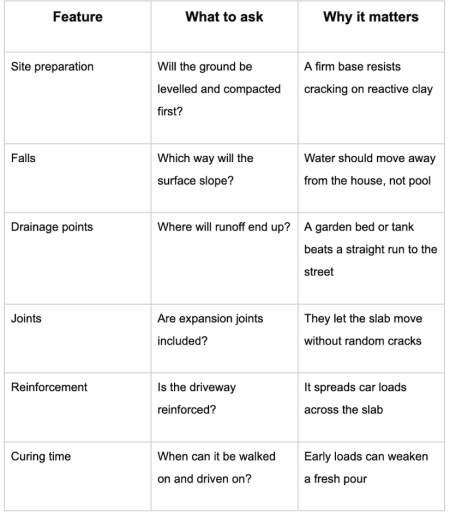
Local clay soil deserves extra care. Ground that swells and shrinks with moisture tests every slab. A plan that keeps water off the base helps the concrete last.
Patience counts too. Fresh concrete is generally walkable within a few days. Full strength takes closer to four weeks, so heavy vehicles should wait. Ask for that timing in writing so the family car stays off the new slab.
A better way to pave a new block
Several habits make a new driveway kinder to both the wallet and the river:
- Get a written, itemised quote before any money changes hands.
- Check the builder's registration on the BPC's practitioner search when the job passes $10,000.
- Ask how runoff will be directed, and whether some can feed a garden or tank.
- Keep paved areas to what you need rather than covering the whole yard.
- Hold back final payment until the work matches the contract.
None of this stops the growth. It simply means that the next 20 driveways in a street do less harm than the last 20.
Frequently asked questions
Do I need a registered builder for a concrete driveway in Victoria?
If the work is worth more than $10,000, the builder must be registered with the Building and Plumbing Commission. Concreting is not on the list of exempt single trades. A major domestic building contract is also required above that figure.
How much deposit can a builder ask for?
The cap is 10% when the total contract price is under $20,000. It drops to 5% when the price is $20,000 or more.
Why does runoff from driveways affect Geelong's rivers?
Hard surfaces stop rain soaking into the ground. Drains then push that water quickly into creeks, where sudden high flows erode banks and carry pollutants. The Corangamite CMA says the risk is high in the Geelong and Bannockburn growth areas.
When can you drive on a freshly poured driveway?
Most fresh concrete can be walked on within a few days. It reaches full strength in closer to four weeks, so cars and trucks should wait longer. Your contractor should give exact timing for each job.