An honest look at cycling the Portuguese Camino from Porto to Santiago: the flight's carbon cost, the 280 km coastal route and what its paths teach Australia.
Every climate-minded Australian heading to Europe faces the same awkward sum. The flight is long and no holiday on the far side cancels it out. What you can control is how you move once you land. That choice says a lot about the kind of traveller you want to be.
Cycling the Portuguese camino from Porto to Santiago de Compostela is one way to make the ground part of the trip count. Top Bike Tours Portugal runs the route as an eight-day coastal tour of about 280 km, guided or self-guided. Riders cover 40 to 65 km a day while their bags travel ahead to the next hotel. It is slow travel on two wheels and it raises bigger questions about how we build transport at home.
Does a bike trip offset the flight from Australia?
No, and it is better to say so plainly. Our World in Data's travel carbon footprint analysis puts a domestic flight at 246 grams of CO2-equivalent per kilometre. A short-haul flight comes in at 154 grams. Long-haul flights do only slightly better per kilometre and Sydney to Porto is a very long way.
The same analysis shows why the ground leg still matters. An average petrol car emits about 170 grams per kilometre and national rail around 35 grams. Cycling sits at roughly 16 to 50 grams, depending on the rider and their diet. Swapping a hire car for a bike over a week shrinks the in-country share to a fraction.
The honest framing is about making fewer, longer trips count. Recent warnings of climate collapse are a reason to fly less often and stay longer. They are not a reason to fly guiltily and then drive everywhere. One long ride, taken slowly, does more good than several rushed short breaks.
What does the coastal route ask of a rider?
The tour page rates the route as moderate, three out of five. It describes a mostly flat coastal ride with a few short climbs, although the last three days are hillier. Total climbing comes to about 3,043 metres.
The standard itinerary has six riding days:
- Porto to Esposende, 60 kilometres (km);
- Esposende to Caminha, 50 km;
- Caminha to Baiona, 40 km, crossing from Portugal into Spain;
- Baiona to Pontevedra, 64 km;
- Pontevedra to Caldas dos Reis, 26 km; and
- Caldas dos Reis to Santiago de Compostela, 40 km.
Day one is a welcome in Porto and day eight is departure. A nine-day version splits the Baiona to Pontevedra leg with a night in Vigo. The operator suggests riders be comfortable covering 40 to 60 km a day. Electric bikes are an optional extra for anyone wary of the Galician hills.
Nights are spent in places with a story of their own. The tour lists the Parador hotels in Baiohow we na and Pontevedra, plus a rural house in Caldas dos Reis. Breakfast is included, so each morning starts in the town rather than on the road.
What can Australian cities learn from the path itself?
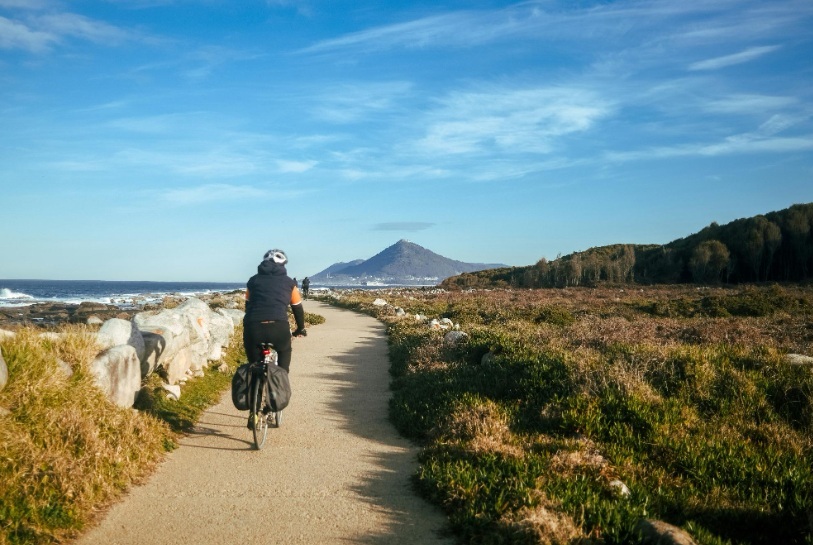
Ride this route and you notice how little of it is shared with heavy traffic. The tour page breaks the riding surface down like this:
|
Surface |
Share of route |
|
Bike lanes and wooden walkways |
30% |
|
Smooth dirt roads |
40% |
|
Paved, low-traffic secondary roads |
25% |
|
Cobblestones and rough dirt roads |
5% |
That mix reflects a choice to give walkers and riders space away from cars. Europe has also put that choice into policy. On 3 April 2024, EU institutions adopted the European Declaration on Cycling. Its commitments include safe and coherent cycling networks in cities and better links with public transport.
Australian riders will recognise the contrast with a painted lane on a busy arterial road. Our own debate keeps circling one question. Are separated paths a luxury, or basic public infrastructure? A week on Portuguese boardwalks makes a strong case for the second answer. The same paths carry locals, pilgrims and tourists at once.
How can you shrink the footprint after landing?
The ride itself is the easy part.
The choices around it decide how light the trip really is:
- skip the hire car, since the tour includes train or bus tickets and transfers from Porto airport;
- let the luggage shuttle carry your bags, so you ride with a small daypack;
- choose a standard bike unless you need help on the hills;
- eat and drink in the towns where you sleep, so your spending lands locally; and
- ride in the shoulder seasons rather than the summer peak.

(Image by Augusto Lopes on Unsplash)
Small costs on the ground are part of the picture too. The tour page notes a city tax of about €2 per person per night, paid on site. Ferry crossings are listed as a small extra as well. These are modest sums and they flow straight to the places you pass through.
Points to weigh before you book
- The flight is the largest part of the footprint, so stay longer to make it count.
- The coastal tour covers about 280 km over eight days, with six riding days.
- Daily rides run 40 to 65 km, rated moderate, with the hilliest days in Galicia.
- Most of the surface is bike lanes, walkways, dirt roads or quiet roads.
- The operator names March to June or September to November as the best months.
Frequently asked questions
How fit should a rider be before booking?
You need basic fitness rather than racing legs. The operator suggests being comfortable riding 40 to 60 km a day. Electric bikes are offered as an extra for the hillier Galician stages.
Should riders pick a guided or self-guided trip?
Both formats are offered. Self-guided riders get GPS routes and luggage transfers, while guided departures need at least four participants. Pick the format that suits your confidence with navigation.
Which months suit the coastal ride?
The tour page recommends March to June or September to November. Those months sit outside the summer peak on the coast. Prices also change by season, so check the dates before you commit.
Is there a way to cut the flight footprint?
Not entirely, since Portugal is a long-haul flight from Australia. You can make the flight count by staying longer and linking the ride with rail travel in Europe. Fewer, longer trips are the practical compromise.
A slower road north
The Portuguese coast will not solve the carbon cost of getting there. It does show what travel looks like when paths are built for people rather than cars. As climate warnings grow louder, that lesson matters well beyond one holiday.
Ride it slowly, spend locally and bring the idea home. The next argument about a bike path in your suburb may feel different.