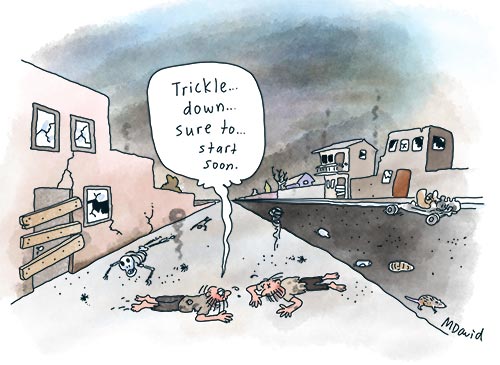
Young people are struggling — but not equally. While some inherit safety nets, others face shrinking futures, creating a quieter crisis and further divide. Carl Rhodes reports.
AUSTRALIA'S YOUNG PEOPLE are doing it tough. The cost of living crisis, housing unaffordability, lack of financial independence and poor job security are hitting hard.
Today’s young people face a future where they will be worse off economically than their parents and even their grandparents.
Economists are sounding the alarm about intergenerational inequality. The Federal Government has flagged it as a policy priority. The private sector is increasingly recognising it as a threat to business and markets.
Yet within this broader generational divide lies another, quieter crisis: inequality between young people themselves. Not all youth are affected equally. Those from less well-off families are bearing the brunt of the crisis, with poorer outcomes, fewer safety nets and more limited access to opportunity.
The looming intergenerational transfer of wealth, set to reshape Australia’s economy in the coming decades, threatens to deepen these divides. The risk is an even more unjust system where, in tomorrow’s Australia, your future may depend less on what you do and more on who your parents are.
We need to ask, do we really want an Australia where economic wellbeing is no longer tied to need, merit or effort, but to inheritance?

Many young Australians are struggling to survive
The 2025 UN Youth Australia Youth Representative Report was launched earlier this month, based on a listening tour that engaged with more than 5,000 people between the ages of 12 and 25. It paints a stark picture of the economic challenges confronting young Australians.
The report finds that, since COVID-19, the cost-of-living crisis has become a defining feature of young people’s lives. For too many, being a young person in Australia is no longer about ambition and advancement; it is about survival.
Monash University’s latest Youth Barometer Survey, which also came out this month, echoes this bleak outlook. Surveying over 500 Australians aged 18 to 24, the report found that a staggering 85 per cent had experienced financial hardship in the past year. Nearly 80 per cent believed they would grow up to be financially worse off than their parents.
Things are deteriorating to such an extent that research conducted by Deloitte early this year revealed more than four in ten Australians aged 18 to 24 feel they are missing out on their youth. Economic and political pressures, they say, are likely to prevent them from living happy and healthy lives in the future.
These numbers are not abstract. They represent the real lives of young people forced to choose between paying rent and buying groceries, or delaying dreams of study, travel, or family because survival comes first.
Some young Australians are more unequal than others
The realities of intergenerational inequalities are grim, but it’s worse when you realise that even inequality is not equally distributed within the younger generation. Wealthier young Australians are getting richer, while those born lower on the socio-economic ladder face conditions that prevent them from keeping up.
Meanwhile, Australia is on the brink of its largest-ever intergenerational wealth transfer, with an estimated $3.5 trillion expected to pass from Baby Boomers to younger generations over the coming two decades.
A fortune in residential property, unspent superannuation balances and business investments will be handed down, creating a new class of wealthy people, enjoying prosperity they have not earned through their own work.
This shift will reshape the nation’s economic landscape, but the bigger risk is how it will reshape the social landscape. If you are born into a family that owns property and other assets, then all is well and good — your financial future is likely to be secure.
If those were not the cards you were dealt, your future will look very different. No matter how much hard work – whether it be in education, career-building, or entrepreneurship – it will be nearly impossible to catch up to those who won the inheritance jackpot.
What we currently identify as intergenerational inequality will evolve into a full-blown, society-wide inequality and an economically polarised society with little opportunity for mobility between the haves and the have-nots.
Australia at a crossroads
We stand at a crossroads. We can either allow wealth and wellbeing to become the exclusive domain of inherited privilege, or we can choose a fairer path that ensures every young person, regardless of background, has a genuine chance at a secure and fulfilling life.
This is not just about economics. It is about the kind of society we want to be. If we believe in fairness, reward for effort and equal opportunity, then we must confront the uncomfortable truth that Australia is drifting toward a future where inheritance matters more than ambition.
The solutions are on the table. Bold tax reform can level the playing field. Reformist housing policies should prioritise affordability and penalise speculation.
A stronger welfare system would guarantee fair access to essential services. National inequality targets could motivate action and hold government accountable. Ensuring equality in education will give everyone the opportunity to succeed. Embedding long-term equality into policymaking will ensure fairness in Australia’s future.
The question is whether Australia has the political will to pursue a fairer future, or whether we will advance Australia for the few rather than the many.
Carl Rhodes is Professor of Business and Society at the University of Technology, Sydney. He has written several books on the relationship between liberal democracy and contemporary capitalism. You can follow him on X/Twitter @ProfCarlRhodes.
 This work is licensed under a Creative Commons Attribution-NonCommercial-NoDerivs 3.0 Australia License
Support independent journalism Subscribe to IA.