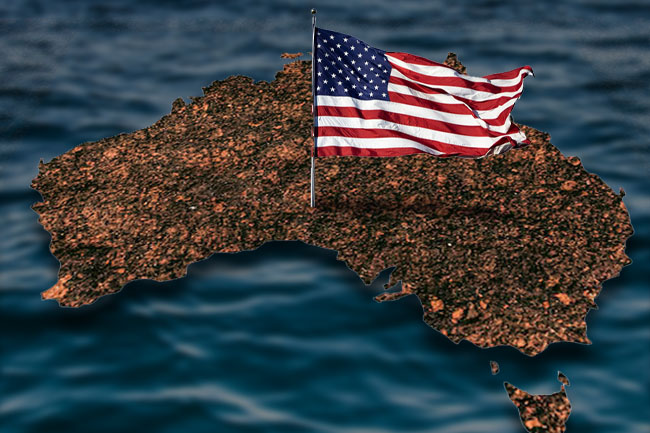
Australia is rich in resources but poor in outcomes because our biggest industries are owned by the U.S., writes Bevan Ramsden.
U.S. CORPORATE DOMINANCE of our economy is depriving Australians of the benefit of our abundant resources and denying our government sovereign control over our economy. It’s time to break free.
That we, Australians, live under the military, economic and cultural domination of the United States is a fact of life and to our great disadvantage.
Whilst much has been written about the military domination expressed through subservience to the U.S. alliance and embracing its sub-sets, AUKUS and the Force Posture Agreement, less is known of U.S. economic domination and its disastrous impact on our everyday life. But it helps explain why a wealthy country has so many poor, homeless and workers struggling to keep their heads above the financial waters.

Len Fox, in his 1980 book Multinationals take over Australia, provided the following figures for foreign control of various industries:
'Motor vehicles 99.8%, Oil refining (ownership) 90.8%, Basic chemicals 78%, Pharmaceuticals 77.8%, Transport equipment 54.6%, Basic metals 38%, Textiles 33.3%, Food, beverages, tobacco 33.2%.'
These figures were obtained from the Australian Bureau of Statistics (ABS), but unfortunately, more up-to-date figures are not available from this source, as John Howard, treasurer under the Fraser Government, stopped the ABS collecting data on foreign ownership in 1978. The figures were becoming an embarrassment at a time when the Fraser Government was encouraging foreign investment.
We are indebted to The Conversation and Clinton Fernandes for more up-to-date information on foreign ownership of industry in Australia.
He writes:
Right now, U.S. corporations eclipse everyone else in their ability to influence our politics, through their investments in Australian stocks.
Using company ownership data from Bloomberg, I analysed the ownership of Australia’s 20 biggest companies a few days after the 2019 federal election in May. Of those 20, 15 were majority-owned by U.S.-based investors. Three more were at least 25% U.S.-owned.
The list included the following:
Commonwealth Bank of Australia, once the “People’s Bank” but following privatisation now 62% U.S. owned. BHP Group, once the “Big Australian” now 73% U.S. owned. Westpac Bank 64% U.S. owned, National Australia Bank 63% U.S. owned, ANZ Bank 54% U.S. owned, Woolworths 66% U.S. owned, Rio Tinto 65% U.S. owned, Westfarmers 56% U.S. owned and so the list goes on.
The ASX’s top 20 companies make up close to half of the market capitalisation of the Australian Securities Exchange.
One might ask how such U.S. economic domination is detrimental to the Australian people. After all, governments keep telling us that "foreign investment" is a great boon and something we can’t do without.
Because of their financial size and domination of industries, decisions about investment and development are made not by the Australian government but in the boardrooms of those corporations and most probably overseas. Those decisions are made to maximise profit for their shareholders, their prime responsibility, not in order to meet national priorities for the benefit of the Australian people.
A classic case is the car manufacturing industry. Successive Australian governments allowed and even encouraged foreign investment and hence ownership until the entire car manufacturing industry was 100% foreign-owned.
The government lost any control over this industry, which was taken out of Australia by its foreign owners when they decided they could make greater profits in a country with lower labour costs. Closure of the car industry caused closure of support industries, loss of jobs and loss of the skills that went with this industry.
We also lose out because of tax manipulation and so-called "creative accounting".
Clinton Fernandes, in his excellent book, Island Off the Coast of Asia, writes:
Recent work by investigative journalist Michael West and the Tax Justice Network have exposed the myriad ways in which certain corporations get around the tax laws. ExxonMobil, for instance, “paid zero tax on more than $18 billion in income” in 2014-15 although the price of domestic gas went “through the roof”.
Figures analysed and released in December 2017 showed Glencore, which operates in commodities industries such as coal, copper, oil and zinc, “managed to exterminate all profit and tax on $22 billion in income”.
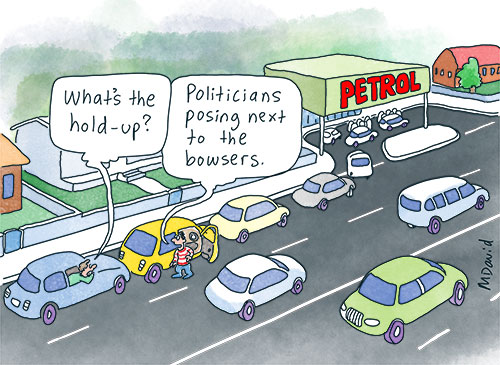
Shell Australia “paid zero on $4.2 billion in Revenue. Chevron nothing on $2.1 billion, Viva Energy (which bought the petrol stations from Shell), zero tax on $16.8 billion and ExxonMobil not a cent on $6.7 billion.
In short, one Australian worker paid more tax than five giant U.S. corporations whose combined income in that year was $51.8 billion. The Australian community suffers because of this lost revenue, which could otherwise finance much-needed infrastructure, such as public housing, the essential upgrading of public health care and climate action.
The clout of the foreign-owned mining sector was seen in 2010 when it mounted a very public political campaign opposing PM Kevin Rudd’s proposed resources rental tax, which would have improved the income from this sector for the benefit of the Australian people.
The ALP buckled under this political pressure, replacing PM Rudd with PM Julia Gillard, who promptly bowed to the wishes of the foreign-owned mineral Industry and removed the resources rental tax proposal from further consideration.
U.S.-dominant corporations have put downward pressure on wages and, as the following example indicates, their attitude to labour leaves much to be desired.
Former trade union organiser Shirley Winton, at a recent Melbourne protest rally, explained:
Exxon-Mobil is the biggest global oil and gas monopoly. In 2017, Exxon Mobil workers in Longford (Victoria), went on strike for more than 6 months, fighting against Exxon Mobil cutting their wages by 30% and worsening working conditions. For six months, in a long and bitter struggle with the oil monopoly, workers set up a 24-hour picket outside Exxon Mobil in Longford in Victoria. They organised and ran the picket themselves and drew wide support from many workers, unions and communities – locally, nationally and internationally.
The striking Longford workers pointed out that in that same time over three years Exxon Mobil did not pay a cent of corporate taxes while pocketing $25 billion from the plunder of our natural resources and exploitation of workers who create billions in profits sent overseas to its head office in the U.S.

Successive Australian governments, by the encouragement – even the subsidy of U.S. and other foreign transnationals – have allowed them to gain ownership dominance in key industries and so have lost sovereign control of the economy and the ability to set national economic priorities.
The defence against dominant foreign ownership and control is the public ownership of enterprises. But this defence was jettisoned by successive governments when they adopted the policy of privatisation, selling off the Commonwealth Bank, the Australian Defence Industries and many others, and opening up those enterprises to takeover via share buyouts.
For a bright and independent future, in which the people of Australia gain the maximum benefit of the country’s bountiful resources, we certainly need to break free of U.S. economic domination. Reversing the privatisation policy, to regain sovereign control through public ownership, is a starting point.
IPAN, the Independent and Peaceful Australia Network, will be addressing the issue of U.S. dominance and the urgent need to break free at its National Conference in Adelaide this year. It is scheduled for 24–26th July. You can register HERE.
Bevan Ramsden is a long-time peace activist going back to his full-time voluntary organising work in the Vietnam Moratorium Campaign, for which he was, with Jim Cairns, the Victorian representative on the National Vietnam Moratorium Campaign committee. He has continued since in peace activities and more recently as a member of the national coordinating committee for the Independence and Peaceful Australia network and editor of its monthly publication, Voice.
 This work is licensed under a Creative Commons Attribution-NonCommercial-NoDerivs 3.0 Australia License
Support independent journalism Subscribe to IA.