A surge in second and third Working Holiday visas is keeping net migration well above pre-pandemic levels, challenging government targets, writes Dr Abul Rizvi.
IN THE FIVE YEARS prior to COVID, working holidaymakers contributed around 25,000 per annum to net migration. That is around 10% to 12% of net migration. But post-COVID, that jumped to 89,950 in 2022-23 and 72,480 in 2023-24.
A strong contribution to net migration from working holidaymakers is likely to have continued in 2024-25. This will extend into 2025-26 due to a record stock of these visa holders currently in the country (around 210,000 but this will rise as we approach summer, as well as a very strong application rate.
There are two different visa types that contribute to the working holidaymaker grouping: the demand-driven SC 417 based on older agreements with nations such as the UK, Canada, France, Japan and South Korea, and the generally more restrictive SC 462 Work and Holiday visa for new agreement countries.

The working holidaymaker contribution to net migration fell sharply during the pandemic when international borders were closed.
As we emerged from COVID and the business community complained of labour shortages, the Coalition Government responded to the pressure by:
- increasing the maximum age for most working holidaymaker (SC 417) agreements from 30 to 35;
- introducing the opportunity for a third working holidaymaker visa;
- widening the areas in which working holidaymakers could work to access a second and third Working Holiday visa;
- allowing working holidaymakers from the UK to access an automatic three-year working holidaymaker visa;
- introducing, for a short period in early 2022, the opportunity for a fee-free working holidaymaker visa;
- announcing increased caps on the Work and Holiday visa by 30% for 2022-23, which the new Labor Government retained; and
- continuing to negotiate additional Work and Holiday visa agreements.
Most of the above changes have been retained by the Labor Government. In addition, a new 1,000-place Work and Holiday agreement with India has been implemented, as well as 3,000 places for the new Mobility Arrangement for Talented Early-professionals Scheme (M.A.T.E.S.) visa for young professionals from India.
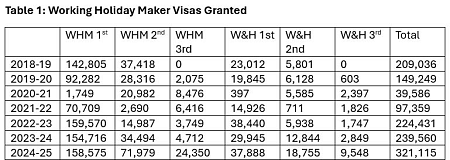
As a result, the number of first Working Holiday and Work and Holiday visas has climbed from 85,716 in 2021-22, to 198,010 in 2022-23, 184,616 in 2023-24 and 196,463 in 2024-25. The 2025-26 application rate is likely to again be around the same level (or slightly higher) as there have been no policy changes to reduce that and the labour market remains strong.
Note that new applications include UK nationals who now automatically get a three-year working holidaymaker visa and are therefore more likely to be counted in net migration.

In addition, it is the number of people getting second and third working holidaymaker visas that is also keeping the contribution to net migration high, because to be counted in net migration, the visa holder must remain in Australia for 12 months out of 16. A working holidaymaker who comes to Australia and only stays here for their first working holidaymaker visa is unlikely to be counted in net migration.
The number of second Working Holiday and Work and Holiday visas has climbed from 3,401 in 2021-22 to 90,754 in 2024-25. The number of third Working Holiday and Work and Holiday visas has increased from 8,242 in 2021-22 to 33,898 in 2024-25. It is these second and third working holidaymakers who will be counted in net migration and are most likely to apply for further onshore visas, such as skilled temporary visas and permanent visas — both of which are booming.
There is currently no announced policy change that would reverse this trend in 2025-26. Only a sharp deterioration in the labour market would achieve that.
Against that background, we should expect the working holidaymaker contribution to net migration in both 2024-25 and 2025-26 to remain high and well above pre-pandemic levels.
That will make Treasury’s forecast of a sharp fall in overall net migration to a long-term level of 230,000 per annum very difficult to achieve. It remains surprising that the Government has not tightened policy in this area in its quest to reduce net migration.
The Coalition has re-committed to a net migration target of 160,000, but is unlikely to get support from the Nationals for cutting working holidaymaker numbers.
Thus, both major parties have committed to reducing net migration to much lower levels, but with few policies to achieve that reduction.
Dr Abul Rizvi is an Independent Australia columnist and a former Deputy Secretary of the Department of Immigration. You can follow Abul on Twitter @RizviAbul.
 This work is licensed under a Creative Commons Attribution-NonCommercial-NoDerivs 3.0 Australia License
Support independent journalism Subscribe to IA.


Related Articles
- Government delayed asylum report amid surge linked to visa schemes
- Treasury’s migration forecast looks shaky as long-term numbers set to surge
- Clear failures, no fixes: The Government's asylum blind spot
- Asylum seekers refused at both primary and appeal stages exceeds 50,000
- Net migration in 2024-25 may exceed Treasury forecast by 45,000