In the wake of the conflict in and around Iran, there is talk of introducing petrol rationing in Australia. Such a move would come with a host of potential problems.
These are problems few ministers or officials have, perhaps, thought through.
A little wartime history here may be useful.
In contrast with the current Australian Government the Menzies Wartime Cabinet moved quickly to preserve and manage national fuel stocks. Serious planning of petrol rationing began in early September 1939, when representatives of state transport authorities met. It would be state bodies which would have to administer any legislation and controls when they came into effect. Then, as now, many were not happy with any proposed restrictions. The approved plan was complex, containing no less than 24 categories of user. Ration tickets would be issued in the denominations of 1, 2, 5, 10 and 44 gallons. The delayed implementation of petrol rationing led to widespread hoarding, not so much by private motorists (who had limited storage facilities), but by transport companies.
Details of the Australian scheme were not announced until 12 July 1940 and rationing began from October that year. Private motorists would be restricted to 3,218 kilometres annually, while the allowance for business users varied between 4,023 and 24,140 kilometres. These measures were expected to come into force in September. Not unexpectedly, there was opposition both from the motoring public and commercial interests.
All applications were to be submitted to (and checked by) the local police. Imagine that happening in 2026? Senior British Government officials were among those who were unimpressed with progress here; the British Trade Commissioner in Sydney advising his Government that an important contributing cause was ‘weak direction by the Government’.
In December 1941, Cabinet approved a further reduction in petrol given the requirement to conserve strategic stocks of fuel. This was based on the principle ‘that the use of private motor vehicles should be prohibited as such vehicles may be required in an emergency.’[1] The Government promoted the use of substitute motor fuels, but petrol savings were offset by rises in the consumption of paraffin by tractors in agriculture, and in the construction of military roads and airfields.
If the Commonwealth was trying to reduce consumption and build up wartime stocks the attempt got off to a bad start. According to one source, petrol sales in March 1940 amounted to 35.5 million gallons, compared to 29.5 million gallons in March 1939, and a monthly average of approximately 23 million gallons during the first five months of rationing from October 1940 to February 1941’[2] Politicians then as now vainly appealed to the public to “do the right thing”.
Within weeks of the introduction of petrol rationing, flourishing black markets soon appeared, with their activities exercising state and Commonwealth police for the remainder of the war. Thefts of petrol, some of which were very bold, regularly made newspaper headlines. To cite just one example, The Argus (29 April 1941) published the outcome of a court case in Melbourne in which a 22 year old Private Roy Cox was sentence to two weeks in goal for larceny. Police had charged him and he admitted to selling 35 gallons of petrol he had drained from army vehicles. His defence lawyer argued that he client’s only explanations was that he “knew they were all doing it”. Unfortunately for Cox he had been under police surveillance for three months acting on a tip off.[3]
Unlike the thriving black market in alcohol, there was not the same degree of illegal activity among petrol retailers and the number of prosecutions against this sector was small. This may be partly explained by the difficulty of obtaining evidence.[4] Subsequently, courts always gave the offender the benefit of doubt. Criminals also resorted to stealing petrol ration coupons from houses and even post offices to obtain them. Others started to counterfeit coupons.
Together with wartime rationing more generally, there also arose a culture of “dobbing in” anyone suspected (with or without cause) of hoarding, pilfering petrol or defrauding the ration coupon system. Anonymous reporting became part of petrol rationing.
It seems in that regard at least, little has changed over the past 70 years. Of course, with 21st Century technology and a more centralised bureaucracy, the task will be easier for the current Government. But whatever measures it takes are sure to be exploited in the best Australian tradition.
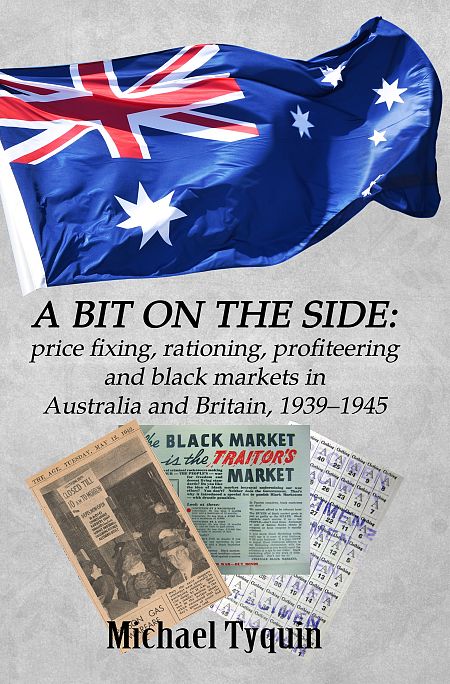
Dr Michael Tyquin is a former army officer and is a military historian. Among other books, he is the author of A Bit on the Side: price fixing, rationing, profiteering and black markets in Australia and Britain, 1939-1945 (2017)
[1] Item 5: ‘Control of use of Essential Materials’, 11 December 1941 (Melbourne), Official History—Papers of Nancy Penman (War Cabinet minutes), AWM 247 1/7, Australian War Memorial, Canberra.
[2]Australia – Petrol Rationing Scheme (1940), BT 11/1445, The National Archives of the UK.
[3] MP508/1/320/701/25, Military Thefts, National Archives of Australia, Melbourne.
[4]AWM 70/170, History of Petrol Rationing, Australian War Memorial, Canberra.
 This work is licensed under a Creative Commons Attribution-NonCommercial-NoDerivs 3.0 Australia License
Support independent journalism Subscribe to IA.