Australia’s reliance on imported goods masks the true scale of its carbon footprint and lets us off the hook for pollution we helped create, writes John Haly.
CLIMATE CHANGE has escalated as the global average temperature has risen above the 1.5°C limit we hoped to avoid. China is responsible for 27% of global carbon dioxide emissions, according to the BBC. China is often unfairly blamed for these emissions, despite accounting for 35% of global industrial production, according to the Centre for Economic Policy Research (CEPR).
Still, before we point fingers at other countries, perhaps we in Australia ought to properly evaluate our own carbon footprint, especially that which results from trade, including outsourcing our manufacturing to China and its consequential pollution.
China should not bear ultimate responsibility for the creation of non-recoverable waste resulting from what it manufactures on our behalf, due to following flawed economic principles. That ought to be allocated as Australia’s pollution. According to MIT, over 22% of China’s carbon dioxide emissions stem from net exports produced there for global consumption. These emissions are classified as “trade-embodied” because China’s exports of goods and services generate the waste on behalf of the global community.

Neoclassical economics and neoliberalism in the late 19th and 20th centuries have promoted trade liberalisation and free market economies. Unsurprisingly, in 2014, Stamford University rehashed a Hayek-inspired economic myth. It claims that advanced post-industrial economies should consider outsourcing or reorganising their secondary and primary sectors and focusing on their tertiary sector. It was based on a three-sector economic model: primary (agricultural, mining), secondary (manufacturing) and tertiary (services). One advances from the first to the third sector, leaving each level behind.
However, increasing one trophic level of an economy at the expense of others introduces risks. If a country primarily develops its primary sector, it becomes more sensitive to changes in commodity prices, agricultural weather and environmental deterioration. Argentina has exhibited such weaknesses. Australia has retained only a remnant of its secondary trophic levels (manufacturing), eliminating market complexity.
As Aaron Patrick in the Australian Financial Review said:
‘Australia sells the world almost nothing, relative to total exports, that requires a degree to make.’
The pandemic’s supply chain issues, which caused inflation due to limited manufacturing in Australia, have forced subsequent administrations to evaluate the implications of not supporting a domestic manufacturing industry.
In an August 2023 speech, Industry and Science Minister Ed Husic reflected this:
“Australia has the highest dependency on manufactured imports and the lowest level of manufacturing self-sufficiency of any OECD country.”

A robust primary sector can provide the raw materials required for a vital secondary industry. This, in turn, can deliver the infrastructure and technologies essential for a thriving tertiary sector, which feeds back to support the primary and secondary sectors. Internally, we now lack the necessary manufacturing infrastructure capabilities, as do many Western countries. However, no modern economy will survive without some manner of primary, secondary, and tertiary levels.
Consequently, post-industrial economic narratives have facilitated the extensive outsourcing of secondary-level manufacturing, leading to a significant decline in domestic manufacturing capabilities. The fact that 35% of global manufacturing is outsourced to China is sustaining these nations’ operational economies.
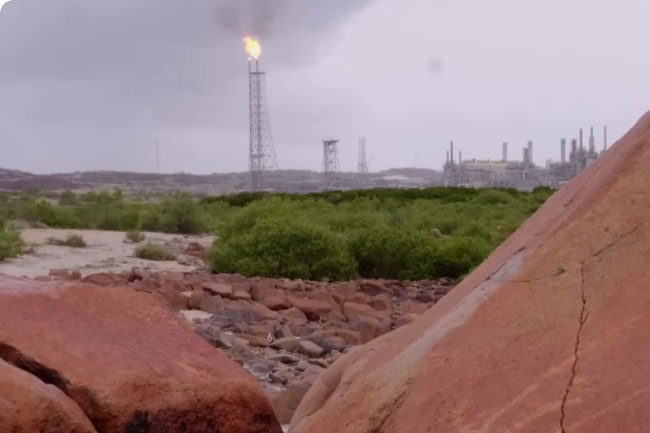
According to Climate Analytics, Australia ranks 11th in worldwide per capita carbon emissions, whereas China ranks 38th, according to Visual Capitalist. Australia accounts for 4.5% of the world’s fossil-fuel carbon dioxide emissions, excluding imports, with 80% of this total coming from fossil fuels. Woodside’s North-West Shelf operations will continue for 40 years as a consequence of the Albanese Government's approval. This should considerably increase the amount of waste we produce.
China’s pollution-related imports should be credited to other economies. Waste by U.S. corporations producing in China to take advantage of reduced costs and better logistics should be blamed on the U.S. This is often overlooked and is particularly detrimental to Australia.
The Department of Foreign Affairs and Trade reports that China’s manufactured goods exports to Australia rose 39% to $106 billion from 2019-20 to 2022-23. Australia’s largest resource and energy market is China, and related waste is a consequence of Australian consumption.
China supplied £63.6 billion (AU$133.6 billion) to the UK in 2024, according to the BBC. Chinese goods accounted for 13.3% of UK imports, making China the top import partner. China is Australia’s greatest import and export partner. In 2024, Australia’s exports totalled $196 billion and its imports reached $115.6 billion, according to the Australian Bureau of Statistics.
When we ignore neoliberal capitalism and capital mobility that facilitates outsourcing, we fail to acknowledge their influence, and we solely attribute carbon pollution to China. China is the outsourcer for much of the secondary trophic level of several Western economies.
Global supply chains and international trade make it challenging to determine which countries are the primary sources of emissions for China’s industry. We can chart the intermediary cause, not the final accountability. The graph from Our World in Data shows “production-based” emissions per capita. It does not account for imported contributions or land use.

Since the Global Financial Crisis, Australia has competed with the U.S. for the highest per capita polluter in the world (excluding “trade-embodied” pollution and land use), only falling behind in 2014 and 2022. The first was a consequence of PM Tony Abbott reversing PM Julia Gillard’s carbon pricing policy. The second is due to the real-world lag created by pandemic lockdowns. While we fell behind in per capita pollution in 2022, we rebounded in 2023.
One can only imagine that if we included land use (we’ve 5% of the world’s land mass) and accounted for imported “trade-embodied” pollution ($115.6 billion in imports from China in 2024), we would hold a more convincing lead position among the world’s greatest per capita polluters. Woodside’s additional 40 years of fossil fuel extraction and exporting from the North-West Shelf are surely going to give us a commanding lead for decades to come.
Better measurements are needed for effective mitigation initiatives. My father (the perpetual accountant) often said to me, “What gets measured, gets managed.” We should include our imported carbon pollution as well as our domestic and exported use. Relevant to Australians because Western economies’ post-industrial economic mantra prefers to dismiss individual contributions and ignore collective responsibility.
That failure contributes to more frequent floods, droughts and massive fires in our country. It provides excuses to minimise our commitment to reducing consumption and addressing the need to switch to batteries and renewables as anything less than an emergency. That choice will result in loss of life, property damage and economic penalty.
We must accept responsibility for driving global temperature above 1.5 degrees, not pass the buck to a country that is manufacturing on our behalf.
John Haly is a freelance writer who manages a freelance business, Halyucinations Studios in Sydney.
 This work is licensed under a Creative Commons Attribution-NonCommercial-NoDerivs 3.0 Australia License
Support independent journalism Subscribe to IA.


Related Articles
- Australia’s war on nature leading to environmental collapse
- Arrest and murder of activists a day's work for fossil fuel industry
- Australian politics suffering from collective madness
- How a Victorian fruit merchant could be leading to answers to the climate crisis
- Evidence debunks 'contemptible' climate lies