Addressing Australia’s urgent reforms requires more confidence and less division, as Alan Austin reports.
FIFTY YEARS AGO this year, a young federal parliamentarian studied with intense interest a detailed report handed down by a National Committee of Inquiry chaired by historian Keith Hancock. Its subject – superannuation – was unknown to most Australians back then.
He determined to make this obscure perk, then available only to the top bureaucrats and corporate executives, universally accessible.
Thirty years ago this year, that visionary MP, Paul John Keating, left the job of Prime Minister, having established arguably the world’s best national superannuation program.
About 18 million Australians now have more than 4.5 trillion dollars stashed away. This provides vital capital for mining, industrial development and the full range of business investments. It generates handsome returns for all those savers.

Economic good news keeps coming
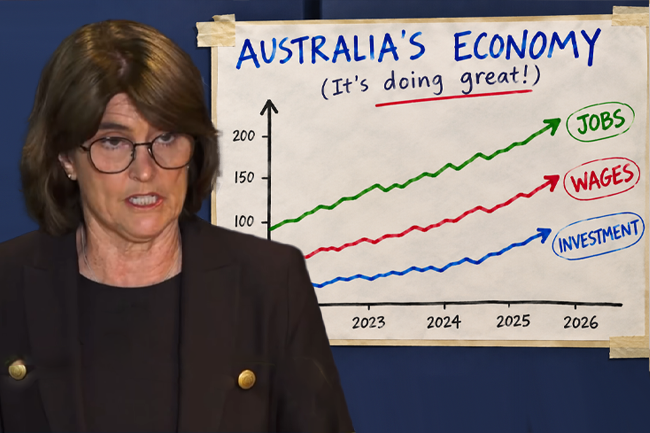
The Bureau of Statistics (ABS) advises that more than 165,000 jobs were created last year, bringing the number of months with Australia’s jobless rate below 4.5% to 49. December’s inflation was 3.76%, bringing the months below 4% to 25. Annual GDP growth remained positive through the year, extending that streak to 19 quarters.
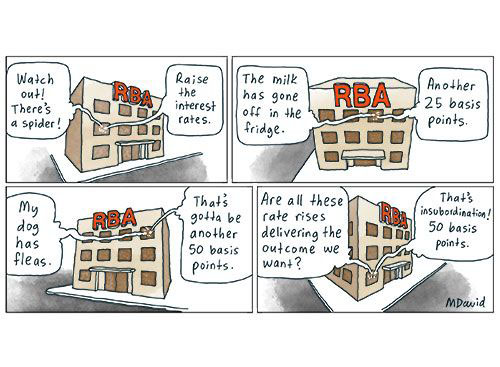
Interest rates were cut three times last year but increased last week to 3.85%, making 14 years with rates under 4.5%. Fourteen. Years.
So, how often since records have been kept has Australia enjoyed such high employment, low inflation, low interest rates and positive growth? The answer is... never before.
In other good news, the Aussie dollar has just surged above 70 U.S. cents (99 AU cents) and 110 Japanese yen (AU$1) for the first time in three years. Following the Albanese Government’s new investment mandate, the Future Fund grew by almost $30 billion last year with a return of 12.4%.
Comparisons with like economies
Looking abroad, how many of the 38 advanced OECD members now have the jobless below 4.2%, inflation below 3.8%, interest rates at or below 3.85%, annual GDP growth above 2%, and have had positive growth for more than two years?
The answer is two. Australia and Denmark. Australia, however, has a lower youth jobless rate, much lower taxes and higher wealth per person than Denmark.
So why are Australians so despondent? Why was there such anguish last week over a minuscule rise in interest rates during a retail spending mini-boom?

Media feeds the melancholy
The constant message from the mainstream media and the powerful institutions is this: You are going to feel dejected and depressed about your dismal lives, regardless of how safe, comfortable and well-governed you are in reality.
An example is the detailed analysis last Wednesday by ABC News of the ABS data on cost-of-living increases across the community.
Titled ‘Living costs rise for all but some hit harder’, the article reported the impact of inflation on pensioners, welfare recipients and employee households.
It claimed that ‘cost-of-living pressures are being felt by all households, but some are being hit harder than others’.
In an appalling journalistic failure, the analysis did not match the cost rises over the year with income increases. It disclosed the rising outlays only.
For the record, living costs for employees rose 2.3%, while the minimum wage increased by 3.5% and average wages lifted 3.4%. Costs for social security beneficiaries rose 4.1%, while benefits increased between 3.2% and 4.3%. Age pensioner outlays rose 4.2%, while pensions increased about 3.6%. Most significantly, costs for self-funded retirees rose 3.3% while their super balances surged 9.3%.
So while not all Australians enjoyed higher living standards, the vast majority certainly did.
IA wrote to ABC News to query this omission but received no reply.
A recent article in The Guardian was titled ‘Australia spends more on tax breaks for landlords than social housing, homelessness and rent assistance combined’. It claimed for 2024-25 that, ‘total expenditure on the key housing assistance programs totalled $9.6 billion’.
That is blatantly false.

Productivity Commission data analysed here last week clearly shows the total was $24.9 billion, as follows:
- Recurrent expenditure on social housing, [PC table 18A.1]: $5,882.1 million.
- Capital expenditure on social housing, [table 18A.1]: $10,813.1 million.
- Expenditure for Commonwealth Rent Assistance, [table GA.4]: $6,419.7 million.
- Additional recurrent outlays by states, [table 19A.1]: $1,754.9 million.
The Guardian quoted an Australian Council of Social Service (ACOSS) spokesperson who asserted, ‘More people are struggling to afford the private rental market, pushing them into homelessness and on to growing social housing waitlists’.
While poverty remains dire for many, it is not true that more people are becoming homeless. Numbers declined in 2024 and again in 2025 from the 2023 peak.
IA wrote to The Guardian to request corrections. They agreed to change the headline, but did not correct any of the false data.
Other tawdry attempts to keep Australians misinformed and miserable include:
- ‘Australia's cost of living “getting crazier” as nearly half of lower-income families worry about affording school shoes’ [The Guardian].
- ‘Nightmare on Martin Place as RBA outlines horror interest rates scenario’ [ABC News].
- ‘Chalmers, RBA fails put us at risk of a 1990s-style recession’ [Daily Telegraph].
- ‘Ex-RBA member laments massive public spending's “drag” on the economy after interest rates were hiked’ [Sky News].
- ‘The return of inflation may poison Labor's second-term agenda and scare more voters to the fringes’ [The Guardian].
- ‘Reserve Bank's “failed experiment” haunts Australia as interest rates rise again’ [News.com.au].
Imagine what could be achieved if the nation were confident and optimistic instead of depressed and divided.
Australians face multiple challenges. These include vanquishing racism, ending Indigenous disadvantage, climate change, persistent inequality, matching the 55,000 homeless families with some of the 140,000 empty homes and media mendacity.
The majority of Australians supported Keating in transforming the nation. Let’s see if they now back Albo.
Alan Austin is an Independent Australia columnist and freelance journalist. You can follow him on Twitter @alanaustin001.
 This work is licensed under a Creative Commons Attribution-NonCommercial-NoDerivs 3.0 Australia License
Support independent journalism Subscribe to IA.


Related Articles
- Facts from the coalface confirm poverty is easing
- Australia's economic momentum builds despite inflation jitters
- Australia’s economy strengthens as the rest of the world struggles
- Australia’s economy shines in a world of deepening gloom
- Doomsayers proved wrong again as businesses expand and prosper