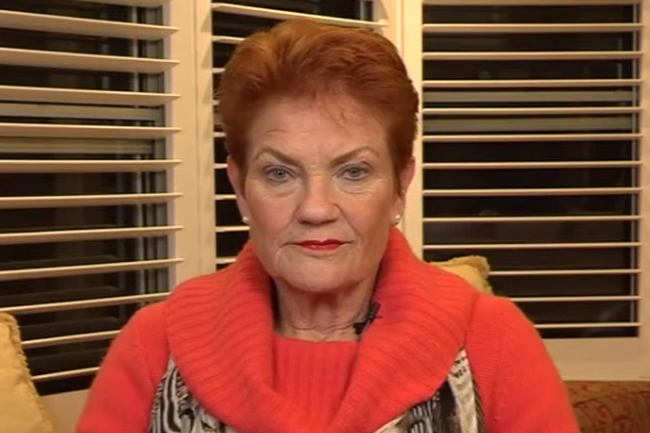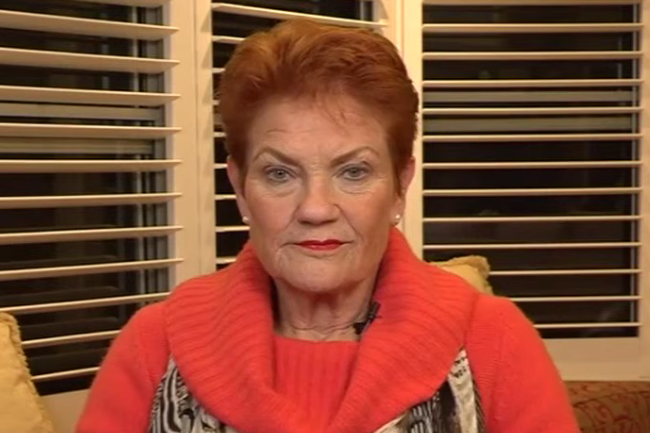
The present media narrative is filled with stories about the rise of One Nation and the resurgence of Senator Pauline Hanson. However, the basic facts of Australian democracy have become lost in the hype because Senator Hanson becoming prime minister is quite the complicated process.
The media runs on getting eyes on the prize. All politicians, including Pauline Hanson, know this.
This is not a criticism of Senator Hanson. Fair play to Pauline, she is only doing what all politicians do. She knows her brand. She knows her tactics: say something controversial — the media keep her in the limelight and, every time she appears on Sky News or Seven or wherever her brand grows.
However, the growing calls for her to be PM disregard the basic facts of Australian democracy. Perhaps it is time for a little fact-checking.
Sorry Hansonites, it is highly doubtful Pauline will ever be prime minister.
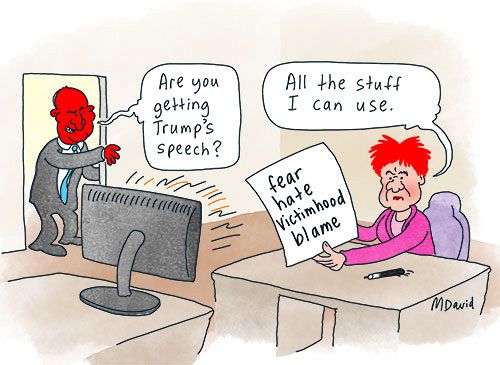
Here’s why.
Senators can become prime ministers, but only for a short period of time, because under parliamentary convention, they must resign from the Senate and run for a Lower House seat. A former senator has become prime minister of Australia before, but only after John Gorton resigned from the Senate after the death of Harold Holt. But, Gorton was elected via the by-election in Holt’s seat of Higgins, a very safe and comfortable Liberal seat.
Under parliamentary convention, inherited from the Westminster system, the prime minister must, under responsible government, have the confidence of the members of the Lower House because this represents the majority vote. So, Labor has 94 seats, thus 94 members of parliament who continue to give Anthony Albanese their confidence as Party Leader.
Former Prime Minister Scott Morrison was not initially elected as PM. He was raised to the position after a leadership spill against Malcolm Turnbull in 2018. He was, however, re-elected to his electorate and became PM in 2019.
Equally, Gough Whitlam held the majority in the Lower House, but not the Senate, so he could not get budgetary laws through and was subsequently dismissed. However, he was not replaced by a senator but by the Opposition Leader, Malcolm Fraser, in a landslide result.
Let’s say Senator Hanson did give up her position. As outlined, she would need to run in her local Ipswich electorate of Blair (named after Harold Blair, who was a member of the Aborigines Welfare Board in Victoria, the Aborigines Advancement League, the Federal Council for the Advancement of Aborigines and Torres Strait Islanders, and the Commonwealth Aboriginal Arts Board).
Labor MP Shayne Neumann currently holds the seat. According to the Australian Electoral Commission (AEC), in the 2025 Federal Election, Neumann received 36.62 per cent of the primary vote. This gives him a two-party preference of 57 per cent.
Now, this is where it becomes difficult for Senator Hanson to win.
The Greens received 12,104 votes, nearly 11,000 of which, after preferences, were distributed to Labor. The One Nation candidate, Brendan Kross, polled well with 11,344 votes. Pauline would, imaginably, garner much higher first preferences. However, whether she got over the line would depend on preferences. For example, the Legalise Cannabis Party received 5,353 primary votes. Thus, if they decided to preference Labor this equates to more than 16,000 votes to Labor.
It is unlikely Senator Hanson will give up her Senator position precisely because this allows her political platform. For argument’s sake, however, let’s say she did give up her senatorial position. If she is not elected to the Lower House, that political platform is lost.
However, let’s say she wins and former Senator Hanson becomes Pauline Hanson MP. She remains the leader of One Nation and has her own seat, Barnaby Joyce’s seat of New England and Farrer: three seats. She needs to win 73 more because One Nation would need 76 seats in order to govern. Demos AU predicted, based on previous elections and polling, that One Nation would win 13 seats in the 2025 Election — they won zero.
In the 2029 Election, with the Liberal Party struggling, she would clearly win more. However, the Liberals were only one part of the Coalition, so One Nation would need to take some of the 42 Liberal/National seats. Even if they did, this is 44 seats and, with some swings against Labor, let’s say One Nation takes another 16 seats.
Total: approximately 60 seats.
Recently, a Redbridge poll predicted One Nation could win 59 seats. However, while the mainstream media fervently lunged at this, it did not do its deep dive. The poll was only 6,000 respondents from two Sydney electorates, one of which is Wentworth, currently held by Independent MP Allegra Spender (who only beat Liberal candidate Ro Knox by 129 first-preference votes and One Nation candidate James Sternhell only received 2,625 first-preference votes).
Given the present dissatisfaction with the Liberal Party, many of the approximately 40,000 Liberal voters would likely shift to One Nation before they vote Labor.
Regardless, Labor presently holds a 94-seat majority. Thus, even after the previous imagined scenario, One Nation would still need to take another 16 seats. As long as the Greens and Independents continue to win seats and preference Labor, this seems highly unlikely.
Nor is Farrer some magical One Nation win — Labor did not even bother to post a candidate.
Further, Senator Hanson is 72 years old. Pauline Hanson is One Nation; without her at the helm, one must wonder whether the party would be as strong. It is doubtful her party would win the 2029 Election, even if she did win a Lower House seat. She may, potentially, have a chance at the 2033 Election, but she will be 79 years old. Determined and driven as she is, she may decide to retire.
A healthy democracy needs a range of parties that support a range of perspectives. We need, as philosopher Jurgen Habermas calls it, a rigorous public sphere. However, within the current political debate and media landscape, we need some reality checks on how modern Australian democracy works.
We are a constitutional monarchy, not a cult of personality. We have preferential voting, which One Nation has openly said it wants to abolish, but preferential voting allows for a broader public sphere.
Thus, One Nation supporters have the right, within a democracy, to express their beliefs and opinions, but, media sensationalism aside, their desired outcome is much more complicated than shouting, “Pauline for PM!”
Dr Jason K Foster is a journalism lecturer at RMIT University.
 This work is licensed under a Creative Commons Attribution-NonCommercial-NoDerivs 3.0 Australia License
Support independent journalism Subscribe to IA.


Related Articles
- What Hanson should be asked at the National Press Club
- A day in the life of Pauline Hanson
- CARTOONS: Pauline Hanson is gaga for Trump and MAGA
- EXCLUSIVE: Meta and Murdoch make AI pact and push Pauline's polls
- Pauline Hanson corrects her immigration arithmetic