As Trump retreats from global leadership, middle powers have an opportunity and a responsibility to confront the climate crisis together, writes Dr Mark Beeson.
FOR SOMEONE who is famously fickle and unreliable, some things about U.S. President Donald Trump are entirely predictable.
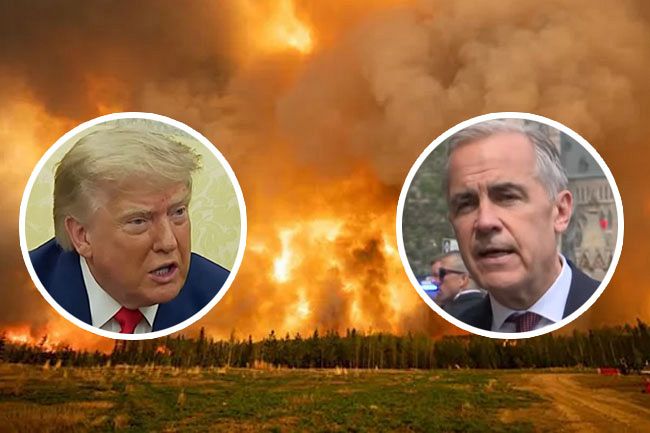
Whenever things don’t go according to plan – which turns out to be most of the time – it’s always someone else’s fault. The smoke currently choking major American cities emanates from Canada; therefore, Canada’s to blame.
Equally predictable is the blame-shifter-in-chief’s response to anyone or any country that behaves in a manner he doesn’t like: lash out, impose sanctions, or if all else fails, try and bomb them into submission. Canada should consider itself lucky that so far, Trump has only contemplated annexing it, rather than invading.
It can’t be easy being Canada’s leader these days and it’s unsurprising that Mark Carney might keep his head down given the volatile nature of the neighbours, but let’s not forget that recently some over-excited commentators were praising the ‘middle power masterclass’ he delivered to a receptive audience at Davos.
To be fair, none of the world’s middle powers are currently displaying the sort of creative diplomacy and “thought leadership” that we might have hoped for or expected given all the lofty rhetoric that has emerged from the likes of Canada, the European Union, Britain and Australia. Indeed, Australia has been an especially enthusiastic champion of middle-power potential, but this has been generally noteworthy by its absence in practise.
The rather sobering reality would seem to be that when it really matters and might make a difference to the ever-increasing array of global problems that distinguish this historical juncture, middle powers are reluctant to put their heads above the parapet. Even more disappointingly, they generally seem incapable of distinguishing the causes of current crises, much less acting on them.
Take the current wildfire literally engulfing North America. It’s not too controversial – unless you’re Donald Trump, of course – to suggest that such fires have been made much more likely by global warming. And yet Canada continues to extract oil from tar sands, one of the most polluting fossil fuels in the world, which not only contributes to global warming, but which directly impacts the health of Indigenous communities near mine sites.
Canadian policymakers are not the only ones who resolutely fail to acknowledge the links between the rapidly increasing climate crisis and the actions of highly polluting industries. Politics in Alberta, where most of the mining occurs, are dominated by a handful of producers who pay significant amounts of tax to Alberta’s State Government, despite having the lowest corporate tax rate in the country.
Canada’s hardly alone in failing to address problems that its state and federal governments are failing to address. Australia is one of the world’s biggest users and exporters of fossil fuels, including coal, which still accounts for three-quarters of domestic electricity.
The influence of fossil fuel companies on domestic politics is particularly stark in their ability to shape electoral outcomes at the federal level, and “capture” the policy process in a state like Western Australia where the political class moves in lockstep with the resource sector.
Under such circumstances, it is entirely predictable that politicians might use the drug pusher’s defence: if we don’t do it, someone else will. Perhaps so, but it’s even more remarkable in a country like the UK, which has made surprisingly effective progress in decarbonising the domestic economy and weaning itself off coal completely. More than 50 per cent of the UK’s electricity comes from renewables.
Despite this comparatively impressive record, it may not last. Britain has become a byword for political chaos and incompetence, which is why such hopes are invested in Andy Burnham, the latest in an embarrassingly long line of potential saviours. And yet the “King of the North” is unlikely to fulfil lofty expectations. Not only are Britain’s problems deep-seated and structural, but one of Burnham’s first policy initiatives is to renew drilling for oil and gas in the North Sea.
All of this is occurring when even the famously cool and damp British Isles are in the midst of – yet another – unprecedented series of heatwaves, with the likelihood of more to come this year and forever, unless unprecedented levels of international cooperation act to address the causes of the problem we are all helping to create.
The point to emphasise about the three Anglosphere amigos is that it really doesn’t have to be this way. Rather than fudging and dissembling, they could name the problem and try to do something about it, possibly together. Yes, it would require unaccustomed political bravery, but what’s the alternative? Trump isn’t going to do it, that’s certain.
Collective leadership won’t be easy, of course, but at least the responsibility and the likely retribution from the increasingly unhinged leader of what used to be known as the free world will be spread around. It might even prove popular with domestic electorates sweltering through this year’s once-in-a-hundred-year “weather event”. This is a time of unprecedented wonders, after all.
Dr Mark Beeson is an adjunct professor at the University of Technology Sydney and Griffith University. He was previously Professor of International Politics at the University of Western Australia.
 This work is licensed under a Creative Commons Attribution-NonCommercial-NoDerivs 3.0 Australia License
Support independent journalism Subscribe to IA.


Related Articles
- Donald Trump: A presidency of metaphors
- JEFF MCMULLEN: Trump attacks the enemy within
- Killings continue to surge under Trump’s destructive rule
- CARTOONS: Donald Trump's reflecting pool is 'off'
- What Catiline tells us about Trump and democratic decline