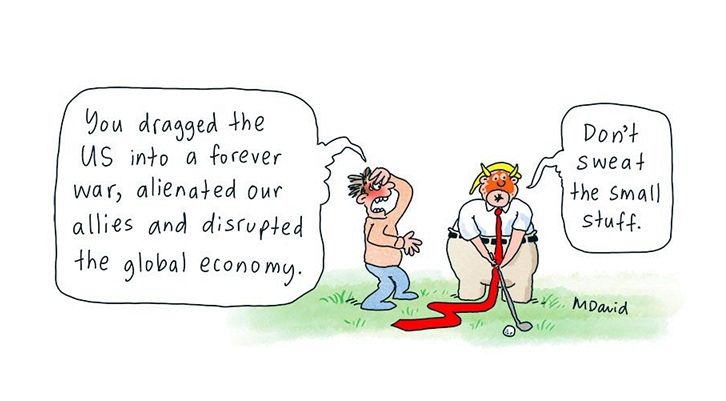
The world continues to toy with normality despite profound changes to the global economy caused by the Iran War. Stepping into the future, George Grundy looks back on this time of strange societal cognitive dissonance.
LOOKING BACK, April 2026 seems like a glimpse of transient illusion, a moment in the before-times when we toyed with normality, as if we didn’t know how profoundly things had changed.
America’s markets were at record highs, despite the wave of oil supply disruption that swept across the world. The supermarket shelves were still full, and we drove our gas-guzzling cars and planned our holidays without a care.
It was a time of make-believe, of strange societal cognitive dissonance, in which we knew that the Strait of Hormuz was closed and what that meant, but chose to live our best lives while we still could. But day after day, the Strait, which had carried around 25 per cent of the world’s oil, remained stubbornly closed. Every passing day meant another 20 million barrels of oil taken from the world’s economy, and the crisis gradually became more severe.
First in line were the poorer countries of South-East Asia, but soon enough, Anthony Albanese was on our television screens, soberly announcing the rationing of diesel, then all fuels, as our oil-refining supplier nations themselves ran dry.
By the end of May, the Australian economy had essentially ground to a halt, and what few liquid resources remained were prioritised for the police, army, health and food production. Every single item on the supermarket shelf had been harvested, packaged, or delivered using machinery that ran on diesel fuel, so naturally, prices rose, leading to panic buying and scarcity.

So, the shelves were running bare, major supermarkets introduced daily limits and were forced to put guards on their doors. Channel Seven ran stories about fights breaking out in the aisles at Coles, just as had happened during COVID.
As a rich country, Australia made do. This country already produced three times as much food as we consumed, so even when fertiliser ran short, there was plenty of food. But price hikes hit the vulnerable the hardest, especially when so many businesses shut their doors as the economy came to a full stop. The government stepped in to stop the eviction of people already facing a cost-of-living crisis and now unable to pay rent or mortgage. Nevertheless, crime spiked, as it does.
It was in the developing world that the real damage was felt. Poorer Asian and African countries saw fuel shortages turn into food scarcity, which in turn led to social unrest and, for some, war with their neighbours.
Sudan, for example, already had 33 million people displaced or facing acute hunger and famine. In the end, it was the loss of around one-third of the world’s fertiliser, strangled on the wrong side of the Hormuz Strait, that did the most damage of all.
Nearly half of India’s imported fertiliser was cut off by the war, and the poor crop yields that followed affected nearly all of that country’s nearly 1.5 billion mouths to feed. As so often throughout human history, famine led to war, and war, in turn, caused more crippling famine.
Financially, there was chaos. By April 2026, a massive 45 per cent of the surging Dow Jones index capitalisation was made up of AI-linked stocks, so when the market turned downward, things were primed to move fast. Perhaps we were all too old to remember that during the 1973 oil shock (caused by just seven per cent of the world’s oil market being taken offline), it took nearly two years for the market to collapse, but collapse it did, falling over 45 per cent by the end of 1974 (the ASX fell nearly 60 per cent).
Ultimately, Trump’s attack on Iran was seen as the start of the collapse of the greenback as the world’s reserve currency. The U.S. was already 39 trillion dollars in debt. Trump had added over $3.5 trillion to that figure in the fourteen months he had been in power, meaning he was running a deficit of over $250 billion every month. As interest rates rose and the U.S. economy plunged into a deep recession, the situation became untenable.
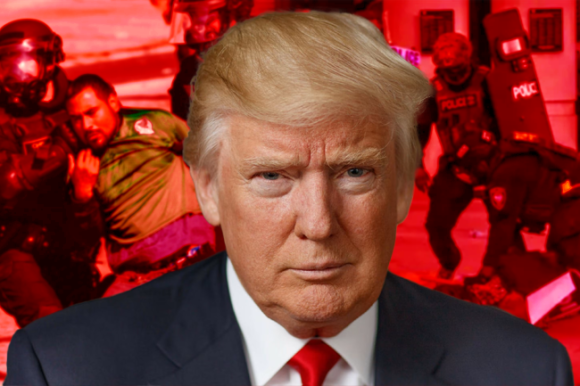
By the summer, Trump faced an unprecedented situation. His approval numbers had collapsed, in great part due to Americans' fury at the record rise in grocery and gas prices. Trump’s numbers dipped below the historic record low of 22 per cent (held by Harry S. Truman), and across America, the ‘No Kings’ marches grew and grew.
Trump responded as he always had done, lashing out and condemning the protesters as paid agitators and communists. Eventually, there came a moment when the unrest was so widespread that Trump invoked the Insurrection Act, as he had long threatened to do, and when active duty personnel, trained in the art of war rather than peace-keeping, opened fire on a crowd in Boston, all hell broke loose.
Trump attempted to declare martial law, prompting a number of his cabinet members to resign, and by the time of November’s mid-term elections, the country was close to a state of civil war.
All of this mayhem and misery happened as a downstream effect of America’s wildly reckless decision to attack Iran. The consequences for the world had been both predictable and widely predicted, but Trump had personally been the most hawkish when that fateful decision was made.
It was Trump who caused this global chaos. He never took responsibility, of course. The rest of us dealt with the consequences.
Looking back, April seems like another time altogether. The past, they say, is a foreign country.
George Grundy is an English-Australian author, media professional and businessman. You can follow him on Twitter @georgewgrundy.
 This work is licensed under a Creative Commons Attribution-NonCommercial-NoDerivs 3.0 Australia License
Support independent journalism Subscribe to IA.


Related Articles
- Oil, war and ecocide: The destruction of the Middle East
- Who's making money? The arsenal trade after Ukraine and Iran
- Waning world order: Ethics in the age of great power politics
- Donald Trump and the Iran War path to madness
- American war strategy and the need for independence