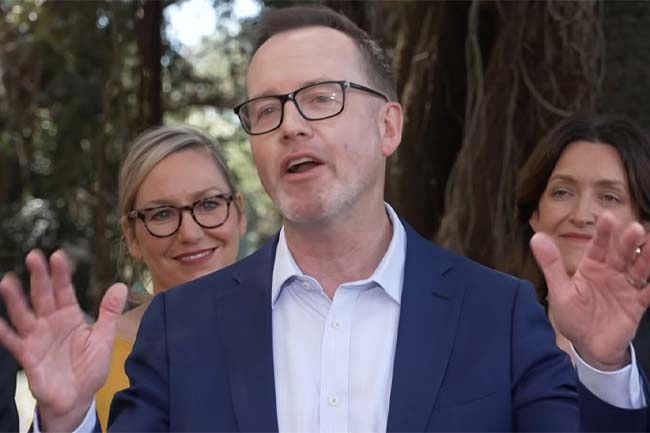
Labor’s reluctance to embrace the Greens and abandon fossil fuels threatens its political future as Australia’s two-party system continues to fracture, writes Dr Klaas Woldring.
THE OPPOSITION PARTIES, now including One Nation, are likely to preference each other more than the ALP and Greens.
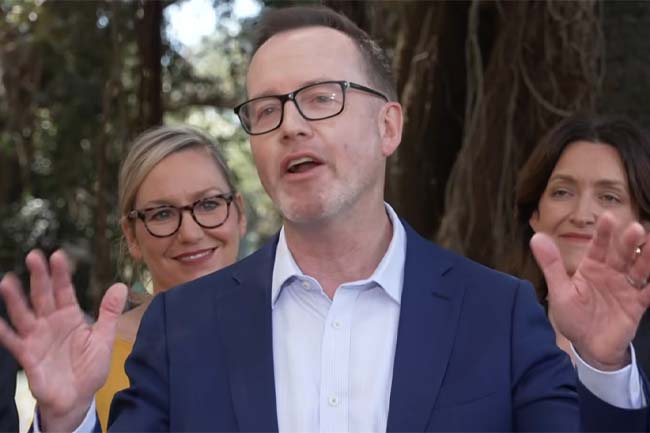
No major shift can be expected here. However, the election of the new Greens Leader David Shoebridge can be expected to strengthen the Greens vote considerably.
The nature of the formerly polarised two-party political system in Australia, the direct result of the single-member district electoral system, was reflected in regular workplace conflicts usually settled by the arbitration system.
However, neoliberal policies have created a serious reward imbalance, affecting the employee wage system adversely. At the same time, senior management financial rewards have increased disproportionately in both private and public sectors.
The ALP’s traditional role to restrain widening income differences appears to have ended. It would suit the Greens to concentrate on restoring income equality more than they do. Surely there is no reason to concentrate predominantly on green issues. The unfair, quite undemocratic distribution of income in Australia today urgently requires attention.
A kinder, fairer Australia is possible
For too long, billionaires, corporate lobbyists and powerful vested interests have defined the limits of what's politically possible, while everyday Australians are told to lower their expectations. But those limits aren't fixed.
In his first Green Magazine column as Leader of the Australian Greens, Senator Shoebridge set out his vision for a stronger, more ambitious Greens movement, one grounded in its values, ready to challenge the political status quo, take on powerful interests and turn the changes Australians want into political reality.
The general economic outlook is currently rather negative. This in itself may not be seen as the Government’s fault but cannot help the ALP.
However, PM Albanese's often overly cautious attitude is increasingly seen as a minus rather than a plus. Albanese may need to be replaced if the ALP hopes to win the next election.
With 18 months to go now, this would be the time to make such a change. The Greens need to win more seats in the House of Representatives. This is quite possible, likely even with Shoebridge performing confidently.
Recent professional assessments suggest that the Greens could win up to five seats in the next Federal Election. One could make a case that this number may well go up now. Shoebridge recently addressed federal politicians and senior journalists.
Nevertheless, a hung parliament could well be the result after the next Federal Election, leaving the Independents in a quite strong position. The case for proportional representation, based on multi-member electoral districts, is growing stronger. This is the Greens' policy but, surprisingly, they have not campaigned on it thus far.
The two-party system has begun to disintegrate, beginning with the emergence of several Independent MPs, mostly women who had become disappointed with the Liberal Party. Remarkably, One Nation successes followed soon after. The failure of the two-party system is a fact now. The ALP could be seriously mistaken to believe that its current small advantage will last much longer. Clearly, it needs to form a coalition with the Greens.
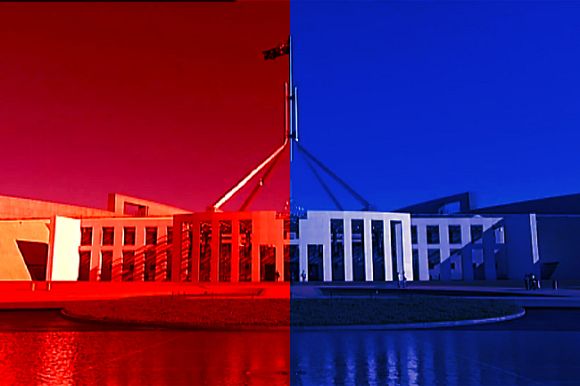
The ALP’s role is confused largely as a result of its negative attitude towards the Greens. The party seems stuck in the past and seems unwilling to effectively embrace the protection of the environment. The refusal to move away from coal and gas development suggests that the ALP has failed to move forward.
That reality is the essence of an excellent article by Christopher Wright. Certainly, the ALP can move away from that pro-coal and gas position, but the current leadership appears not inclined to do so. If this conservatism continues, Australia can expect the ALP to lose the next Federal Election.
Wright’s position, summarised, is that
Because Australia is one of the world’s largest exporters of coal and gas and is among the world’s highest per capita carbon emissions... the fossil fuel sector has been central in shaping the nation’s energy and climate policies.
The political capture of Australia by the fossil fuel industries has prevented any meaningful attempt to move away from fossil energy. They have historically obstructed attempts to regulate and reduce carbon emissions through lobbying, networking and financial donations to parties in the political arena.
A fair assessment. Does the ALP have to adhere to these direct and indirect interests? I would think not. If it does, an electoral loss seems on the cards and that could mean a major setback for Australia altogether. The opportunity for reform exists, but it requires a change in ALP policy direction on environmental issues. This may require a leadership change.
The 2025 Federal Election even almost removed the presence of the Green Party from the House of Representatives, reducing it to one only. So, in terms of effect at the national level on environmental policy, the Senate only has a blocking function and new initiatives to promote renewal cannot be expected.
Surely, this isn’t good enough, but the system conservatism within the ALP is a serious problem. The possibility of discussing this situation was even refused at the recent ALP National Conference, where questions were blocked. One has to say that the party’s internal view of democracy was surely damaged by this conference policy. Could or should the membership really have accepted this?
Therefore, unless the ALP itself either improves on its own environmental policies, the status of the party and support for it may well decline further. Also, introducing proportional representation would give the Greens a significant voice in the House of Representatives. This would undoubtedly reflect positively on the ALP and would assist in winning the next Federal Election.
Surely the ALP could concentrate much more on alternatives in a country that has amongst the highest levels of sunshine in the world. Rapid encouragement of electric power in all possible ways is the obvious answer here. This is the type of revolution the ALP should be promoting rather than looking after the interests of direct and indirect beneficiaries of the continuing fossil industry.
The political system is indeed dominated by coal and gas interests in many ways. The ALP urgently needs to deal with this if it seeks to remain a major party. Tackling it, with the assistance and cooperation of the Greens, is the answer here.
Dr Klaas Woldring is a former associate professor at Southern Cross University and former convenor of ABC Friends (Central Coast).
 This work is licensed under a Creative Commons Attribution-NonCommercial-NoDerivs 3.0 Australia License
Support independent journalism Subscribe to IA.


Related Articles
- The Labor paradox: Too progressive, not progressive enough
- Forest carbon scheme puts Great Koala National Park at risk
- One against six in Labor’s battle for reform
- Victoria’s wildlife pays the price for Labor’s bushfire failures
- Pressure mounts on Albanese Government over failure to sign nuclear ban Treaty