The rapidly growing support for Pauline Hanson’s One Nation is indicative of some underlying support for racist attitudes, but Australia has the potential to grow further into a tolerant and open society, writes Dr Klaas Woldring.
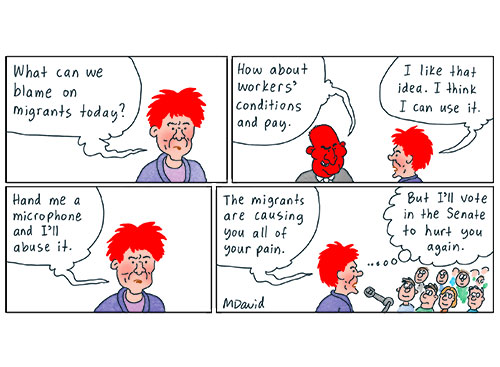
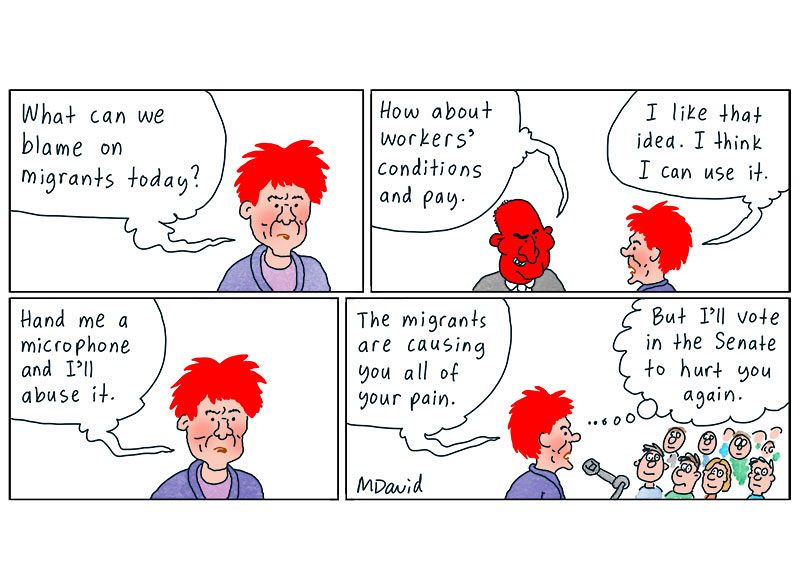
THE MIGRATION DEBATE initiated by One Nation’s Pauline Hanson to reduce immigration to essentially European migrants – and even fewer of them – belongs philosophically to the 1950s.
What is of great concern, no doubt, is that it seems, initially at least, a significant minority of voters support such ideas.
This country, continent really, is part of the Asian and Pacific regions of the world where most countries have the Islamic religion. They are not even “white” either.
Hanson has adjusted her “whites only” migration policy wording to something less unacceptable for the majority of voters, but the essence of her preference is unmistakable.
Most Australians do realise that this is fundamentally wrong, no matter how camouflaged it is dished up.
Australia’s credibility and growing acceptance in Asian and Pacific countries, which has certainly been PM Anthony Albanese’s strongest contribution, would be damaged by a One Nation Government.
The rapid growth in support for her party may in part also be caused by the fatigue of voters with the existing system and the disunity in the conservative Coalition parties.
Also, quite likely really, by the timidity of the current ALP Government and their deplorable abandonment of strong environmental policy measures.

Significant sections of the media provide wide publicity that actually assists the growth of the One Nation Party, but in the longer term the reality of Australia’s geographical position should reduce their voter support.
However, this cannot be taken for granted by any means. More and more immigrants may well come from the Asian and Pacific countries. Nevertheless, the immigration debate is positive in the sense that greater care is needed as to which migrants should be encouraged to come.
Important studies about migration in the last decades have been published recently that should be read much more actively by Australians. The notion of a “white” Australia policy surely is most unhelpful.
One text stands out as exceptionally interesting and useful for Australians. It is a quite substantial book by the Dutch academic Professor Paul Scheffer, translated into English and available in Australia under the name Immigrant Nations.
Scheffer’s book deals in detail with many migrations over the last 300 years, including to the U.S. and Australia.
Remarkably, soon after WW2 many Europeans migrated away from Europe, but from about 1965 onward many Europeans countries became immigration countries themselves instead of emigration countries. This resulted in the need for all kinds of experiences and adjustments.
It is quite obvious that different religions can often be major stumbling blocks. This is especially the case between Christianity and Islam.
Conceivably, this could be the case in Australia as well when a larger number of Asian and Pacific Islanders are invited to or desire to migrate to Australia.

When one thinks of the several wars both Americans and Australians have fought in Asian countries in recent years – mostly with unsatisfactory outcomes for the Western countries involved in them – major differences came to light. Especially that of the role of women in their societies.
Most recently, the situation in Afghanistan revealed the role of women to be quite different compared to what is claimed to be U.S. and Australian standards.
Women have fled from Afghanistan to Australia very recently, seeking the freedoms and equalities that are denied them in their home countries. These are daring undertakings for them and problems for their societies as well.
The fact is that Australia does have much more democratic standards for women than most Asian and Pacific countries. Women refugees should not become a major or lasting problem here.
Of course, it should be made clear that even in Australia there is still room for improvement!
Not everywhere is this a problem in the Pacific region as it is in Afghanistan. Japan only recently appointed a very competent woman as Prime Minister.
Even in Australia, a person like Pauline Hanson, who apparently aspires to limit immigration to “whites”, appears to want to become Prime Minister one day.

The ABC Charter apparently reflects the cultural diversity of the Australian community with a specific focus on “Indigenous and multicultural” communities.
However, my question here is what is actually meant by “multicultural communities”?
These seem to be communities which apparently do not include the communities of the earlier established Australian society, mainly those of Anglo-Saxon origin.
If so, there is a problem here. Either you have a multicultural society which includes ALL cultures, that means including those of Anglo-Saxon origin, or you don’t have a multicultural society.
To speak of “multicultural communities” as “the others” would seem to exclude the Anglos. Surely, this needs to be avoided — and can be avoided.
However, does the ABC realise this? The ABC Friends may be interested in taking this issue up.
The sometimes uninformed, negative utterances by the One Nation leader Hanson, and by some others, do require serious discussion.
Having lived a couple of years in apartheid South Africa in the early 1960s, prior to re-migration to Australia, I am well aware that Australia should not move in that direction.
However, the rapidly growing support for Hanson’s One Nation party is indicative of some underlying support for racist attitudes.
Australia certainly also has the potential to grow further into a tolerant and open society and become a great example for the Pacific and the world at large!
Obviously, the ABC in particular has a truly major positive role to play here.
Dr Klaas Woldring is a former associate professor at Southern Cross University and former convenor of ABC Friends (Central Coast).
 This work is licensed under a Creative Commons Attribution-NonCommercial-NoDerivs 3.0 Australia License
Support independent journalism Subscribe to IA.


Related Articles
- One Nation's immigration plan: A dystopian future for Australia
- CARTOONS: Pauline's primitive penance
- Happy 30th Anniversary Pauline Hanson — thanks for nothing
- CARTOONS: Pauline pitches another not-so-super plan
- Libs haemorrhaging votes to One Nation as Overton window shifts