Defending Country and Defend Sacred Ground have different objectives, but they agree on the need for clarity in how the Australian War Memorial deals with frontier conflict in Australian history.
This forum has been organised with the agreement of the publishers of Independent Australia and Quadrant Online. The protagonists are each providing a 1,200-word article, a 600-word rejoinder, and a 100-word summing up.
Both publications provide for reader comment. Defending Country and Defending Sacred Ground thank Independent Australia and Quadrant Online.
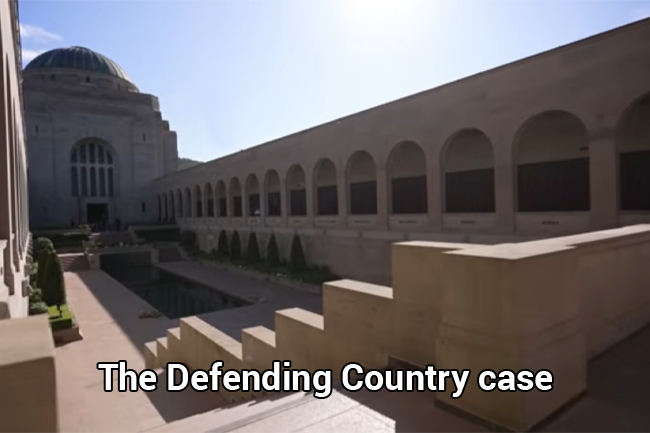
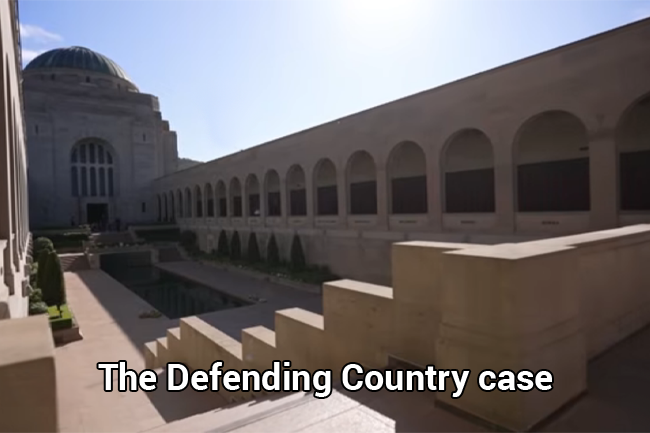
WHEN WE HOSTED the annual Australian War Memorial Summer Vacation Scholars, as its Principal Historian, I would invariably first take scholars to the building’s parapet, overlooking the Pool of Reflection. Tapping the stonework, I’d say that while the building looked solid and unchanging, the ideas and emotions it represented had changed over its history.
The Memorial’s stones have seen massive changes, especially in the past decade, as has the scope of its treatment of Australia’s military history. It began as a memorial to the dead of the Great War and, through several successive changes to its governing Act, gradually expanded its remit — to encompass the Second World War, conflicts before 1914 and after 1945, and recently has embraced a much wider ambit, now concerned with Australians and conflict far beyond the initial purpose.
That scope needs to now acknowledge what we now know to be the truth of Australian military history.
Although the current legislation, the Australian War Memorial Act 1980, defines “Defence Force” to include ‘any naval or military force of the Crown raised in Australia’, in fact for a couple of decades, the Memorial has included civilians in its coverage of Australia’s military history — merchant sailors, the victims of the bombing of Darwin, police peacekeepers, election monitors in the Solomons, former members of the ADF, the civilian dead of the “war on terror” and refugees of recent wars who seek sanctuary in Australia.
At the recent commemoration of the Australian involvement in Afghanistan, the catafalque party fittingly comprised three ADF members and a Federal Police senior constable — and no one objected that the AFP is not a ‘military force of the Crown’.
The Memorial’s scope has and needs to change, to explain Australia’s experience (including ‘the events leading up to, and the aftermath of, ...wars and warlike operations’, as the Act puts it), and to commemorate Australia’s losses in and because of war. Why, then, has frontier conflict not been part of the story the Memorial tells about our military history?
The 1980 Act was conceived and passed at a time when interest in Australian military history was undergoing a revival. Parliamentary debate preceding the Act’s passing made clear that legislators (still then including many who had served in and lived through the Second World War) understood the profound significance of war for Australia; hence the emphasis on causes and aftermaths of war.
But they debated in ignorance of the scale, duration and consequences of what is now understood to have been conflict for the possession of the continent from 1788. As evidence changes, so our understanding must change.
Research on frontier violence was then in its infancy – Henry Reynolds’s pioneering history The Other Side of the Frontier appeared only in 1981. Since then, research has established – without question – that settlement was accompanied in every colony by a long series of armed clashes between British troops or colonial police (ironically, often Native Mounted Police) and, above all, armed settlers, who wrested control of the land from its Indigenous inhabitants.
Among the uncomfortable facts research disclosed were many massacres (but also Aboriginal resistance), that the main combatants had been armed civilians, and that the conflict had resulted in anything between 20,000 and 100,000 deaths, 99 per cent Indigenous. (Precision is impossible: Aboriginal dead were uncounted and unburied.)
Whether these conflicts constituted “war” according to various arbitrary definitions is irrelevant — and anyway, the Memorial’s Act refers to ‘wars and warlike operations’. That they involved relatively few troops, no battle honours or formal declarations of war is also irrelevant. Military historians cite many asymmetric conflicts involving irregular protagonists. But Europeans involved – including colonial officials or military officers, participants such as landowners or observers such as journalists or clergymen – described these conflicts as “war” often enough to reflect the reality.
And for Indigenous peoples, who experienced massacre, defeat, dispossession and dislocation, conflict must have seemed not just war, but war for survival. On these points, the scholarship is virtually unanimous. Since 1980, dozens of books and articles have established this new understanding of the reality of Australia’s colonial frontier, which only those who disagree with its inclusion in the Memorial question.
For 40 years, the Memorial maintained that frontier violence had no place in an institution dedicated to commemorating the dead of overseas wars. However, since 2022, it has changed its position. In 2022, the Memorial’s Council decided to present a “much broader”, “much deeper” depiction of colonial violence. Kim Beazley, Chair of Council from 2022, urged that the Memorial accord to Indigenous combatants “the dignity of resistance” (rather than being regarded as merely the victims of frontier massacres).
In 2026, a staff working party began to plan a frontier conflict gallery to open in 2028. The Memorial accepted that the facts of history are stronger than the wording of the 1980 Act, and that the sterile legalism it espoused is no longer conscionable. The Act, and especially its definition of what constitutes Australian military history, must be amended to end ambiguity and divisive argument.
The Memorial’s progress in facing this issue has been slow — perhaps rightly so, because an important question for a national institution needs mature consideration. It long rejected the inclusion of frontier conflict, arguing that the evidence was tenuous, that conflict, even on a continental or existential scale, was not “war”, or that conflict involving armed civilians was unworthy of regard. Opponents often used tortuous, legalistic arguments, effectively denying or twisting historical fact.
Now, even leaders of a conservative interpretation of Australia’s colonial history, such as Tony Abbott in his Australia: A History, concede that conflict occurred. But the ground of objection has shifted. Opponents now say, “it should be commemorated... just not at the Memorial”.
The Australian War Memorial, they emphasise, is a place to honour those killed in Australia’s overseas wars, to express pride in our Anzac heritage and to extol those who have served Australia nobly or heroically. It is all these things (though the Australian War Memorial Act does not mention “overseas wars” or use words like “honour” and “pride”. These are certainly part of the Memorial’s purpose and significance for many Australians and they should be respected, but they surely do not define it. They are certainly legitimate, but they should not limit the Memorial’s functions.
The Memorial can both honour our Anzac heritage (in historically justifiable ways) and respect the facts of history (even when they may be unpalatable). It can serve all Australians and their desire to understand our diverse military past; as the Memorial’s founder, Charles Bean wrote in the final paragraph of his monumental official history, he had faced ‘the good and the bad’.
Just as Australia’s overseas wars are commemorated in many places – in local and state museums and memorials – so should wars fought on (and for) Australian soil. The Memorial now bravely accepts, as Henry Reynolds said at its recent Imperialism and Resistance conference, that we are talking about conflicts fought in and across Australia, largely by people who lived in this country and for possession of the continent. They were “Australian wars”, why should they not be commemorated in the place where Australians remember their wars?
Professor Peter Stanley is president of Defending Country Memorial Project Inc, which argues that the Australian Wars should be properly recognised and commemorated at the Australian War Memorial.
 This work is licensed under a Creative Commons Attribution-NonCommercial-NoDerivs 3.0 Australia License
Support independent journalism Subscribe to IA.


Related Articles
- Australian War Memorial must tell the whole truth of the Frontier Wars
- The Australian War Memorial's Rocky Horror Show
- War Memorial makes little effort to recognise Frontier Wars