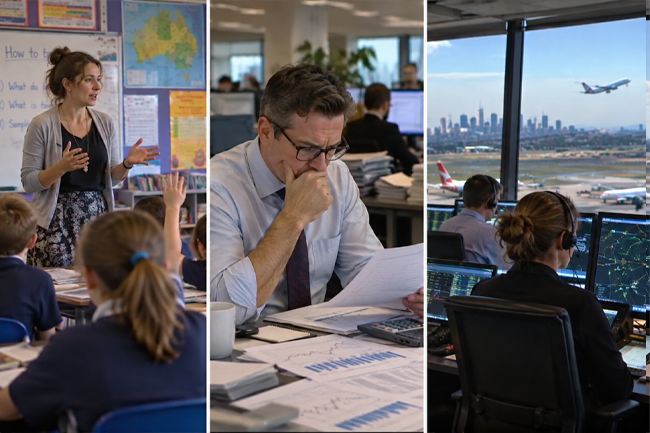
Australia’s labour market is softening, with rising unemployment and sluggish job creation putting full employment at risk, writes Stephen Koukoulas.
THE RECENT labour force data for August revealed an unemployment rate of 4.2%, which, from one perspective, is very good. Rarely, in the past 50 years, has the unemployment rate been so low.
From another perspective, it is a sign that the ongoing sluggishness in the economy and the end of the surge in public sector-inspired job creation is a threat to the maintenance of unemployment at current rates.
Recall that the unemployment rate got as low as 3.4% in October 2022, meaning there has already been a 0.8 percentage point increase in the unemployment rate from that cyclical low.
It is this latter point that is most relevant — the unemployment rate is trending up.

It is increasingly acknowledged that there has been a structural change in the economy over the past decade that has seen the “full employment unemployment rate”, as economists like to call it, ratchet lower to somewhere around 3.5 to 4%.
A decade ago, this was estimated to be around 5%.
In other words, an unemployment rate in today’s ever-changing economy that is much above 4% is a sign of a softer, less-than-fully-employed labour market. It demands that policy settings move to pro-growth to keep the economy fully employed.
The recent run of indifferent labour market data is also being seen in the pace of total job creation, which has slowed to a crawl. Employment actually fell by 5,000 people in August, which means that in the last four months, there has been a net gain in employment of just 24,000 or an average of just 6,000 a month.
This is the weakest four-monthly rise in employment (outside the pandemic) since May 2018 and before then, November 2016. Note that the labour force is increasing by around 25,000 per month.
This is worrying because it shows the economy is struggling to generate the demand for labour that gives a job to everyone who might reasonably want one, and to keep their hours worked from falling and the unemployment rate from trending up.
The current level of interest rates is still restrictive. This remains an anomaly given that annual GDP growth is struggling to get towards 2.25% and the higher productivity objectives are being thwarted by high interest rates.

In addition, there are the various labour demand indicators — job vacancies, advertisements and internet listings of available jobs that are predicting ongoing labour market sogginess.
These measures provide a long-run and reliable guide to future trends in employment and unemployment.
All measures of labour demand are down a hefty 30% or more from the 2022-2023 peak levels. Recall this was the time of severe labour and skills shortages.
Even the recent ABS job vacancies data confirmed a hefty 2.7% fall in August, which is down over 33% from the recent peak. It is difficult to paint a picture where this is consistent with the current unemployment rate.
There is a growing risk that the longer the Reserve Bank of Australia (RBA) keeps interest rates at a restrictive level, the softer the labour market will be. This means there is an extreme risk that the unemployment rate moves to 4.5% or higher. If or more likely, when this occurs, there will be downward pressures on inflation from an already low starting point.
The RBA mandate is ‘achieving sustained full employment, which is the current maximum level of employment that is consistent with low and stable inflation’.
To be fair, it has done quite well in the recent past on these fronts. But it needs to do more.

In the kerfuffle about the one-off monthly inflation data for August, which was driven by non-monetary policy factors including the phase down of electricity subsidies and higher tobacco taxes, any further material upturn in unemployment will demand easier monetary policy from the RBA.
One further issue that will enhance the prospects for lower interest rates is wages, which are inexorably linked to the health of the labour market.
The ABS wage price index is rising at an annual pace of 3.4%, which is well down from the 4.3% peak in 2024. At the same time, the Seek measure of advertised wages shows a more material slowing in annual wage growth, to below 3%.
Full employment as a target of policy is difficult to achieve and then sustain.
The last 50 years of Australian economic history show that. But having stumbled across low unemployment in recent years, the RBA needs to ensure the good news is not unwound because of some unhealthy obsession with inflation being a few ticks above the midpoint of the target or some lame modelling that shows inflation remaining “sticky”.
Interest rate cuts are still on the agenda. The level of unemployment rate will determine how many interest rate cuts are still to come.
Stephen Koukoulas is an IA columnist and one of Australia’s leading economic visionaries, past chief economist of Citibank and Senior economic advisor to the Prime Minister. You can follow him on Twitter/X @TheKouk.
 This work is licensed under a Creative Commons Attribution-NonCommercial-NoDerivs 3.0 Australia License
Support independent journalism Subscribe to IA.


Related Articles
- Employment opportunities? Sorry, no vacancy
- 1.5 million Aussies out of work and the immigration solution
- Joblessness: Another photo op, no follow up disaster
- Incompetence, not the pandemic, has wrecked the economy
- Conservative politicians and media pressuring 'lazy' youth into farm work