As the Trump Administration weaponises state power against critics, America’s self-image as the guardian of a rules-based international order is collapsing in real time, writes Mark Beeson.
FOREIGN AFFAIRS has long been one of the most influential policy journals in the United States.
Prominent figures from both sides of politics, such as Hillary Clinton, Condoleezza Rice, Donald Rumsfeld and Madeleine Albright, as well as influential academics like Joseph Nye, Francis Fukuyama and Samuel Huntington, have all graced its pages and given an insight into the ideas that underpinned American foreign policy.
As you might expect, it’s not terribly radical. On the contrary, it is often regarded as the voice of “the Blob”, or the predominantly liberal policy-making elites who have articulated a rather smug and idealised view of America’s role in international affairs. Equally predictably, American power was invariably seen as a positive and “indispensable” force in international affairs and central to the preservation of the “rules-based international order”.
It is testimony to how much has changed in the U.S. since the second coming of Donald Trump that Foreign Affairs has rapidly turned into an authoritative and insightful source of critique about the state of America’s current foreign and domestic policies.

A new article by three widely respected scholars of authoritarian regimes illustrates not only what a threat to democracy the Trump Administration represents, but just how brave you have to be in contemporary America to point this out.
As Levitsky et al observe:
‘No government, Democratic or Republican, has engaged in anything remotely like the Trump Administration’s politicised attacks on critics and rivals.’
Little wonder that so many media outlets and individuals have chosen to self-censor rather than invite retaliation from an administration with little tolerance for other views:
The Trump Administration’s authoritarian offensive has transformed American political life, perhaps even more than many of its critics realise. Fearing government retribution, individuals and organisations across the United States have changed their behaviour, cooperating with or quietly acquiescing to authoritarian demands that they once would have rejected or spoken out against.
The authors detail the pernicious impact of Trump’s policies, which have systematically undermined or weaponised key elements of the American political system, including the judiciary and even the military. The consequence is that ‘the outcome of the United States’ authoritarian turn depends less on the regime’s strength than on the opposition’s willingness to continue playing a difficult game’.
To judge by the supine nature of Congress and the Supreme Court, it is far from clear that democracy will survive, let alone rein in Trump’s authoritarian proclivities. Indeed, it is an open question whether the mid-term elections will even take place if Trump thinks he may lose and the political situation is deemed too unstable.
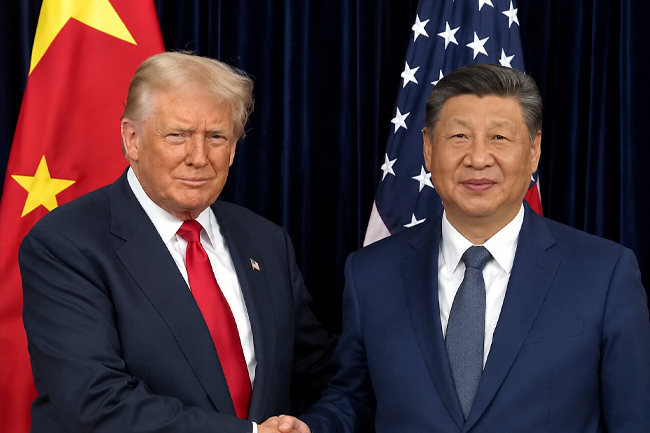
All of which raises important questions that political leaders in this country seem incapable of contemplating, much less responding to. If we have a policy of ‘cooperating where we can and disagreeing where we must’ with undemocratic China, why shouldn’t the same rationale and benchmarks apply to relations with authoritarian America?

One of the other issues that gets a lot of attention in the shrinking public sphere is the rise of populist authoritarians like Hungary’s Viktor Orbán, from whom Trump has drawn important policy lessons. Indeed, Trump wants to use the likes of Orbán to undermine the European Union and ‘cultivate resistance to Europe’s current trajectory’, a position first articulated by Vice President JD Vance when he told an audience of stunned European officials at the Munich Security Conference that “what I worry about is the threat from within… the retreat of Europe from some of its most fundamental values”.
Given what’s happening in the U.S., this is not just breathtakingly hypocritical, but evidence of a systematic campaign to undermine European solidarity and their efforts to resist Russian aggression via a “coalition of the willing”, which the Trump Administration has done little to support.
To be fair, the Albanese Government has given practical support to Ukraine in its existential struggle with Russia. And yet, no matter what Trump Administration officials say or do, our government continues to offer uncritical support and billions of dollars of taxpayers’ money to a country that exercises unilateral aggression and has no compunction about violating international law.
But, as Albert Einstein pointed out, “the world will not be destroyed by those who do evil, but by those who watch them without doing anything”. That observation has never looked more apposite. If American democracy fails, or if the Trump Administration manages to undermine it in Europe, the future for less powerful outposts of liberal democracy like Australia will be lonely at best, existentially fraught at worst.
Canada is much more exposed to American bullying than we are, but there are signs that even the oldest of friends can rethink their priorities when times change. How much more effective might such actions be if they were supported by other “Anglosphere” countries like Britain, New Zealand and us?
Perhaps we could collectively tell our American cousins that something has gone badly wrong with their country and we’re not going to have anything to do with them until they sort it out. Sounds unlikely, but it worked in South Africa. Although given that some of Trump’s key supporters weren’t all that happy about the end of apartheid, they’re unlikely to respond well to similar forms of outside pressure.
It’s not impossible to imagine the other members of the Anglosphere cooperating to send a message to the U.S., but it is impossible to imagine Australia doing so. Indeed, even if the U.S. invade Canada, Deputy PM and Defence Minister Richard Marles will unctuously remind us why this is vital for our “national interest” and The Australian will enthusiastically endorse such sentiments.
Thankfully, there are some independent outlets left with enough literate readers to support them. It’s a useful measure of the political climate in any country.
Mark Beeson is an adjunct professor at the University of Technology Sydney and Griffith University. He was previously Professor of International Politics at the University of Western Australia.
 This work is licensed under a Creative Commons Attribution-NonCommercial-NoDerivs 3.0 Australia License
Support independent journalism Subscribe to IA.


Related Articles
- CARTOONS: Donald Trump is not 'falling asleep' in the White House
- Trump’s decline into open corruption signals the end of America’s authority
- Trump’s Security Strategy: A delusional blueprint for disaster
- Trump scores an own goal for FIFA
- Trump’s America being destroyed by its own racism