The mainstream media’s response to political violence reveals who they believe deserves remembrance and who they’re willing to forget, writes Dr Victoria Fielding.
THE CHARLIE KIRK murder and the media circus that followed have exposed concerning truths about mainstream media in the U.S. and in Australia.
It goes without saying that the media should – as we all should – decry and condemn political violence in no uncertain terms. Indeed, to do so properly is to put a mirror to society and talk about the causes of political violence, even if that raises uncomfortable truths about the victims of the violence itself.
Rather than host and contribute to conversations about right-wing extremism and its inevitable eruption into political violence, mainstream media contribute to normalising increasingly extreme political discourse. In doing so, they enable right-wing architects and beneficiaries of right-wing radicalisation – like Donald Trump – to reframe violence by their own movement as the fault of the Left.
The sad fact is, when right-wing political violence happens to left-wing people, it is treated by the media as insignificant. However, right-wing people – like Kirk – are treated by journalists as far more important, no matter how incendiary and controversial they are in life. This media inequality results from structural media inequality between left-wing ideas and right-wing ideas.

To show how this media inequality in reporting of political violence occurs, consider the fact that within days of Kirk’s murder, he became a household name.
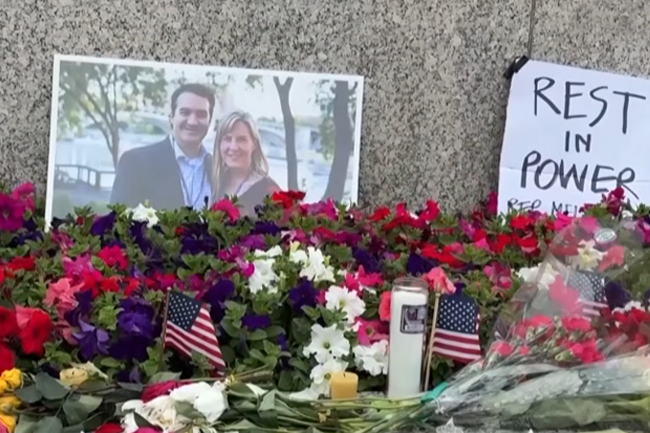
Yet, how many people remember the names of Minnesota state representative Melissa Hortman and her husband Mark Hortman, who were assassinated in their home in July this year? And Minnesota Democrat Senator John Hoffman and his wife, Yvette Hoffman, who survived being shot by the same gunman who dressed as a policeman and invaded their home.
The Hortmans’ killer, Vance Boelter, a White, 57-year-old conservative evangelical Christian, had a hit list of Democrats he was planning to assassinate. This was a textbook case of politically motivated right-wing violence directed at left-wing democratically elected representatives. Yet, this incident was treated by the media as far less significant than the murder of hard-right media celebrity, Charlie Kirk.
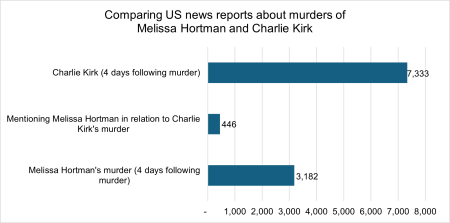
To demonstrate the different emphasis placed on the two cases of right-wing political violence, this graph compares the number of U.S. online news stories in the NewsBank database that mention Charlie Kirk four days after his murder, as compared with stories about Melissa Hortman four days after she was murdered. Kirk received over double the number of mentions.
It’s also noteworthy that since Kirk’s murder, Hortman has been back in the news 446 times, mentioned in relation to Kirk, after disappearing from the news agenda months ago.
The same story can be told of Australian mainstream news, with an analysis of NewsBank online news articles revealing an even starker inequity between the two cases of political violence.
Where Hortman received only 73 mentions in the first four days after her murder, Kirk, in four days, has had a staggering 360 articles mention him, and 33 articles have brought up Hortman again in relation to Kirk.
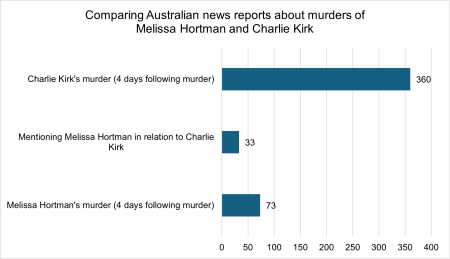
This inequality of coverage, where Hortman is treated as less important than Kirk, is caused by a structural bias towards right-wing ideology in mainstream media.
This structural bias results from left-wing people being treated as automatically less legitimate than right-wing people. This means that even when left-wing people are violently murdered for their political views, they quickly disappear from media narratives, their victimhood de-emphasised and forgotten.
The reverse happens for right-wing people, whose victimhood is not only emphasised by the media, but their reputations are laundered to present them as perfect victims in death and in life.
A disappointing example of this phenomenon, which occurred across all media, is “our ABC’s” stenography piece reporting about Kirk’s wife’s public statements after his death. Nowhere in this piece does the ABC mention Kirk’s White supremacist racism, his profound misogyny, his support of gun violence and how such extremist rhetoric harms vulnerable groups.
Highlighting Kirk’s toxic impact on the public sphere does not, of course, imply that he deserved to be killed. But ignoring it, or as Ezra Klein incredibly and offensively argued in The New York Times – calling it the right way to do politics – serves to legitimise it.

At the same time, the true victims of Kirk’s hard-right hate-filled movement – vulnerable groups like immigrants, LGBTIQ+ people, trans people, women – are deemed not important enough to mention. They are delegitimised by the media’s silence.
To further add to this media inequality, where right-wing victims of political violence like Kirk are celebrated, right-wing perpetrators of political violence – and yes, almost all these perpetrators are right-wing – are quickly forgotten. Their villainy is not blamed on the collective “right-wing” culture they came from, but rather they are characterised as lone wolves, as mentally unwell and as outliers not related to the political climate fermented by the movements they contribute to.
A prime example of this media phenomenon is coverage of the assassination attempt directed at Trump during the 2024 Election. Trump was held up as a legendary hero who had superhumanly dodged a bullet. The shooter, who is incredibly not a household name – 20-year-old Thomas Crooks – is still being described benignly by journalists as “acting alone and not holding strong political views”.
In the rare journalistic efforts to get to know Crooks, he is treated sympathetically as a “nice boy” who “kept to himself”. At the same time, he is described as becoming obsessed with guns and using a range of technological tools to mask his constant internet activity.
This internet activity – which remains a mystery – shows he was not “alone”, but that he was clearly radicalised online. Imagine for a moment that Crooks was not White, male, and American. No stone would be left unturned to find out exactly how he came to nearly assassinate then-presidential candidate Trump.
To make matters worse, not only are left-wing victims of right-wing political violence treated as less worthy of victimhood status, but the mainstream media also emboldens Trump and his political allies to falsely blame right-wing violence on the Left.
As I wrote about after the Trump assassination attempt, Trump’s MAGA movement went unchecked in the media, blaming a nefarious “them” on the assassination attempt, with “them” implied to be the Left, the Democrats, immigrants, whatever boogeyman the MAGA audience wanted to scapegoat.
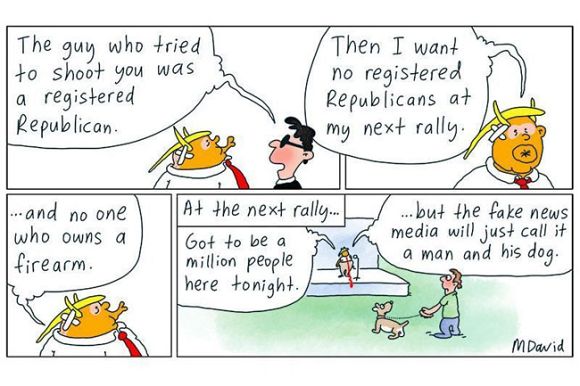
To the great shame of mainstream media, the same thing happened after Kirk was killed. While none of the facts of the shooting were known, Trump immediately blamed the shooting on “the radical Left”. The once proud masthead, The Wall Street Journal, followed Trump’s lead, falsely reporting that Kirk’s shooter’s bullets contained messages exhibiting anti-fascist and pro-trans messages, a story which created scores of defamatory headlines around the globe, including unsurprisingly at The Australian.
As the facts about Kirk’s killer emerge, evidence – documented by non-mainstream media by the way – points to the fact that this White, Mormon, gun-toting man from a Republican family was immersed in far-right internet subcultures, including the groypers. This subculture is aligned with White nationalist, Holocaust-denying Nick Fuentes, who thinks hard-right conservatives like Kirk are too moderate.
Rather than have a conversation about the dangers of right-wing radicalisation, a problem caused by toxic media discourse, mainstream journalists just look away and shrug. They do not want to investigate how toxic and hateful online and mainstream discourse, contributed to by Kirk himself, as well as the political beneficiaries of these cultures, is radicalising people like Kirk’s killer, because to do so would be to turn a mirror on the part they play.
What emerges from this structural inequality in media is that the Left is always hurt politically and culturally by right-wing extremism and violence, and the Right is allowed to continue to build and benefit from right-wing extremism and violence.
When left-wing victims of right-wing political violence are forgotten, when right-wing victims of political violence who contributed to radicalisation are glorified, when left-wing people are falsely blamed for right-wing violence and when right-wing perpetrators of violence are not framed as a problem of right-wing political culture, the result is that the political architects and beneficiaries of right-wing extremism are made more powerful.
Yet, those who suffer the ills of this extremism are silenced and ignored.
Dr Victoria Fielding is an Independent Australia columnist. You can follow her on Threads @drvicfielding or Bluesky @drvicfielding.bsky.social.
 This work is licensed under a Creative Commons Attribution-NonCommercial-NoDerivs 3.0 Australia License
Support independent journalism Subscribe to IA.