The deaths of four Australians during the Optus outage have reignited urgent calls for mandated safeguards in our national telecommunications network. Paul Budde reports.
FOUR AUSTRALIANS have now died after their triple-zero calls failed to connect during the most recent disastrous Optus outage.
Around 600 Triple Zero calls were affected across South Australia, Western Australia and the Northern Territory. In the past, we have warned about the potential loss of life as a result of such outages. To our shock, this time it was no longer theoretical; sadly, four lives were lost. The company has admitted the problem stemmed from a routine network update that cascaded out of control.
This is not just another corporate mishap or I.T. glitch. It is a stark reminder that telecommunications is a critical national infrastructure. When redundancy fails, when roaming doesn’t work and when investments in resilience are deferred, the consequences are not merely financial — they are measured in human lives.
What went wrong at Optus
The pattern is depressingly familiar. A software update error triggered a system-wide disruption.
In an era of AI-driven, self-healing networks, such a failure should never escalate to this scale. Nor should emergency roaming, or “camping” – the mechanism that allows a handset to connect to another network when its own fails – have been unavailable. The fact that both protections failed points to chronic underinvestment in resilience.
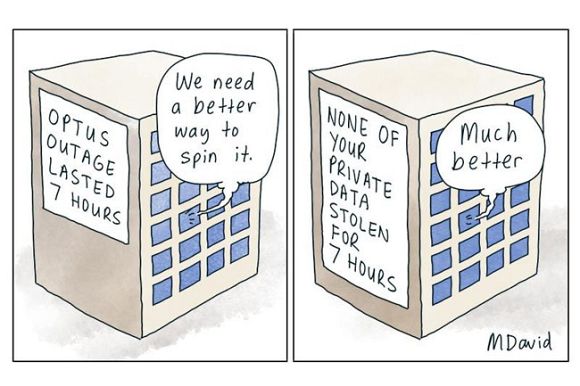
This was not Optus’s first major breakdown. In 2023, it was fined $12 million by the regulator after failing to connect more than 2,000 emergency calls during a 14-hour outage. Despite that penalty, it looks like the industry has continued to treat resilience as a cost centre rather than a core responsibility.
A sector-wide problem
It would be a mistake to see this as an Optus-only issue. Every carrier is vulnerable if redundancy, roaming and mutual assistance remain optional extras. For decades, the industry has resisted national roaming and gateway systems, arguing that network size is a competitive advantage. That position may have made commercial sense, but it is essential national infrastructure and should be politically treated as such.
Australia cannot afford a telecommunications market where competition trumps safety. If carriers will not cooperate voluntarily, then the Government must mandate the safeguards.
Telstra’s blind spot
The Optus disaster throws fresh light on Telstra’s own national ambitions. When CEO Vicki Brady addressed the National Press Club earlier this month, she spoke with urgency about a “small window” to position for the future. Yet her ‘Shared national vision for Australia’s digital future’ made no mention of the NBN, the country’s largest public infrastructure project and the foundation of universal access.
Instead, Brady outlined a corporate roadmap focused on backbone fibre, enterprise products, mobile data infrastructure and data centres. Missing was any recognition of resilience, redundancy, or universal service. In other words, the very issues Optus has just demonstrated so catastrophically.
This is not new. Telstra spent decades resisting fibre-to-the-home, blocking competitors and weakening the NBN. It ignored its own internal warnings in the 1990s that voice revenue would collapse, and it stifled alternative models such as hybrid fibre-coaxial (HFC) and voice over IP (VoIP). Only now is it repackaging that long-delayed vision under the guise of “programmable” networks.

ROI versus public good
Telstra’s Connected Future 30 strategy treats the network as a product — latency, speed, jitter and other attributes sold as features. Technically, this is overdue. But when the entire industry frames connectivity purely in terms of return on investment (ROI), the public good gets lost.
What leadership should look like
Australia’s telcos had the chance to lead a national conversation about resilience and rights. They could have called for a connectivity charter, enshrining broadband as a social and economic right. They could have committed to redundancy as a duty and universal service as a principle. They could have acknowledged that reliable networks are not just commercial assets but a national security infrastructure.
Instead, the industry continues to prioritise market advantage, leaving the Government to clean up after every outage.
Where to from here
The lesson from Optus is clear: without enforced redundancy, transparent testing and mandated roaming, these failures will repeat.
The Bean Review in 2024 already made 18 sensible recommendations — from six-monthly triple zero testing to independent oversight of emergency calling. The question now is not what to do, but whether the political will exists to make carriers comply.
For Optus, the immediate challenge is to rebuild public trust. For Telstra, it is to show that its grand “vision” extends beyond investor returns.
And for the industry as a whole, it is to accept that resilience is not optional. Lives depend on it.
Paul Budde is an IA columnist and managing director of independent telecommunications research and consultancy Paul Budde Consulting. You can follow Paul on Twitter @PaulBudde.
 This work is licensed under a Creative Commons Attribution-NonCommercial-NoDerivs 3.0 Australia License
Support independent journalism Subscribe to IA.


Related Articles
- Optus outage aftermath leaves lessons for telco industry
- CARTOONS: Mark David phoned home
- Why we can't afford Optus outages
- Optus customer site was on cybersecurity blacklist
- Optus hack reveals fragile state of Australian cyber security