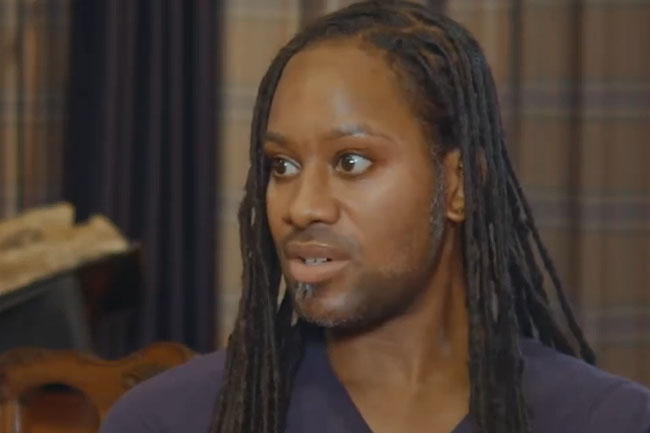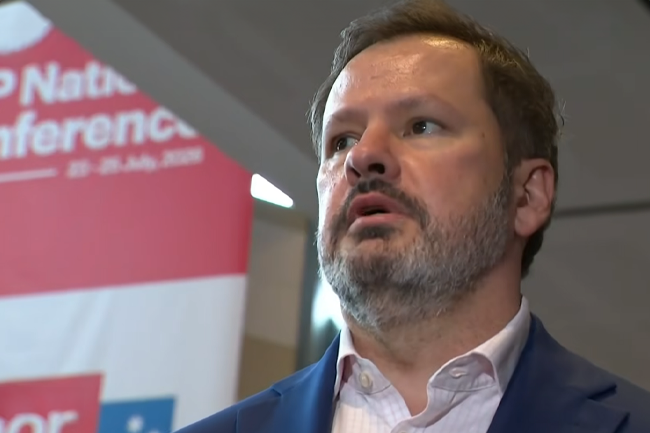
Ed Husic's blunt outburst says more about Labor's political paralysis than party discipline, through the unexpected lens of William Blake's philosophy, writes Carl Gopalkrishnan.
ACTUALLY, that isn’t quite right.
What Labor MP Ed Husic actually said was: “
They can put me in the freezer. I don’t give a shit.”
It's a glorious sentence. Not because politicians should swear more often. Australians have never needed encouragement on that front. It's glorious because, for a brief moment, a politician stopped speaking politics. The media quoted the shit. They analysed the freezer. Then they moved on.
I'd like to do the opposite. Before we unpack his freezer – and with Ed Husic's indulgence – let’s spend a little time unpacking his shit by asking if this brand of Australian polemics is actually hiding something more profound.
“Shit” is an extraordinary word. It's a noun. It's an adjective. It’s Karl Stefanovic trying to sound intelligent. Sometimes it's almost a sentence all by itself. It is definitely an Australian Value. It's multiculturally ambidextrous. It carries frustration, anger, affection, disappointment, exhaustion, loyalty and defiance without bothering to separate them neatly.
When Husic says “I don't give a shit”, Australia instantly understands him. Why? Because people are already living inside a grammar where certainty has broken down. “Shit” is an honest word in an unstable world. It speaks to people who want to keep voting Labor but are quietly wondering whether they can vote for this shit any longer. I am saying this and I am not White. I am not shitting you.
I also suspect that the profundity of Husic’s expressiveness goes back centuries.
A couple of years ago, writing an essay on complexity during times of war and peace in VALA, the journal of the Blake Society in London, I found myself making an observation that has stayed with me. Analysing military doctrines, it dawned on me that institutions have a habit of promoting their nouns and executing their adjectives when trying to outline a vision.
The military becomes fluent in capability, strategy, deterrence and security while quietly losing words that make any sort of common sense to civilians who suffer disproportionately in wars. Today’s political parties do much the same thing, with the recent Labor Party Conference’s homage to The Stepford Wives a leading example of what a world without adjectives looks like. This is why Husic's shit matters.
Psychologists often ask people who have become emotionally stuck on one word to expand their emotional vocabulary before they try to solve a problem. Stay with the feeling. Give it a name. Try a few more names until you find the right one. Don't rush to explain it. Is it anxious? Angry? Resentful? Seething? Hopeful? Curious? Committed? If we can identify the precise emotion, we can better communicate our truth and be understood in return.
I wonder whether Australian politics needs the same advice. Which brings me back to William Blake. Using him to understand a former Australian cabinet minister doesn't strike me as especially strange in this context. Husic's sentence felt like jumping into Dr Who’s TARDIS to remind myself that shit has been around for a long time.
Blake lived through another traumatic era of industrial revolution and global conflict not unlike today. Different machines. Similar anxieties. His 1790 poem The Marriage of Heaven and Hell asks awkward questions that feel remarkably contemporary. How do we recognise good from evil once they refuse to stay where we left them? When our beliefs and values are turned upside down, exactly who are the good guys?
Or, in Blake’s own words:
Now the sneaking serpent walks
In mild humility;
And the just man rages in the wilds
Where lions roam.
Most political arguments assume the answer is obvious. Blake wasn't so sure and nor are most Australians anymore. He distrusted fixed moral positions because he distrusted stillness as an imitation of goodness. What looks respectable might seem safe and protective to some. What looks dangerous might be carrying the energy needed for everyone else's renewal. Heaven and Hell, God and Satan, reason and energy refused to sit politely in their assigned seats in the 1790s, and they are feeling very jumpy in 2026.
Blake’s complexity isn’t about moral relativism so much as a moral responsibility to keep moving. If the world is moving, then goodness cannot simply be inherited. Movement is good because it keeps us discovering, not stagnating. For Blake, stagnation is evil and movement is good.
That's why Husic's sentence stayed with me. We don't think he's simply angry about Gaza or simply talking about internal Labor politics. We think he's desperate to speak a language millions of Australians already understand and just be heard by anybody.

To people whose lives no longer feel stable and safe, perhaps they think a little bit of biff is maybe saying you care enough to get down and messy trying to sort it out. Or, to invert Husic’s own polemics, the broader community want to see a Labor that gives a shit.
They wake up daily to a world that seems to rewrite itself before breakfast. Labor still speaks another language entirely and it’s not because Labor lacks compassion. As Husic himself explained through the media, it's because it is trapped inside its own TARDIS of trauma.
The Rudd-Gillard-Rudd years taught the party that instability was electoral poison. It built rules, habits and instincts designed to stop movement. The lesson made sense at the time. History, however, has a habit of changing the meaning of our virtues. Something that looked like responsibility now looks like a freezer. A freezer preserves. It stops movement. Nothing changes and, perhaps, that's what Ed Husic was trying to tell us.
I don't think his “shit” was simply a swear word. I think it was the last surviving adjective in a political culture that has become increasingly fluent in an accent of nouns. The tragedy is that Labor just hears a swear word. The country hears the feeling and William Blake, I suspect, would have heard something move. He might even have smiled because he spent his life reminding us that ‘without contraries there is no progression’.
Perhaps the Labor Party doesn't need to escape Hell. Perhaps it needs to stop being afraid of it.
Carl Gopalkrishnan is an Australian artist and policy practitioner with long-standing experience in multicultural policy, social cohesion and community engagement.
 This work is licensed under a Creative Commons Attribution-NonCommercial-NoDerivs 3.0 Australia License
Support independent journalism Subscribe to IA.