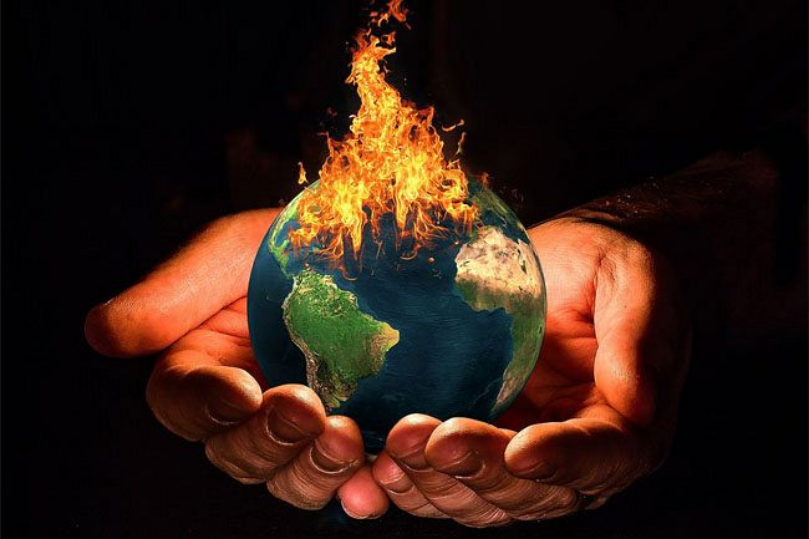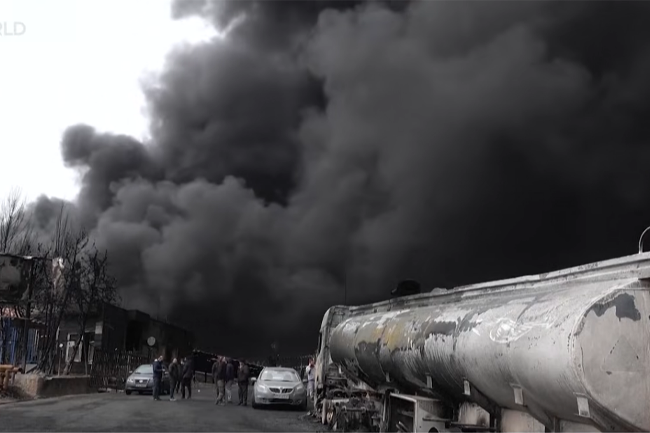
Without urgent systemic change, escalating climate breakdown risks pushing humanity beyond the point of no return, writes Dr Klaus Moegling.
A lesson from the “anticipated danger”
The construction of negative scenarios – in the sense of an anticipated possibility of dystopian development – can certainly serve a constructive purpose.
In his book, The Imperative of Responsibility, the philosopher Hans Jonas developed what he called a “heuristic of fear”, meaning that potential undesirable developments should be recognised in all their severity and menace and described in drastic terms commensurate with their presumed magnitude.
According to Jonas, this enables a society to look the potential risks squarely in the eye and thereby resolve to acknowledge its own responsibility for the planet and the fate of future generations:
‘What can serve as a compass? The anticipated danger itself! In its flash of lightning from the future, in the foreshadowing of its planetary scope and its human depth, the ethical principles from which the new duties of new power can be derived become discernible for the first time.’
The inadequacy of the Paris Climate Agreements
From the spectrum of multiple crises – which are certainly interconnected – this article will focus on the disrupted relationship between humanity and nature and heuristically develop it into a negative scenario.
David Spratt and Ian Dunlop predict that even if the 2015 Paris Climate Agreements were fully implemented, stable climate conditions would still not be expected. In particular, climatic feedback effects would render the Earth largely uninhabitable for human civilisation by the end of the century. Even if the Paris climate targets were met, a temperature rise of five degrees Celsius would be expected by the year 2100, with devastating consequences for life on Earth.
It must also be taken into account that not all countries have accepted the Paris Agreements or have since withdrawn from them, as the U.S. did under Trump.
Fires, storms, overheating and floods
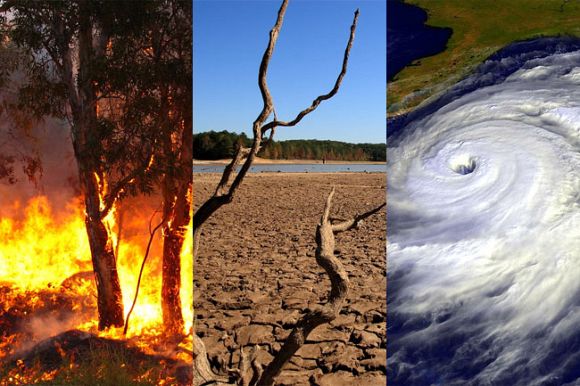
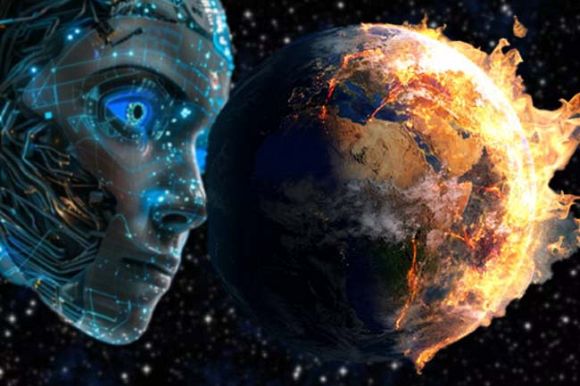
A worst-case scenario for such an increasingly hot biosphere must anticipate a rise in wildfires. Vast areas of the Earth will begin to burn. Firewalls driven by massive gusts of wind will engulf everything in their path: trees and bushes, houses, animals and people. Such firestorms are beyond human control and cannot be fought.
The result will be the desolation of entire regions, leading to humanitarian, ecological and financial problems on a global scale. The fires of 2025 and 2026 are already providing a preliminary glimpse of what lies ahead for humanity.
Future average temperatures of 50–60 degrees are projected for the Persian Gulf, meaning that for the average person, human life there will no longer be possible — or will only be possible in artificially cooled spaces. Even in the countries of the Global North, mass mortality is beginning due to overheated living environments.
It is undisputed that sea levels will rise due to the melting of the poles, the warming of seawater and the accompanying melting of Arctic ice.
However, a potential average rise of 2.5 meters by 2100 does not represent the extreme level of sea level rise. During storm surges in particular, the rise in sea level can be several times this value and lead to flooding deep into continental areas. This will also affect the Global North.
Islands, coastal regions, and low-lying inland areas will be flooded, destroying living conditions there and, in turn, triggering migration. Not only will island groups disappear, but countries such as Bangladesh and India will also be flooded over vast areas, triggering mass exoduses. In this context, rising sea levels, combined with the monsoon rains – which are already becoming increasingly devastating in this region – pose a particularly grave threat.

The thawing of Arctic and Siberian permafrost will lead to a massive increase in global warming due to the associated release of carbon dioxide and methane, abruptly intensifying all related processes.
In other parts of the world, climate shifts will cause air masses with extremely different temperatures to collide, resulting in correspondingly devastating storms in the form of tornadoes and hurricanes. Houses, cars, animals and people will be whirled through the air and smashed to pieces. Skyscrapers will collapse and the infrastructure – including electricity, water and gas lines, as well as the internet – will be irreparably destroyed.
Radioactivity is released from destroyed nuclear power plants, circulating in the atmosphere around the Earth, falling as rain, and leading to increased cancer rates and birth defects in humans and animals.
Catastrophic impact on social and political development on a global scale
Massive migration in the form of mass exoduses or mass migrations will be triggered by climate change. Migration to date should be viewed, at best, as the tip of the iceberg in this context, as billions of people will set out as refugees if global warming continues unchecked.
It is not difficult to imagine the conflicts – including military confrontations – that will arise from these upheavals in the struggle for regions that are still ecologically intact.
Global warming will lead to massive crop failures and associated famines. The global agricultural food system will collapse. The struggle for food and survival will lead to massive price increases, looting and military conflicts. The call for a heavy hand, for authoritarian leaders and for police-state methods will grow louder even in democracies.
Far-right governments will, in the interest of their base, attempt to deny climate change and continue to rely on the exploitation of fossil fuels.
The struggle for drinking water will intensify — on the one hand, due to increasing periods of drought and, on the other hand, due to the growing trend of profit-driven privatisation of water sources. Privatised water sources will be guarded by militarily organised security forces against raids by groups of thirsty people.
Furthermore, if a UN in need of strengthening fails to dissuade unscrupulous governments from the generationally selfish destruction of the rainforest for the purposes of cattle ranching, soybean cultivation, the search for mineral resources, or land speculation, then this, too, will not only destroy the Earth’s lungs but also bring about a drastic climate shift.
Wars raging across the globe and emissions from explosions and fires exacerbate climate change while simultaneously preventing the affected regions from taking effective measures against this climatic dystopia. The military in active service is becoming the largest institutional global destroyer of the climate.
When will the “point of no return” be reached?
The question is when the global situation will reach a point beyond which there will be no return to ecological balance for many generations to come.
The progression of overpopulation, coupled with unchecked economic growth and rampant consumerism, leads to increased ecological exploitation of the Earth system under the conditions of an increasingly overcrowded planet.
However, it is to be expected that population pressure is not primarily responsible for environmental destruction, but rather, in particular, the irresponsible consumption of resources by the wealthier segment of the world’s population (Roettig, 2021).
The “point of no return” is likely to be crossed soon. Once the biosphere’s planetary responses gain an uncontrollable momentum of their own that turns against human civilisation and the conditions for all life on Earth, it will be too late — both for prevention and for mitigation.
The Doomsday Clock makes this clear. According to the Doomsday Clock – established and maintained in 1947 by Albert Einstein, among others – we are already 85 seconds away from the destruction of the planet’s foundations as of February 2026. In 1991, there were still 17 minutes left until destruction.
Conclusion
The outline presented here of a dystopian scenario for planetary development – based on a negative ecological scenario – should have made it very clear: When the right decisions are not made and drastic systemic changes are not implemented in the coming years, the destruction of planetary habitats can no longer be stopped.
If, on top of a biosphere in decline, additional stressors are added – such as potentially runaway generative AI, authoritarian and aggressively acting nation-states at war with one another, and the threat of a nuclear inferno – this will likely spell the end of humanity. No more and no less.
The ecological dystopia outlined here does not have to come to pass. Everything depends on how responsibly and competently the current generation – which is currently active in the global centres of power – will act, and what corrective influence civil society resistance can exert in this regard.
Dr Klaus Moegling is a political scientist with a postdoctoral qualification and a university professor. He is the author of the book, Realignment: A peaceful and sustainably developed world is (still) possible), published open access.
 This work is licensed under a Creative Commons Attribution-NonCommercial-NoDerivs 3.0 Australia License
Support independent journalism Subscribe to IA.


Related Articles
- The climate crisis behind Australia's migration panic
- The carbon capture con keeping fossil fuels alive
- Arming for extinction: The climate cost of militarism
- Australia’s environmental crisis ignored as political parties drift Right
- Climate emergency ignored as banks double down on coal and gas