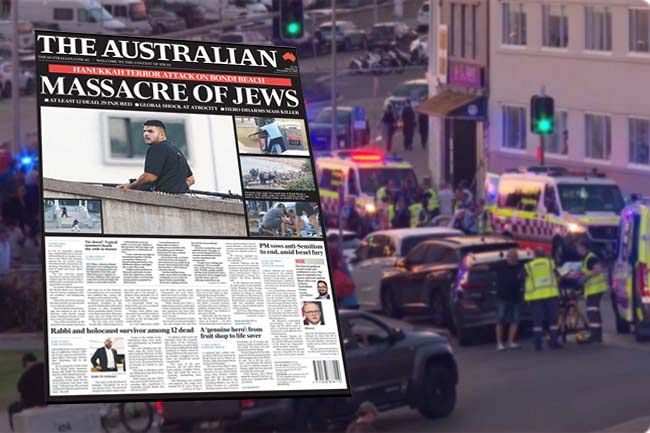
The Bondi attack has been cynically repurposed to advance an immigration narrative that collapses under even basic factual scrutiny, writes Dr Abul Rizvi.
IN AN ARTICLE in The Australian titled Are We Being Careful Enough About Who We’re Allowing In? journalist Claire Lehmann tries to link comments I made about changes in student visa and migration policy in 2001 to the appalling actions of the Bondi terrorists.
Note the older of the two terrorists is reported to have arrived in Australia on a student visa in 1998 – three years before the student visa policy changes of 2001 – and became a permanent resident around 2000 on the basis of a marriage to an Australian permanent resident or citizen of Italian heritage. The younger of the two terrorists was born in Australia and is an Australian citizen.
While most journalists talk to me before they quote me in an article, Lehmann did not — always a sign of a hit piece. She used a podcast on wider immigration policy issues that I did with Joe Walker.
She correctly quotes me about the 2001 changes, which more explicitly linked student visa policy to skilled migration policy, being driven mainly by considerations of demographic ageing, skill shortages and funding of public universities. During the podcast, I was asked if the policy was put to a vote today, would it be supported? I said, “No”.

That was because, at the time, net migration was running at over 500,000, driven largely by a surge in student numbers following the Coalition's acceleration of student visas in 2022 and the Labour Government's slow response to tighten student visa policy.
But student visa policy has nothing to do with security and character checking (whether we are letting in the “wrong people”). That operates largely irrespective of the visa applied for through the character provisions of the Migration Act (s501). Indeed, in 1998, I was involved in a major strengthening of the character provisions, which is the underlying architecture for who is accepted and who is refused a visa in terms of character (including security). Student visa policy also has nothing to do with whether a person is at risk of becoming radicalised or not. The drivers of that are quite different.
While there has been much fine-tuning, the basic link between student visa policy and skilled migration policy has been maintained by every government and every immigration minister since 2001, when the policy was introduced by Philip Ruddock. No government and no immigration minister, including Scott Morrison and Peter Dutton when they were immigration minister, has ever proposed removing the link. The link is also supported by every state/territory government, who frequently nominate successful overseas students to fill key skill shortages in their jurisdiction.
Moreover, just about every major developed economy, including China, Japan and South Korea, has copied Australia’s approach of establishing that link (although Donald Trump keeps fluctuating on that).
If Lehmann thinks the link is wrong, she should be more explicit in saying so rather than conflating that with issues of radicalisation, terrorism and character/security checking. The victims of the Bondi massacre deserve better than to be misused by Lehmann for her own political ideology.
Dr Abul Rizvi an Independent Australia columnist and a former Deputy Secretary of the Department of Immigration. You can follow Abul on Twitter @RizviAbul.
 This work is licensed under a Creative Commons Attribution-NonCommercial-NoDerivs 3.0 Australia License
Support independent journalism Subscribe to IA.