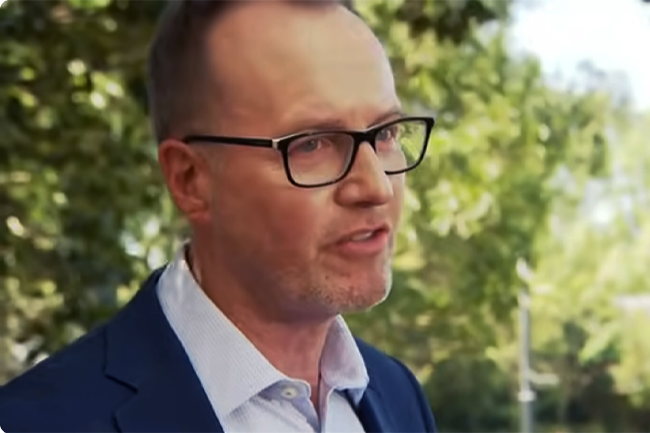
Australia’s bid for a UN Security Council seat exposes foreign policy contradictions that stand in sharp contrast to Finland’s diplomatic approach, writes Dr Mark Beeson.
AUSTRALIA HAS JUST launched a campaign designed to win a non-permanent seat on the United Nations’ Security Council.
The last time Australia held this position in 2013-14, it spent $25 million trying to gain support from the two-thirds of the General Assembly members required to get elected. This time, Australia may be competing with Finland and money may not make much difference to its chances.
As part of the current effort, Prime Minister Anthony Albanese made a keynote speech on climate change and joined other nations in signing a statement calling for greater control over the development of artificial intelligence (AI). Given Australia’s record in both areas and its general failure to exhibit the sort of creative middle power diplomacy championed by Canada and Finland, it doesn’t deserve to be elected.
Australia’s environmental record is especially disappointing and full of the sorts of contradictions and inconsistencies that characterise domestic and foreign policy more generally. Not only is Australia still a major exporter of gas and coal, but domestic politics – especially in Western Australia – is overwhelmingly driven by powerful fossil fuel companies, effectively locking in destructive policies for the foreseeable future.
True, there has been a remarkable uptake in solar power – something Australia isn’t short of – but this has been driven primarily by individual choices, rather than the Government making “difficult” decisions about whether to keep exploiting the country’s equally abundant fossil fuels.
This would be hypocritical and disingenuous under any circumstances, but it is especially galling for members of what successive Australian governments rather patronisingly refer to as “our Pacific family”, or the microstates that are especially exposed to rising sea levels. If Australian policymakers really wanted to do something useful, they could reduce fossil fuel exploitation.
Likewise, if the Australian Government really is concerned about the impact of AI and social media, it could stop doing everything it can to entice tech giants to build data centres in Australia. Not only will this facilitate the even more rapid development of a technology that even its creators regard as dangerous, but it will add to global warming and undermine the quality of life of whoever is unfortunate enough to find themselves living next to them.
And these aren’t even the most consequential obstacles to Australia playing a useful role on the global stage. On the contrary, given that all middle powers can do is draw attention to problems that only their great or veto-holding counterparts on the Security Council can address effectively, independence of thought and action is vital. Having sensible proposals that might benefit humanity as a whole would also seem to be a prerequisite.
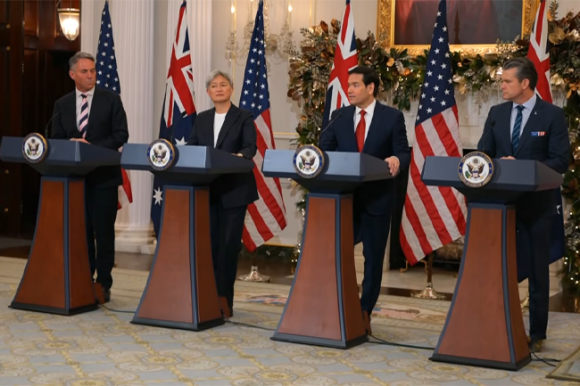
Australia has none of these. Not only are Australia’s political leaders generally obsessed with the “national interest”, rather than the international variety, but they take this to mean an uncritical and overly obliging alignment with the United States. Australia’s alliance with America means there is no capacity or willingness to do anything other than pursue uncritical strategic business as usual.
By contrast, it is to Finland’s (and Canada’s) credit that it is ‘actively taking on the world as it is, not passively waiting for a world we wish to be’. True, this also involves getting more closely aligned with the U.S., conducting exercises on Finnish soil, but that and joining NATO don’t look unreasonable given Finland’s long border with Russia. Indeed, Finland has actually been invaded by its increasingly unpredictable neighbour, whereas Australia’s geography makes it one of the safest places on the planet.
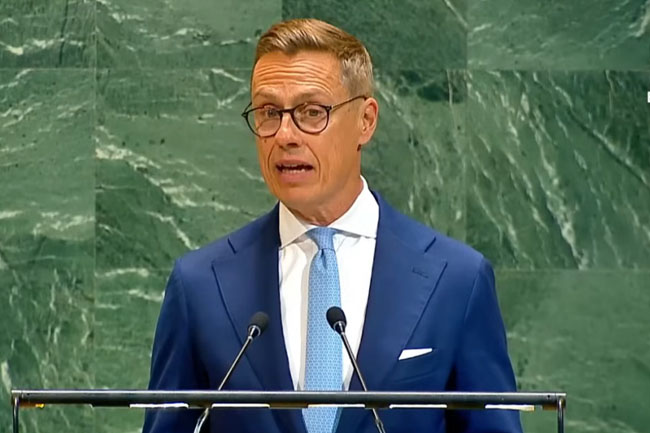
Perhaps the most encouraging aspect of Finnish diplomacy is that it manages to be simultaneously progressive and plausible. Finland’s President, Alexander Stubb, has even written a book on the subject. Interestingly and importantly, he makes a distinction between multipolarity and multilateralism, with the latter applying to every country regardless of size, while multipolarity is an ‘oligopoly of power’.
Stubb also has useful ideas about how to revitalise the United Nations, which even its most ardent admirers would have to concede struggles to have an impact in the Trump era. One of the most critically important and difficult reforms needed here, of course, is reform of the anachronistic and unrepresentative Security Council itself.
Given that none of the permanent members will want to give up their privileged positions, this is no easy task, but recognising the nature of the problem and the need for greater inclusivity is a modest step in the right direction. Indeed, it is an essential prerequisite for the creation of greater trust and the calling out of those that might oppose it.
As Stubb points out, regional integration and the rejuvenation of international institutions ought to be essential parts of any agenda to address an ever-lengthening list of global problems. Australia still struggles to come to terms with the region of which it is a part and looks ill-prepared to offer the sort of inspiring and transformative ideas the world desperately needs.
As a member of the European Union and NATO, both of which are thinking seriously about their respective roles and how to deal with aggressive and unpredictable great powers, Finland looks well placed to be part of a much-needed reconfiguration of an international order that looks increasingly chaotic and past its use by date.
Dr Mark Beeson is an adjunct professor at the University of Technology Sydney and Griffith University. He was previously Professor of International Politics at the University of Western Australia.
 This work is licensed under a Creative Commons Attribution-NonCommercial-NoDerivs 3.0 Australia License
Support independent journalism Subscribe to IA.