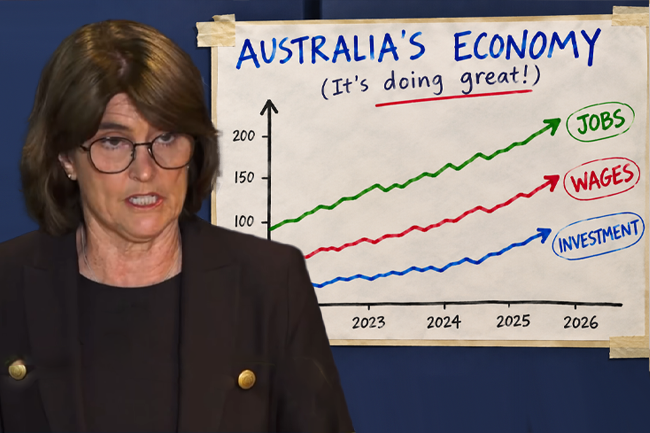
France-based Australian journalist and Independent Australia columnist Alan Austin has contributed to the Albanese Government’s Economic Reform Roundtable. This is the text, slightly edited and with extra graphs.
AS MOST PUBLISHED outcomes prove, Australia has experienced several years of surging productivity. This has been concealed, however, by inaccurate data and false economic narratives from several mainstream newsrooms.
How we know productivity has accelerated: wage rises
Business leaders, politicians and economists have told us for decades that businesses can increase salaries only if productivity rises. They are correct.
Australia has enjoyed a remarkable surge in real wages – rising higher than inflation – for the last 18 months. Wages paid in March 2025 were up 5.8% from $99 billion the year before, to a series high $104.8 billion. See chart below:

Consumer spending boom
Retail spending in May was $37.29 billion, the highest for any month on record. The total for the first quarter this year was $111.48 billion, an all-time quarterly high.
This is not just normal retail sales growth with population. The last three years have also seen fresh all-time highs for retail spending relative to gross domestic product (GDP). See chart below.

More spending on luxuries
Spending on dining out, cosmetics, jewellery, overseas flights and other luxuries have surged to all-time records — in dollars, as a percentage of all retail sales and relative to GDP.
Imports of perfumes, watches, clocks, artworks, antiques, gold, silver and private light aircraft are at all-time highs in dollars and as a percentage of all imports.
Record profits
The authorities also insist that productivity must rise for company profits to increase. They are correct again.
According to the Australian Bureau of Statistics (ABS), company gross operating profits have surged since 2017. Total profits in 2022-23 were $566.1 billion, well over double the $249.7 billion in 2016. In 2024-25, profits in all sectors except mining reached a fresh record $304.8 billion. See chart below.

Budget surpluses and debt reduction
Australia is one of only six OECD members to have generated budget surpluses in 2023 and 2024, along with Ireland, Portugal, Denmark, Norway and Switzerland.
Between the 2013 and 2022 elections, net debt deepened by $379.7 billion. Since the 2022 election, $17.4 billion of Australia’s net debt has been repaid.
Conclusion: Productivity is excellent but no longer measured accurately
All the above data suggests that if Australia ever had an actual productivity problem, it was pre-COVID. Since 2022, however, all areas of the economy have surged.
Never before since records have been kept has inflation been below 3% and the jobless rate below 4.5% for ten months straight. Australia is now the world’s only economy with its jobless rate below 5% and median wealth per person above $400,000. It is the only economy with triple-A credit ratings, inflation below 2.5% and continual GDP growth for the last three years.
Such wage growth, surges in consumer spending, record profits, budget surpluses and debt reduction would be impossible if productivity has fallen off a cliff, as some have falsely claimed — notably in the Murdoch and Nine newsrooms. In fact, Australians are more productive than ever, but the productivity formula no longer measures this.

The problematic productivity fraction
Since 1978, the ABS has calculated Australia’s productivity index numbers by dividing GDP by hours worked in the economy.
For decades now, GDP has been challenged as failing to measure total output adequately. Similarly, the number of hours worked per year is considered an imprecise estimate, especially since COVID necessitated more work being done remotely. Additionally, the National Disability Insurance Scheme (NDIS) has made productive hours caring for individuals with disabilities in the home higher than in the past, making them harder to measure.
Inevitably, a dodgy numerator divided by a dubious denominator will yield an unreliable dividend. This is why the official ABS number for productivity no longer works.
This is where it gets interesting: Comparing economies
Australia’s productivity index numbers show a flat trajectory from 2015 to 2020, then spikes during COVID, then a decline since 2022. Parallel patterns are observed in Italy, Canada, France and the United Kingdom. See chart below.

Similar trajectories are also evident in New Zealand, Luxembourg, Germany and Greece.
Only a minority of OECD members still show productivity steadily improving over time, despite worldwide advances in technology, AI and business innovation.
This confirms that the weakness of the old productivity formula is not confined to Australia.
Confirmation from consumer spending worldwide
In many developed economies, the official productivity index numbers correlate closely with consumer spending. This should not surprise, as surges in productivity should enable increased profits to flow through to wages and household spending power. And vice versa. Denmark exemplifies this well. See chart below.

The same parallel tracking of productivity with consumer spending is evident in the Netherlands, Poland, Sweden, Austria, the Czech Republic, Finland, Germany, New Zealand, Slovakia and Slovenia.
Here is the Netherlands:

Australia, in contrast, has a bizarre non-correlation since the COVID-19 recession in 2020. See chart below.

The blue line is a reliable indicator that, historically in Australia and most comparable economies, closely tracks the grey productivity index numbers. The observed divergence since 2020 further undermines the validity of official productivity numbers.
This opposite tracking of productivity against consumer spending is evident also in Canada, Luxembourg, Ireland and elsewhere.
Help is on the way
Fortunately, Treasurer Jim Chalmers has requested that the ABS measures non-GDP output in the series Measuring What Matters.
The ABS has also stated that it will soon publish estimates of hours worked in the non-market sector, along with the market sector.
A revised productivity formula is essential. It will help fix both econometric inaccuracies and media mendacity.

Alan Austin is an Independent Australia columnist and freelance journalist. You can follow him on Twitter @alanaustin001.
 This work is licensed under a Creative Commons Attribution-NonCommercial-NoDerivs 3.0 Australia License
Support independent journalism Subscribe to IA.


Related Articles
- Royal commission now: The case against Albanese’s environmental record
- Labor shifts more income from the wealthiest to the poorest
- Australia's failure to sanction Israel a diplomatic and moral abdication
- Republic should be top priority for Albanese re-election
- Economic growth slows, incomes surge and Coalition hypocrisy hits new high