The Australian War Memorial needs to tell the full story of the Frontier Wars, including massacres and dispossession, not just organised Indigenous resistance, writes Dr David Stephens.
ANYONE FOLLOWING the Australian War Memorial’s delicate dance around the Australian (Frontier) Wars needs to consider the evidence and draw conclusions.
The Memorial itself tends not to explain its moves or even draw attention to them. Instead, it has a history of hedging its bets.
Recognising resistance
Memorial director Matt Anderson, interviewed in April, confirmed that the Memorial had a place for the Australian Wars:
“Because, you know, it was warfare, it was guerrilla warfare and they should be given the dignity of people understanding that they formed war councils, that they actually fought a war of manoeuvre. They were outgunned, they were outmanned, but they still resisted, and they resisted in war-like ways, and that’s the story that will be told in the galleries.”
There was also the Memorial’s submission (dated 29 May) to the Parliamentary Committee Inquiry into racism against First Nations Australians.
The submission said the Memorial would focus on ‘warlike actions’ and ‘organised resistance’, not Indigenous ‘victimhood’:
‘As appropriate to the Australian War Memorial, we will tell the stories of war fighters and of organised resistance built from centuries of a culture of defending country.’
Indigenous service figleaf
Long before it began to focus on resistance, the Memorial had tried to circumscribe its treatment of frontier conflict.
In 2019, journalist Paul Daley complained about how the Memorial:
‘...bangs on endlessly about the “Black Diggers” who served the imperial forces in uniform. That is a fig leaf for its continued refusal to honour the Indigenous fighters who resisted British invasion.’
In 2021, director Anderson told documentary maker Rachel Perkins:
“What we seek to do is to tell the story of frontier violence in the way in which it affected the men and the women who joined the Australian Imperial Forces and went away.”
Private William Punch, an alleged massacre survivor, later a soldier in the 1st AIF, became the standard-bearer. His story “not only speaks”, said the director in Senate Estimates in May 2023, “to the fact of frontier violence but also speaks to the fact that there are those subjected to it who then went on to serve in the Australian Defence Force”.
Sorry business or everybody’s business?
Some people, including at the Memorial, have described deaths in the Australian Wars as “blackfellers’ sorry business”, about which blackfellers should decide what is said when and how. Of course, the number of Indigenous deaths in the Australian Wars – somewhere between 20,000 and 100,000 men, women and children, but no one knows exactly how many – compels First Nations attention and sorrow today.
But those deaths are whitefellers’ as well as blackfellers’ business.
Prime Minister Paul Keating made this clear at Redfern Park in December 1992:
“We [non-Indigenous Australians] took the traditional lands and smashed the traditional way of life. We brought the diseases. The alcohol. We committed the murders. We took the children from their mothers. We practised discrimination and exclusion.”
The Australian Wars are something for all Australians, Black and White, to deal with.
A lack of artefacts to tell the story?
Other people have said we lack artefacts to tell the stories of First Nations resistance. There are no holed tin hats or battered Bushmasters, no Chinook helicopters or Lancaster bombers, no sets of medals, no diaries written in trenches, the sort of stuff the War Memorial has been full of since it opened in 1941.
Historians like Stephen Gapps and Ray Kerkhove have nailed the “no artefacts” furphy. State museums, the British Museum, the National Museum of Australia, and the Australian Museum have items they could loan to the Memorial. Ten years ago, the Memorial’s own For Country, For Nation exhibition included important artefacts.
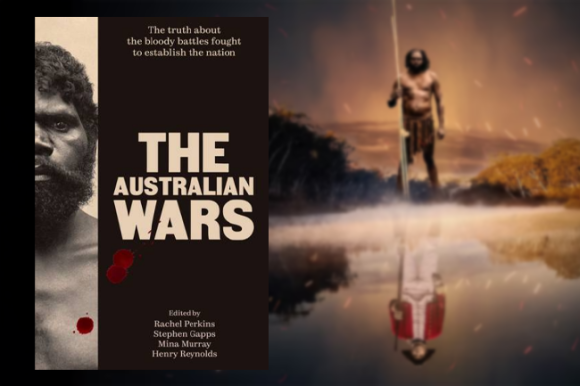
There have been dozens of books written about the Australian Wars and there is a trove of oral history, as the documentary and later book The Australian Wars showed.

The “lost” policy
Between August and November 2022, the Memorial Council struggled to agree on a compromise that satisfied both its departing chair, Dr Brendan Nelson, who had told journalists that the Council had agreed to the Memorial providing “a much broader, much deeper depiction” of frontier violence, and Council members who wanted rather less than that.
The Council’s “determination” included this sentence:
‘Wherever possible it [the Memorial’s coverage] would relate to and inform, subsequent Indigenous military service to Australia, providing a context for that service.’
The Memorial did not trumpet the 2022 determination and by 2025 it claimed to have lost it altogether. It took an FOI claim from Defending Country for the Memorial to admit that the 2022 determination ‘outlines current policy for the recognition and commemoration of frontier violence’.
The limits of “resistance”
Look again at those quotes above from director Anderson’s interview and the Memorial’s submission to the Parliamentary Inquiry. The Memorial seems to be looking for battles – resistance – which resemble the overseas battles in which it has specialised till now.
It seems to want to focus on blackfellers fighting like whitefellers, with planning and strategy and tactics and weaponry, reinforced by a fighting tradition, “a culture of defending country”, which sounds rather like the whitefellers’ Anzac Legend.
Battles at, say, One Tree Hill, 1843, Eumeralla, 1834-44 or Battle Mountain, 1884, deserve recognition, it seems, to the extent that they look like Hamel, 1918, Milne Bay, 1942, Long Tan, 1966, or Khaz Oruzgan, 2008.
Yet, the Memorial has never tried to tell the story of 60,000 uniformed dead in the Great War, or 103,000 in all Australia’s overseas wars, by focusing on a few battles. How can it cover the Australian Wars without mentioning estimates of total deaths, and that many of those dead were not warriors but women, children and old men, and that many of those non-warriors died from poisoned flour and water or being pushed over cliffs, with their bones burned or buried or scattered?
Distinguishing battles from massacres is unacceptable, just as it would be unacceptable to tell the story of Gaza by concentrating only on street battles between Hamas and the Israel Defence Forces but ignoring the tens of thousands of dead Gazan civilians or tell the story of World War II without mentioning the Holocaust. (The Memorial does deal with the Holocaust.)
This is not about “victimhood”. It is about truth-telling.

Conclusion
The August 2022 determination also includes another important caveat:
‘The gallery will inform visitors of the significant institutions whose charter it is to tell the full story of Frontier Violence.’
Of course, the Australian Wars need to be covered by other cultural institutions like the National Museum, the National Gallery and the National Archives, as well as by the Memorial, but the Memorial’s battles-focused coverage needs to be properly set in its context.
Historian Henry Reynolds put that context best:
‘...not only was it war but it was our most important war. One, it was fought in Australia, two, it was fought about Australia and, three, it determined the ownership and the control, the sovereignty of a whole continent.’
Words like those need to appear on the wall of the Memorial’s Australian (Frontier) Wars gallery. Battles alone, without context, just will not do.
Dr David Stephens is editor of the Honest History website and a member of the Defending Country Memorial Project, campaigning for the Australian War Memorial to properly recognise and commemorate the Australian Frontier Wars.
 This work is licensed under a Creative Commons Attribution-NonCommercial-NoDerivs 3.0 Australia License
Support independent journalism Subscribe to IA.


Related Articles
- The Australian War Memorial's Rocky Horror Show
- War Memorial makes little effort to recognise Frontier Wars