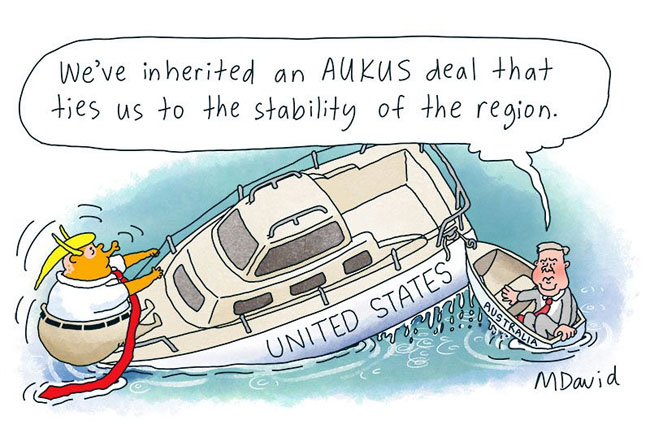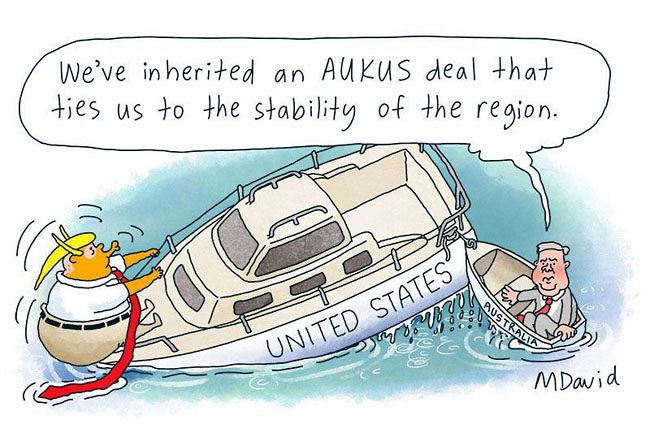
Australia’s dependence on the U.S. risks undermining its sovereignty and security as the global order rapidly shifts, writes Alana Baker.
AUSTRALIA'S CURRENT trajectory should concern every citizen, yet the greatest danger may be complacency — the failure to recognise how the convergence of political, economic and strategic pressures could evolve into an existential crisis.
For much of its modern history, Australia has relied on its strategic alliances with the United Kingdom and, later, the United States as the foundation of its national security. For most of this period, that approach seemed to benefit it.
However, as the international order shifts from a predominantly unipolar to an increasingly multipolar world, a convergence of domestic political, economic and institutional pressures raises important questions about Australia's ability to adapt and remain resilient in a more complex strategic environment, where the historical advantages associated with Western geopolitical dominance continue to erode.
Most troubling is the way these domestic challenges have converged to constrain meaningful public discussion and understanding of the issues confronting Australia. Despite 60 per cent of Australians expressing “no confidence at all” in Donald Trump to do the right thing in world affairs, with the 2026 Lowy Institute Poll recording the lowest level of confidence in any U.S. president in the poll's history, Australia has remained closely aligned with the United States. This is despite what many analysts regard as a series of political, strategic and policy miscalculations that have contributed to the erosion of U.S. global hegemony.
Australian political parties such as One Nation have also tapped into White nationalism through employing sensationalist rhetoric to exploit Australians’ concerns about their deteriorating living standards and fear of migrants. This is despite the irony that they continue to receive funding from members of the same billionaire class as Australia's major political parties and advance many of the same interests.
The following analysis explores the key issues contributing to Australia's current trajectory and explains why recent polling, which shows a rise of this minor party with a history of xenophobic policies focusing on hardline immigration policies, is a symptom of Australia's broader failure to adapt to a changing geopolitical and economic environment.
How moral panic over migrant crime distorts Australia's security priorities and national identity
The selective outrage evident in the public and political responses to the 2025 Bondi massacre, compared with Australian media and political discourse on the Christchurch mosque massacre carried out by Australian-born Brenton Tarrant in 2019, illustrates a disproportionate impact on Australian politics and society.
In contrast to the Christchurch massacre response, the ramifications of the Bondi Beach massacre have had a pervading impact on Australian society. The first generated no discussion of Islamophobia or the rise of right-wing extremism in Australia, while the second facilitated the unleashing of endless legislation that limited free speech, the right to protest and attacks on community organisations while claiming to champion social cohesion.
Both incidents involved Australian citizens and apparent intelligence failures, yet the public and political responses differed markedly depending on the perceived racial or ethnic identity of the perpetrators. As media and political discourse contributed to moral panic and amplified perceptions of threat, conditions became more conducive to foreign interference. The 2026 Royal Commission on Antisemitism and Social Cohesion, which has heavily relied on the International Holocaust Remembrance Alliance (IHRA) Working Definition of Antisemitism as a key framework to shape the development and interpretation of public policy in favour of Israel’s geopolitical goals, has been deeply problematic.
The conflation of antisemitism with criticism of the Israeli Government’s ongoing war crimes in the Middle East has made it almost impossible to criticise Israel at all — despite criticisms which may be in Australia’s national interests.

Australians now also face increasingly punitive measures for daring to criticise the war on Iran, which American intelligence has repeatedly stated has been driven by Israel’s foreign interference in the U.S. This war has destroyed one-third of the world's global energy and fertiliser supplies, creating shortages that will impact the next decade.
The detrimental impact on Australia extends beyond rising petrol prices and increasing the cost of living for many Australians. The real threats arise from a regional war that risks escalating into a wider international conflict, a global economic crisis with the potential to trigger widespread famine and the growing threat of nuclear war. Australia's strategic, geographic and political circumstances make it especially vulnerable to these unfolding crises, increasing the risks to its national security and sovereignty.
Given the proactive funding by pro-Israel lobby groups of Australia’s major political parties to support Israel’s geopolitical goals and Australia’s monopolised private media, which has censored most criticism of Israel for decades, Australian public discourse on foreign affairs has been relatively stifled. Unless Australia reclaims the erosion of its strategic autonomy through maintaining a position of political neutrality, it risks becoming embroiled in an evolving conflict with an increasingly widening geographic scope and escalating strategic risks.
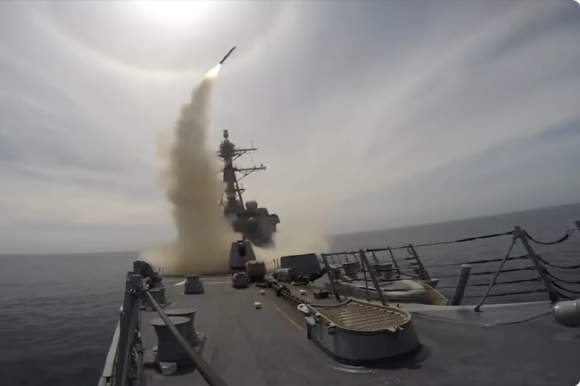
The failure of the U.S to protect the Gulf States after embroiling them in a regional war has awoken the world to the realisation that it is an unreliable ally with an overstretched military capacity. Given that public media discourse in Israel has openly discussed the use of nuclear warheads on Iran and the U.S’s depleted supplies of sophisticated missile defence interceptors and long-range precision missiles, the risks associated with broader nuclear escalation threatening Australia can not be ruled out.
President Trump has been increasingly desperate for some kind of win, as evidenced by his constant threats of bombing Iran back to the Stone Age.
In a dangerous global crisis with no clear exit plan or solutions, Australia must carefully assess its place in an evolving world and actively resist foreign interference in all forms that undermine its national interests. This includes awakening the Australian public to the real costs of embracing racist discourse and White nationalism, both of which risk undermining Australia's capacity to navigate an increasingly complex multipolar international order.
Now more than ever, its sovereignty, national security and existence depend on it.
 This work is licensed under a Creative Commons Attribution-NonCommercial-NoDerivs 3.0 Australia License
Support independent journalism Subscribe to IA.


Related Articles
- The cost of loyalty: Australia’s silence in America’s war
- Australia must break ties with U.S. on defence