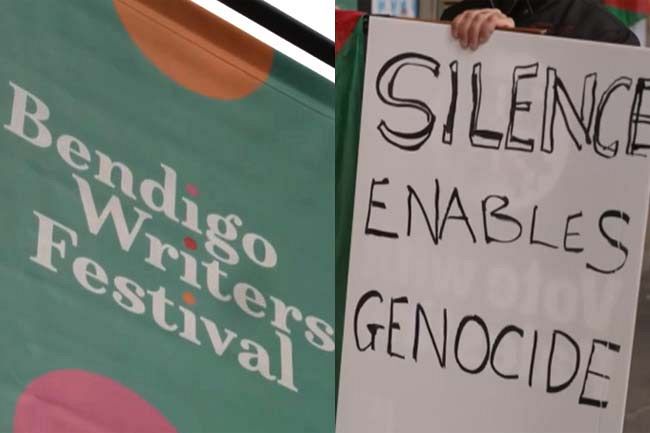
Bendigo Writers Festival founder Dr Rosemary Sorensen reports on the censorship row over La Trobe University’s definition of "antisemitism", which has triggered mass withdrawals and left the Festival in disarray.
IT’S A DRIZZLY, cold day in Central Victoria. As the weekend comes to an end, just up the Calder from where I live, the Bendigo Writers Festival is dragging itself towards the finish line. Will its self-inflicted wounds be fatal?
The news broke last Wednesday, filtering out on Thursday and hitting the headlines on Friday. Inexplicably, astonishingly, a letter had been emailed to some participants, those in the “La Trobe Presents” sessions within the program, asking them to sign on to a code of conduct which conformed to La Trobe University’s censorious definition of "antisemitism".
By 9 AM Friday, when ABC Central Victoria’s traditional opening day outside broadcast began, Bendigo Writers Festival was facing collapse. Randa Abdel-Fattah, who had been scheduled to talk about her book Discipline (about, as the festival program says, ‘the cost of speaking up and the privilege of remaining silent on Israel’s genocide in Gaza’), pulled out, saying she couldn't attend a festival that asked her to self-censor.

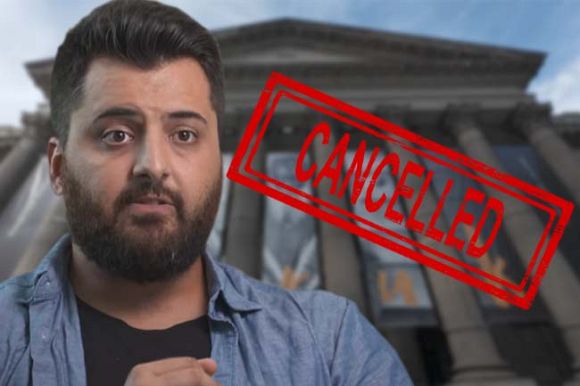
Wave after wave of cancellations followed until it was clear the festival program was gutted. Writer after writer, session after session, were cancelled.
Friday afternoon, by which time statements put out by La Trobe University and the Festival (but not the Festival’s “owner”, the City of Greater Bendigo) had further inflamed the backlash, I received a call from ABC Statewide radio. As the Festival founder, would I discuss what this means for Bendigo?
My first reaction was, “No”. You don’t weigh in when you’ve bowed out. But then I reconsidered. Writers that day had spoken so compellingly about what such a code of conduct meant, and why it must be called out as intolerable. Randa Abdel-Fattah in the morning, then Jess Hill, on the program by which I was approached. They were so clear, so eloquent and unflinching, I thought I had a responsibility to support such a stand. I wrote way back in these pages that there is a moral obligation to anyone who can speak in support of Palestine to do so.
In the past few days, I’ve repeatedly said, to myself and out loud, many variations on the expostulation, “Strewth!” We still don’t know how this happened and it’s unlikely that we ever will. People have said to me this wouldn’t have happened on my watch and I’m grateful for the recognition within that comment of the way I went about directing Bendigo Writers Festival for all those years. But I think it could have happened if I’d still been there. Or, perhaps, it couldn’t have happened because, given the current structure of the Festival, I would by now have resigned even if I’d wanted to go on.
It's always been an unusually fluid management situation: I used to say that if it became a council event, it would lose its power and energy. The freedom I had was a gift, bestowed among others by the late David Lloyd, who was manager at what was then called the Capital Venues and Events.
David and I had some volatile and often unpleasant meetings, but a committee of management that included council managers and the Bendigo campus director of La Trobe University, as well as the then Mayor of Bendigo, the late Rod Fyffe, understood what the Festival meant to Bendigo and, crucially, that it was, by its nature, challenging and risky. They trusted me, I think.
That trust was also a gift and I hope I didn’t take it lightly. It was important to respond to the needs of the community and writers, as well as to the integrity of the Writers Festival ethos. Some writers remembered me from my time as a books and arts journalist, and sometimes that helped. Other times, it meant that our invitations were refused.
I thought I’d made my very best decision when, in the tough year after COVID, I reached out to Clare Wright at La Trobe University for her help to put together the program. Clare is very special. She is respected by writers, she has a strong reputation as a historian and author and she has the kind of drive that can get things done ten times faster than most people.
When Clare said “Yes”, it was just such a joy: Bendigo, with the festival already prospering through the relationship with La Trobe University, would benefit enormously from what Clare was able to bring to the city.
Here's where things get murky from my perspective — and the warnings that writers have put out in the past few days about the implications of this code of conduct scandal are important. How did it develop that a sponsor/partner demanded that a council event impose restrictions on people who are contracted to speak in a council venue? What made it necessary to impose these restrictions so close to the event? And what legal advice did the Festival seek before sending out what must have been a council-approved letter, given the (surely) predictable ramifications?
In an alternative history, had I still been involved and still working towards that enlivening, exhilarating atmosphere created by the collusion and collision of writers at a festival, I suspect that grotesque code of conduct letter would still have been sent out, possibly without my knowledge, and certainly without anyone (the people who prompted, demanded and imposed this on the Festival management) listening to my wails of protest.
Resignation would have been essential — but they don’t seem to care that Clare Wright has resigned, so I doubt that annoying Sorensen’s departure would have troubled them too much.
Someone said to me that the right thing to do would have been for the Festival to own the error (which seems like too small a word under the circumstances) and say they will commit to change and a new start. For that to happen, the silence (beyond useless statements) of La Trobe University and of the City of Greater Bendigo’s directorate would have to be broken. If they had that courage, understanding and integrity, this wouldn’t have happened in the first place.
Dr Rosemary Sorensen is an IA columnist, journalist and founder of the Bendigo Writers Festival.
 This work is licensed under a Creative Commons Attribution-NonCommercial-NoDerivs 3.0 Australia License
Support independent journalism Subscribe to IA.