Australian protesters at Pine Gap argue that civil disobedience is justified when secrecy, surveillance and alliance politics entangle Australia in mass civilian killing in Gaza, writes Dr Binoy Kampmark.
WHILE THE SECRET SIGNALS and surveillance facility at Pine Gap in Northern Australia, officially named the Joint Defence Facility Pine Gap (JDFPG), is billed as a joint affair between Australia and the United States, it is nothing of the sort.
Just as offices direct the callow intern to make the coffee, Australian officials remain America’s permanent interns, helpful, certainly, but never powerful or given challenging roles. The contempt with which Australians are treated is evident in the level of secrecy that continues to shroud one of the largest signals intelligence centres outside the United States.
It is this secrecy that, on occasion, finds its way into court. For this, we can thank those plucky protesters who have, over the years, sought to expose the role of the base in aiding U.S. military operations against targets in any number of locations unbeknownst to the Australian Parliament, not even the Australian Prime Minister and Cabinet.
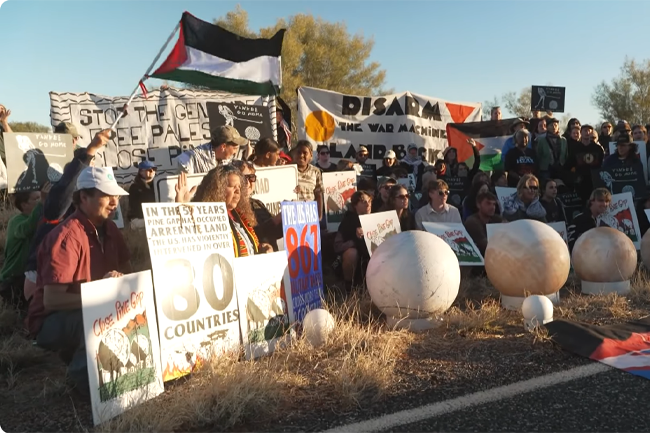
Two of those protestors, Carmen Escobar Robinson and Tommy Walker, brought attention to the base’s activities when they blocked Hatt Road, the main access route to Pine Gap, in October 2023. On 27 November 2023, a second effort was made that temporarily prevented some 100 Pine Gap employees from entering the facility.
Robinson and Walker were part of a group of 50 activists, an eclectic makeup of health workers, community members and the Arrernte Traditional Owners, all steered by the social justice outfit Mparntwe for Falastin. The action had been enlivened by revelations from an ex-Pine Gap employee that intelligence from the base was finding its way to Israeli sources.
The revelations, published in Declassified Australia by Peter Cronau, came from David Rosenberg, a veteran of the U.S. National Security Agency (NSA) who performed the role of “team leader of weapon signals analysis” at Pine Gap for 18 years till 2008.
Rosenberg stated:
“Pine Gap facility is monitoring the Gaza Strip and surrounding areas with all its resources, and gathering intelligence assessed to be useful to Israel.”
Personnel at the base were tasked to gather such signals pertaining to Hamas’ command and control centres in Gaza. Their aim would be to minimise casualties to non-combatants in achieving their objective of destroying Hamas, given the proximity of such centres to civilian infrastructure such as schools and hospitals. (This claim proved over time to be aspirational, given the staggering civilian death toll arising from Israeli strikes.)
Cronau had previously obtained evidence of the role played by Pine Gap in supplying geolocation data to the U.S. military for targeting purposes from an NSA document from August 2012 entitled ‘Site Profile G’, stemming from the archive of former NSA contractor Edward Snowden and first published in the Australian Broadcasting Corporation program Background Briefing in 2017.
The document states:
‘RAINFALL [NSA’s designation for Pine Gap] detects, collects, records, processes, analyses and reports on PROFORMA signals collected from tasked target entities.’
These signals, writes Cronau, constitute ‘the communications data of radar and weapons systems collected in near-real time’. Pine Gap, ‘with its satellites so strategically positioned to monitor the Middle East region, along with its targeting and analysis capability’, was bound to be valuable to Israel.

Robinson and Walker were subsequently charged with summary offences for the second action, comprising loitering, causing a hazard on the road and blocking the use of a public road. On 23 September 2025, they pleaded “not guilty” to the charges, arguing that the obstruction had been staged to prevent “the offence of genocide in Palestine”.
In his ruling, Judge John McBride found the two protesters “exemplary citizens” in dedication to their cause despite finding them guilty of loitering. (The prosecution dropped the obstruction charges late in 2024.)
McBride ruled:
“I conclude that the conduct of both defendants, deliberate as it was, cannot be accepted by this court as reasonable in justifying their intended commission of a criminal offence.”
The defence made by the duo’s lawyer, John Lawrence, resorted to the Northern Territory’s Criminal Code Act, which stipulates that force – in this case a blockade – can be justified in certain circumstances, one of them being to ‘prevent the commission of an offence’. Robinson and Walker had committed their acts with intent “because it was their view, their belief, their understanding that what was going on in Pine Gap was an offence”. The Crown was unable to “prove beyond reasonable doubt” that the defendants “weren’t moving in order to prevent genocide”.
Professor Richard Tanter of the Nautilus Institute, an untiring student of Pine Gap’s cloaked activities, was called upon to give evidence on the facility’s role. This, argued Crown prosecutor Machiko Raheem, was not relevant to the defence of applying force to prevent genocide.

But the Court did hear Raheem's rather startling confession that a genocide was taking place:
“A blind person can see that since the Balfour Declaration of 1917 and the UN Partition Plan in 1947, there has been a systematic annihilation of the Palestinian people.”
This annihilation had “only recently [been] labelled... genocide — which is consistent with human history as a whole. That’s not the issue in these proceedings”.
The Judge agreed with the prosecutor that “actions taken in Gaza which constituted an offence of genocide” did not excuse the duo’s conduct. Both were given good behaviour bonds lasting six months and made to pay a court levy of $150.
In remarks made to Guardian Australia, Robinson made the salient point:
“With no transparency to parliament or the public, Australia is hardwired into the U.S. military surveillance industrial complex through Pine Gap. The Australian public should be very concerned... how many countries are we unofficially attacking? How many people is Pine Gap involved in killing in Palestine? Lebanon? Syria? Yemen? Iran?”
Most Australian politicians, mutely, subserviently, persist in avoiding the matter. The errand boys and girls of the American empire remain an unquestioning bunch.
Dr Binoy Kampmark was a Cambridge Scholar and is a lecturer at RMIT University. You can follow Dr Kampmark on Twitter @BKampmark.
 This work is licensed under a Creative Commons Attribution-NonCommercial-NoDerivs 3.0 Australia License
Support independent journalism Subscribe to IA.