The Government says it supports international education, but its shifting visa policies and soaring fees tell a very different story. Dr Abul Rizvi writes.
EDUCATION MINISTER Jason Clare has announced that the National Planning Level (NPL) for new overseas student commencements for the higher education and vocational education and training (VET) sectors is to be retained at 295,000 for 2027.
At the same time, Clare said:
‘Current tracking indicates international student commencements are on track to be below the NPL for both 2026 and 2027.’
The Minister says commencements are tracking at 8% below the NPL.
So what is the point of an NPL that the Government has no intention of delivering? This has not been explained.
The Group of Eight (Go8) lobby group has issued a media release welcoming the Government’s decision not to reduce the NPL. Its media release says nothing about the Government’s intention not to deliver the NPL. That is likely because Go8 universities will meet their respective NPL allocations, particularly as these universities have a high reliance on students from China. It is the lower-tier universities and VET providers who will not meet their allocations.
When the 2026 NPL was announced in mid-2025, the Government was still talking about “managed growth” of a “sustainable” international education industry. At the time, I asked the Government what the 25,000 increase meant for the Treasury’s net migration forecasts. I was told net migration is just a statistical measure and not a consideration in setting the NPL.
Astonishingly, this may well have been what the Government thought at the time, as some academics were also peddling this line to them.
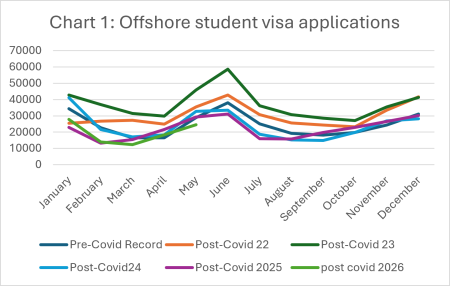
Announcement of the higher NPL for 2026 led to a strong increase in offshore student applications as education providers understandably recruited to the higher allocations they had been given. That clearly had the Government worried. By September 2025, net migration had stopped falling and was increasing again.
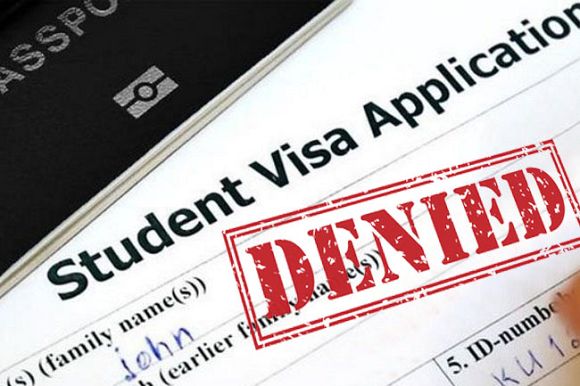
From October/November 2025, the Government cranked up offshore refusal rates for student visa applicants, particularly from South Asian nations (but not for China), to unprecedented levels. While the Government argued this was about achieving greater levels of visa “integrity”, reducing net migration had to also have been an objective.
By March 2026, Assistant Minister Julian Hill said, “Growth has stabilised, commencements are down by about 15%”. Within nine months, the Government had gone from talking about “managed growth” to proclaiming commencements had reduced by 15%.
The cranking up of refusal rates eventually impacted offshore application levels, with these falling in May 2026 to levels not seen since 2015-16 (outside COVID). Offshore student applications for 2026 to date are now below pre-COVID records (see Chart 1).
But can high refusal rates based on very subjective criteria be sustained? Will these be enough to get net migration down sufficiently before the next election?
To try and put further downward pressure on application rates (and thus net migration), the Government initially increased the student visa application fee to $2,000. This was double the next highest student visa fee, which is around $1,000 charged by the UK.
The Australian Government subsequently doubled the temporary graduate visa fee from $2,300 to $4,600 on 1 March 2026. Then, as part of another major hike in most visa application fees on 1 July 2026, the Government increased the student visa application fee to $2,500 and the temporary graduate application fee to $5,750.
The two main instruments the Government is now using to reduce net migration are high student visa refusal rates and extreme increases in visa fees. Both are very poor policy instruments and reflect a degree of panic to reduce net migration against the background of a surge in the polling of One Nation.
The Government has gone from Treasurer Jim Chalmers in May 2023 saying, when asked about the blowout in net migration compared to Treasury forecasts, “That isn't a government policy or a government target. It's not a floor or ceiling, it's not something the government determines”, to the Prime Minister now saying he is committed to delivering the Treasury’s latest net migration forecasts.
But two problems arise. First, the Government has, to date, been using very poor and untargeted tools for managing net migration down and has applied them in a very haphazard way. Second, it still hasn’t done enough to get net migration down to the levels the Prime Minister has committed to by the time of the next election. It will need to do more.
A better approach would be to develop a long-term plan for net migration and to clearly explain that plan to the Australian public. But none of the three major forces in Australian politics seems interested in doing that.
Dr Abul Rizvi is an Independent Australia columnist and former Deputy Secretary of the Department of Immigration. You can follow Abul on Twitter @RizviAbul or Bluesky @abulrizvi.bsky.social.
 This work is licensed under a Creative Commons Attribution-NonCommercial-NoDerivs 3.0 Australia License
Support independent journalism Subscribe to IA.


Related Articles
- Visa fee increases reflect lazy government
- Skilled visa invites reveal Australia's workforce priorities
- Why political diversity lags as ethnic diversity rises in Australia
- Labor Government playing dicey politics with immigration management
- Tony Burke signals an immigration shift as Labor confronts migration reality