

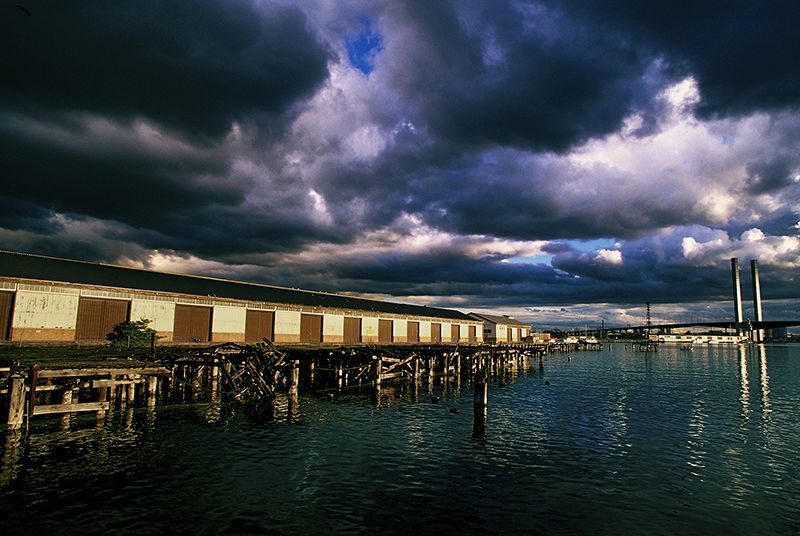
Photojournalist Bill McAuley made a weekly pilgrimage to Docklands in the late '90s to catalogue what remained of the once-vibrant maritime gateway. Now, those remarkable images have come to light, writes Derek Ballantine.
HISTORY LINGERS here. It is where the Yarra, born pure and bright in the Great Dividing Range, meets the salted waterway that carries the world to our shore.
They call it Docklands, but there is no justice in that name. It requires a bigger, bolder name, for here is a place of industry and sweat, energy and ingenuity, even crime and passion.
On these banks, and in these sheds, on these piers, wealth was earned and won and grafted and seized.
The world sent its manufactured goods to this, Melbourne’s front step and Australia despatched its resources from this same threshold. Coal in sacks came from Newcastle, timber and even gold began its global journey here.
Docklands owes its birth to the era of sail – before the colonies embraced nationhood – and it thrived at a time when the fug of coal smoke clung to the air over the decks of steam ships.
Union hard men gave it flavour between world wars and after the worst conflict of them all, when millions perished, ships and sailors and stevedores laboured to feed the poor souls caught in the maelstrom that was World War II. The planks and pylons shuddered under barrows and forklifts, while the halls echoed to the curses of men in overalls.
For decades, the tramp steamers defied progress in the form of containerisation, even the emergence of air freight and there were times when muscle was preferred over machines. Change came slowly, then in a torrent. Suddenly, the protestations of the old timers gave way to new voices — then came capitulation.
And Victoria Dock was no more.
The wharves sat silent and sullen as Melbourne turned its back on this industrial landscape that had once enriched Victoria. It was unloved, decay set in, the end loomed large and ugly.
But one man did not forget. Photojournalist and Independent Australia columnist Bill McAuley did something remarkable when the lights went out at the dock. He took his camera and captured the magic and the mystique and the memories generated in this nether world on the river.
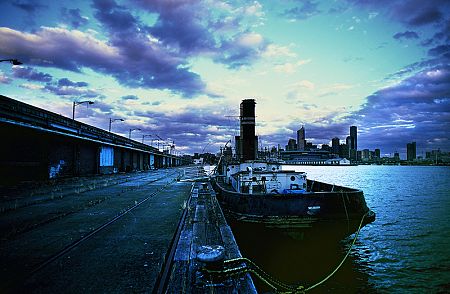
For one and a half years, he made a pilgrimage to Docklands, two or three nights a week, until he had catalogued what remained of a once-vibrant environment that was, on the one hand, slipping into obscurity and, on the other, still rich in nostalgia.
Fortunately, McAuley was able to capture the old-world vibe of the deserted Victoria Dock before they built a new and bustling city in its place.
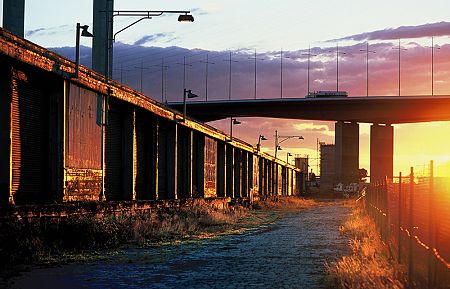
A sailing vessel survives here, a steam tug there, but the rest of the maritime scene in McAuley’s portfolio speaks of neglect and decay, all under the wondrous colours of evening skies.
Victoria Dock is the segment of Docklands that resides between Melbourne’s CBD and the intersection of the Yarra and Maribyrnong, not far from where the conjoined rivers slide past what are now modern shipping terminals prior to greeting Port Phillip.
It was an engineering marvel at the outset, a large excavated harbour basin constructed between 1887 and 1892, the largest single dock in the world. There were 21 berths, monstrous sheds, cranes trundling along railway tracks.
The dock handled two million tons of cargo annually in the 1950s, rising to 20 million tons in the 1980s, before container shipping put paid to this beehive of industry.

An award-winning photographer with a sterling reputation in newspapers and magazines, McAuley has finally revealed his essay on the old Victoria Dock.
He has called the portfolio 'Last Light on Victoria Dock 1999'.
All the photographs were shot on high-resolution transparency film. The haunting evening light adds to the mystique of the collection, which has waited 25 years to be exposed to the world. It has come about because Dockland’s Magnet Galleries got wind of McAuley’s secret collection and encouraged him to put it on show.
Says Bill McAuley:
“I went about what might be called a labour of love, mainly for my own satisfaction, though as a photographer I know that photographs as historical documents grow in power with time. You could say in this case the photographs waited unseen until someone demanded they be shown.”
Now, printed and framed, 50 of these images will be featured in a photographic exhibition on 4 September at Docklands' Magnet Galleries, entitled ‘Last Light on Victoria Dock 1999’. (Details HERE.)
A beautifully printed book of these historical images (available HERE) will also be launched at the exhibition.
Note: Bill McAuley is the author of IA's 'Eye for Australia' column. He has several published collections, including 'Portraits of the Soul: A lifetime of images with Bill McAuley' and 'The Valley Voice: Eltham's Newspaper of the times 1978-1979'. To see more from Bill, click here.
Derek Ballantine is a retired journalist who worked in newspapers and on radio in a career spanning 40 years. He is the author of The Horse in Australia and co-editor and compiler of the Australasian Book of Thoroughbred Racing.
 This work is licensed under a Creative Commons Attribution-NonCommercial-NoDerivs 3.0 Australia License
Support independent journalism Subscribe to IA.







