Mobile isn’t truly wireless — every call depends on fibre and without it, the whole system breaks, writes Paul Budde.
PEOPLE OFTEN ASK a seemingly logical question: if most Australians use mobile phones for calls and internet access, why do we still need to invest billions in fixed networks such as fibre? At first glance, it can look as though mobile networks could do the job on their own.
The reality is very different. Almost all mobile traffic ultimately depends on fixed, fibre-optic infrastructure. Without it, mobile networks simply cannot function at scale, with reliability, or with the quality that people expect — particularly for voice services and emergency calls.
When you make a mobile phone call, your phone connects wirelessly to the nearest mobile tower. That is the only truly “wireless” part of the journey. From the tower onwards, your call travels through fixed links back into the operator’s core network and from there to the person you are calling. In metropolitan and regional Australia, those towers are almost always connected via fibre-optic cables.

This means that the mobile signal itself typically only covers the last few kilometres — sometimes much less. The heavy lifting is done by fibre, which provides the capacity, stability and low delay that modern communications demand.
In areas where fibre is not available, operators have traditionally relied on microwave links. These are point-to-point radio connections between towers or relay sites, often using line-of-sight links over tens of kilometres. Microwave can work well, but it requires towers, power, maintenance access and clear transmission paths. In very remote parts of Australia, that infrastructure can be difficult or uneconomic to deploy.
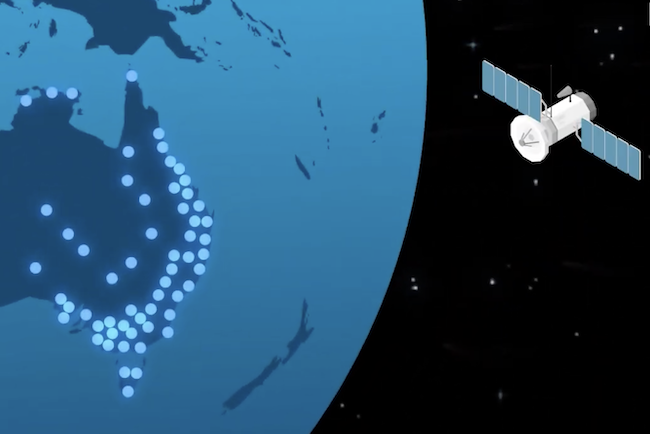
This is where satellite backhaul enters the picture. In recent years, low-Earth-orbit (LEO) satellite systems have been promoted as a way to connect remote mobile towers that cannot be reached by fibre or microwave. In Australia, Telstra has been the first major carrier to deploy LEO satellite backhaul at scale, using services from OneWeb, which is owned by Eutelsat.
The way this works is relatively straightforward in principle. A mobile tower in a remote location sends calls and data up to a passing LEO satellite. The satellite then relays those signals down to a ground station, which is connected by fibre to Telstra’s core network. From there, the traffic behaves like any other call or data session on the national network.
This approach has enabled Telstra to extend mobile coverage into locations where it would otherwise be impossible or prohibitively expensive. However, as recent reporting and community feedback show, it also comes with significant limitations.
LEO satellite backhaul is still a relatively new technology in this context. Telstra’s rollout only began in early 2024, and the OneWeb constellation is still being expanded. Until more satellites are in orbit, capacity remains constrained. When too many users share a limited satellite link, voice quality is often the first thing to suffer. Calls may drop out, voices can sound distorted, or conversations may be interrupted altogether.
Unlike data applications, which can pause, resend information and recover from brief interruptions, voice calls require a continuous, real-time connection. Even short disruptions that may not register as “outages” in network monitoring systems can make phone calls extremely difficult or impossible to maintain.
Another challenge is that LEO satellites are constantly moving. Mobile towers must hand off traffic from one satellite to the next as they pass overhead. While this process is designed to be seamless, in practice, it can introduce momentary interruptions. For users, this may feel like random drop-outs rather than clearly defined outages.
These technical realities help explain why some remote communities report ongoing call quality problems, even when operators state that services are largely available. From a network perspective, the system may be “up”. From a user perspective, it may be unreliable for everyday use — particularly for critical services such as Triple Zero calling.
More satellites will help. Eutelsat has announced large additional orders for new LEO spacecraft, which should improve capacity, resilience and handover performance over time. But even with those upgrades, satellite backhaul will never match the reliability of fibre or well-engineered microwave links. It remains, by definition, a compromise solution.

There is also growing interest in a different satellite approach: direct-to-device services, where ordinary mobile phones connect directly to satellites without relying on a local tower. This model is being aggressively pursued by Starlink (among others) and we have discussed its potential in previous articles. Direct-to-satellite services may eventually provide a valuable safety net for basic connectivity and emergency messaging in remote areas.
However, they do not eliminate the need for fixed networks. High-capacity fibre remains the backbone of Australia’s communications system. Mobile networks, satellites and fixed infrastructure are not substitutes for one another; they are complementary layers of the same ecosystem.
The current debate around satellite backhaul failures is therefore not an argument against innovation. It is a reminder that there are no shortcuts in telecommunications. Extending coverage to the most remote parts of Australia is essential — but it must be done with honesty about the limitations, and with realistic expectations about what satellite-based solutions can and cannot deliver.
Paul Budde is an IA columnist and managing director of independent telecommunications research and consultancy, Paul Budde Consulting. You can follow Paul on Twitter @PaulBudde.
 This work is licensed under a Creative Commons Attribution-NonCommercial-NoDerivs 3.0 Australia License
Support independent journalism Subscribe to IA.