Clare Wright says La Trobe lacked “moral courage” in the Bendigo Writers Festival collapse — and still hasn’t apologised or explained its actions. Dr Rosemary Sorensen reports.
WITH A SHAKY voice but clarity and conviction, Professor Clare Wright has spoken publicly about La Trobe University’s lack of “moral courage” in the lead-up to the collapse of Bendigo Writers Festival – and she chose to do so just a day after the Bondi anti-semitic murders. She did so, she told Fiona Parker on ABC Radio Central Victoria, because she, a Jewish Australian, refused to see the work of her “pro-Palestine friends” undermined by the weaponising of what happened in Bondi.
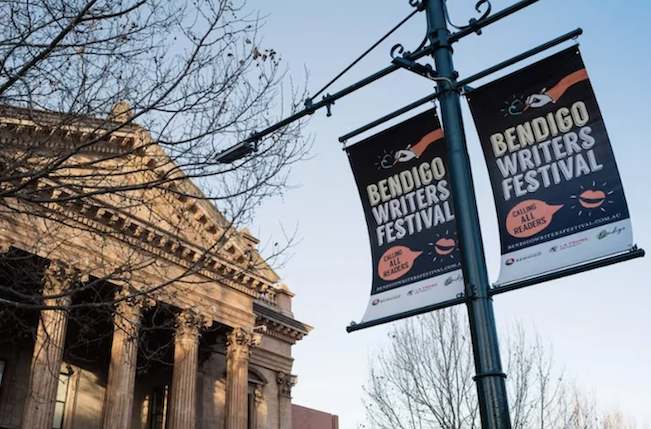
On Monday, 15 December, City of Greater Bendigo council voted to suspend the Festival in 2026 to prepare for a new start in 2027.
Wright, who had curated LTU’s events within the program as a core part of the university’s long-running partnership with the council-managed Festival, told Parker on Tuesday morning:
“I hail the Bendigo council’s decision to save the Festival … it’s the right one.”
She clarified for the first time the way Vice Chancellor Theo Farrell “escalated” the response to a letter from the 5A Zionist academics complaining about Randa Abdel Fattah’s presence on the August program. Wright called La Trobe’s actions before and after the boycott of the Festival by more than 50 writers “unsatisfactory”.

And while La Trobe University has only said, in a public statement, that “lessons have been learned”, the review they undertook has not been finalised, and no apology has been issued either to the writers, to the La Trobe staff, or to the council and the people of Bendigo.
Newly-elected Mayor, Thomas Prince, was also interviewed by Fiona Parker on ABC Central Victoria earlier in the Tuesday morning radio program. He was asked if La Trobe University had apologised for escalating the demands on writers and the inclusion in the hastily prepared Code of Conduct of a specific demand to comply with the controversial definition of anti-semitism (which includes voicing support for Palestine).
Prince said:
“I have received nothing. The City has received nothing. As part of the (CoGB) process...all stakeholders had the chance to contribute … They (LTU) didn’t.”
I took part in a round-table-discussion convened by Bendigo as part of their process, and identified from that meeting that a review of Bendigo Writers Festival, which I founded and directed from 2011 until 2023, was due even if 2025 hadn’t ended in disaster. It was clear that it had reached a critical point following the stresses of the COVID years, then (because I had worked in a quasi-voluntary capacity) having to deal with both financial and capacity pressure for the Bendigo Venues and Events staff.
One of the huge advantages the Festival had in that first decade was that I was able to rely on the resources of BV&E as well as La Trobe University. And they relied on – and trusted – me, as programmer. Only once did Council interfere in the program (a very special case which, nonetheless, put strain on the relationship). With first Robert Manne, then Clare Wright, as well as several former Campus Directors in Bendigo, there was open discussion about La Trobe’s and the City’s roles. I tried hard to accommodate expectations from the University because I always valued the collaboration: it opened up the possibility of bringing influential, experienced, respected and brilliant researchers and writers to this proud regional city, as well as providing a kind of window onto blue sky, where those writers could be listened to out of Melbourne’s self-reflective white noise. Regional spaces invite open-minded thinking. That can invite and result in a better quality of discussion.
We had some truly wonderful events at Bendigo Writers Festival, that’s the truth.
What was heartening about the Review carried out by CoGB is that almost 900 responses were received, which were clearly very much in favour of the continuation of the Festival. While there are those on Council and probably in the community who think of a writers' festival as a waste of money, it appears that there is an understanding about the non-commercial value of books, writing and the discussions they promote.

I had to chuckle to hear Thomas Prince (who spoke well) mention that there are concerns, in relation to financial viability, about the way the Festival “entertains a lot of locals, which is great”, but how to attract visitors needs to be part of what the model for sustainability looks like. I chuckled because that is definitely one of the major tensions for any Festival director and management, balancing expectations from the locals with the City’s emphasis on and need for tourism.
Something Clare Wright said gave me pause, too. I’d been asked by ABC regional radio last week, before Council voted on the proposal to keep the Festival running, about La Trobe University’s likelihood of continuing involvement. I was negative, given the damage they’ve caused and their lack, so far, of owning the blame. Clare, in contrast, saw a future for her University and the collaboration with a City in which they play a major role. She reiterated that La Trobe, “looking at the wrong risks” and failing to “show moral courage”, has not yet been open about what happened in Bendigo.
But nevertheless, she believes it can be salvaged.
She said:
“I hope a skilled festival director is employed, I hope the partnership can flourish."
Dr Rosemary Sorensen is an IA columnist, journalist and founder of the Bendigo Writers Festival.
 This work is licensed under a Creative Commons Attribution-NonCommercial-NoDerivs 3.0 Australia License
Support independent journalism Subscribe to IA.