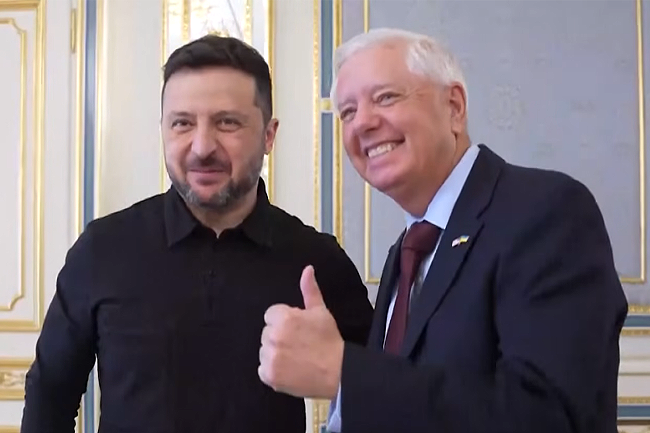
With Lindsey Graham gone, the U.S. Senate must decide whether to serve the Constitution or the President, writes Thom Hartmann.
U.S. ATTORNEY and former Senator Lindsey Graham died on Saturday 11 July at 71 and President Donald Trump couldn't even wait for the body to reach a funeral home before using the death for political advantage.
Trump invoked his “beloved friend” at least three times in 24 hours to demand the Senate pass his stalled voter-suppression legislation and kill the filibuster to do it. It's really a grotesque spectacle, but also a clarifying one.
For a decade, Graham acted out a particular answer to Trump’s central question: what’s a senator for? His answer, after 2016, was that a senator exists to manage, flatter and serve the president. Sadly, he wasn't an outlier, as one after another senator fell into line (as we saw this week with the Blanche hearings). His death removes the most visible practitioner of that servility, but five tests will tell us if this is truly the new normal or if the past year-and-a-half have been an outlier.
The first is the filibuster. Trump is demanding its termination and claiming Graham was “coming aboard” on the issue before he died (which nobody actually believes). The 60-vote threshold is the last structural feature forcing any president to negotiate with the Senate under his own party’s control rather than dictate to it.

The second is the reconciliation workaround. Graham chaired the Budget Committee, the gatekeeper for the party-line process the White House wants to use to insert its voter suppression bill into Pentagon funding. That gavel is expected to pass to Senator Ron Johnson as Johnson’s House launches a third reconciliation attempt. If the new committee chairman stretches budget rules far enough to carry it, reconciliation stops being a budget tool and becomes a new and probably permanent way around any semblance of Senate independence.
The third is personnel. Graham's death narrows an already thin Republican majority just as a contested attorney general nomination and stalled spending bills hit the floor this week. Advice-and-consent was already dying on Graham's watch when his Judiciary Committee installed a Supreme Court justice eight days before the 2020 Election. The coming fights will tell us if it’s simply dead.
The fourth is the war power, a true matter of life-and-death. When the U.S. joined Israel's strikes on Iran this February, the Senate never debated an authorisation, and Graham was the loudest voice insisting it needn't bother. Now Trump is openly threatening to seize the Strait of Hormuz if diplomacy fails.
Ukraine hangs in the same balance: Graham was Kyiv's fiercest Republican champion, standing with Ukrainian President Volodymyr Zelenskyy the day before he died, but now there's no successor in sight as Trump continues to support Russian President Vladimir Putin by refusing to ship weaponry to Ukraine. Whether the bipartisan Ukraine bloc survives him will reveal whether independent senate foreign policy still exists at all.
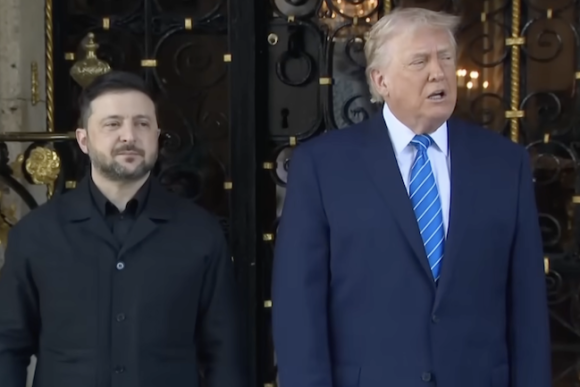
The fifth is the voters. South Carolina holds a special election this fall. Four Republicans – Susan Collins, Mitch McConnell, Lisa Murkowski and Thom Tillis – have so far refused to cowtow to Trump on voting rights, and every one of them will now be worked over with every weapon or gift Trump can command. Whether they hold and whether voters reward spine or punish it will shape the Senate for a generation.
The framers designed the Senate to check presidents’ power, trusting senators would guard their institution's prerogatives out of raw self-interest if nothing nobler. Graham spent ten years proving them wrong, having abandoned the principled stances of his time as John McCain’s compatriot and instead adopted total fealty to Trump’s every whim.
The Republican senators eulogising him this week get to decide whether his career was an aberration or the template for their own individual futures. They can keep the filibuster, restore real confirmation scrutiny, reclaim the war power and stand by Ukraine. Or they can finish converting the world's greatest deliberative body into a pathetic cheering section overseeing the unravelling of the world’s oldest democracy.
Americans should be jamming their senators' phone lines this week, making clear which kind of Senate they expect and this time Lindsey Graham won't be there to decide for them.
Thom Hartmann is a four-time winner of the Project Censored Award, a New York Times bestselling author of over 30 books, and America's number one progressive talk radio show host for more than a decade.
 This work is licensed under a Creative Commons Attribution-NonCommercial-NoDerivs 3.0 Australia License
Support independent journalism Subscribe to IA.