Paul Keating’s Redfern and War Memorial speeches, written over 30 years ago, remain a powerful indictment of Australia’s failure to reckon with its past and present, writes Dr David Stephens.
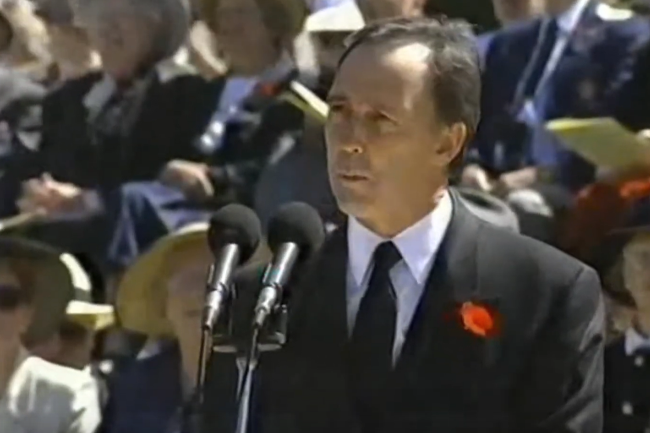
PAUL KEATING, Prime Minister from 1991-96, gave two especially memorable speeches, one in Redfern Park, Sydney, on 10 December 1992 (video here) and one at the Australian War Memorial, Canberra, on 11 November 1993 (video here) at the interment of the Unknown Australian Soldier.
Keating’s speechwriter, Don Watson, worked on both speeches.
The Redfern Park speech contained some words which should be engraved on the footpaths outside the homes of every Australian who voted “No” in the Voice Referendum of 2023. The Unknown Soldier speech is remarkable in a different way, and we’ll come to that.

Redfern Park first. Here are the key sentences:
If it isn't reasonable to say that if we can build a prosperous and remarkable harmonious multicultural society in Australia, surely we can find just solutions to the problems which beset the First Australians, the people to whom the most injustice has been done.
...the starting point might be to recognise that the problem starts with us, the non-Aboriginal Australians.
It begins, I think, with an act of recognition. Recognition that it was we who did the dispossessing. We took the traditional lands and smashed the traditional way of life.
We brought the diseases and the alcohol. We committed the murders. We took the children from their mothers. We practised discrimination and exclusion.
It was our ignorance and our prejudice. And our failure to imagine these things could be done to us.
With some noble exceptions, we failed to make the most basic human response and enter into their hearts and minds. We failed to ask, how would I feel if this were done to me?
As a consequence, we failed to see that what we were doing degraded us all.
Shorthand: We, Whitefellas, pinched Blackfellas’ Country and then did our best to wipe Blackfellas from the face of Australia. Surely, a good enough reason to have voted “Yes” in 2023 — to make a start on the path of Reconciliation.
Don’t, “No” voters, come back with that argument that “we weren’t there, we didn’t do it, it was a long time ago!” We all, Black and White, have a responsibility to address the consequences of what happened then today.
Some of those results are catalogued in the Closing the Gap reports. Keating at Redfern Park went on to mention the then recent Royal Commission into Aboriginal Deaths in Custody, which, he said, “showed with devastating clarity that the past lives on in inequality, racism and injustice”.
The metrics have changed little in 30 years; many have got worse. All our yesterdays connect to our today.
Now, the Unknown Soldier speech from 1993.
Again, here are some key sentences, with commentary:
We do not know this Australian's name and we never will.
We will never know who this Australian was.
We know almost none of the names of the Indigenous men and women who died in Australia in the Australian Wars from 1788 to at least 1928. Tens of thousands of unknown Australians.
“We do know that he was... one of the 60,000 Australians who died on foreign soil [in World War I]. One of the 100,000 Australians who have died in wars this century.”
Somewhere between 20,000 and 100,000 Indigenous Australians and perhaps 3000 settlers, military and police, died in the Australian Wars. We do not know the exact number of Indigenous deaths because bodies were burned and buried, stories hushed up and records lost or destroyed.

“He is all of them. And he's one of us.”
A mature Australia will be one that recognises the unity of our Black and White history.
“This Australia and the Australia he knew are like foreign countries.”
Indigenous numbers, lands and waters have been decimated since 1788. Disease, poisoning, rape, Snider rifles and hard-hoofed herds destroying Country, all helped bring the change.
“On all sides they were the heroes of that war... those who taught us to endure hardship, show courage, to be bold as well as resilient, to believe in ourselves, to stick together.”
Blackfellas stuck together, often in the face of overwhelming odds and hardship.
“...we've gained a legend: a story of bravery and sacrifice and with it, a deeper faith in ourselves and our democracy, and a deeper understanding of what it means to be Australian.”
Our Black and White history reveals stories of bravery and sacrifice, and what it means to be Australian. Heritage need not wear a uniform
Australia today still bears the scars that Keating described in 1993. Indigenous Australian warriors – and old men, women and children – died in horrendous but unknown numbers.
Wouldn’t it be great if our most famous shrine, the Australian War Memorial, gave equal weight to the deaths of men and women defending Australia in our overseas wars and the deaths in the Australian Wars — the wars fought on Country, for Country?
Dr David Stephens is editor of the Honest History website and a member of the Defending Country Memorial Project, campaigning for the Australian War Memorial to properly recognise and commemorate the Australian Frontier Wars.
 This work is licensed under a Creative Commons Attribution-NonCommercial-NoDerivs 3.0 Australia License
Support independent journalism Subscribe to IA.


Related Articles
- Paul Keating lashes out at AUKUS upgrade
- VIDEO: Paul Keating vs The National Press Club
- Why we shouldn't sink $368 billion into nuclear submarines
- EDITORIAL: Dear Bevan, Why we shouldn't sink $368 billion into subs
- Paul Keating fires shots at AUKUS, corporate press takes casualties