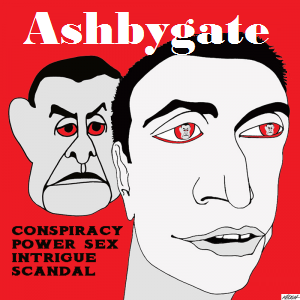
Politicians and media are accused of rushing to label incidents as terrorism before the facts are established, raising questions about political agendas and journalistic scrutiny, writes Paul Begley.
WHEN U.S. media tycoon Rupert Murdoch swept into Australia on 12 December 2024, he made a beeline to the Adass synagogue in Melbourne’s Ripponlea. The synagogue had been firebombed six days earlier.
Mr Murdoch told a News Corp reporter at the site that antisemitism had “no place in Australia, or anywhere in the world”, making it abundantly clear to his editors that he had decided what he had witnessed on that visit to Ripponlea.
Two days earlier, on 10 December, Prime Minister Anthony Albanese had visited the same synagogue. A waiting crowd heckled him with insinuations that he had caused the firebombing.
It didn’t stop the PM from telling them what they wanted to hear.
‘...as Prime Minister, it’s difficult to have personal views; you have to follow protocols. But I made it clear, in my view, it was a terrorism event.’
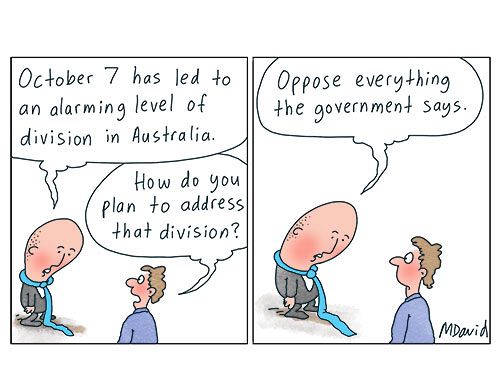
In March 2025, with the police still investigating the incident, Albanese issued a media release headed ‘Support for rebuilding the Adass synagogue’. It led with the observation that ‘the rise of antisemitism is abhorrent and there is no place for the kind of hate speech and attacks we have seen recently in our country’.
It concluded by announcing $31.2 million for rebuilding the synagogue along with a security upgrade.
Thousands of buildings claim insurance for fire damage each year in Australia. There was no acknowledgement by the Prime Minister on whether Adass had insurance cover, or whether it might cost in the magnitude of $30 million to replace the building. The taxpayer would cover the cost for reasons unexplained.
By June 2026, 18 months after the fire, a Victorian joint counterterrorism team quietly arrested three men and charged them with numerous arson offences, one of which was the firebombing of the Adass synagogue in Ripponlea. They were charged with arson, conduct endangering life and theft of a motor vehicle.
Not one of the men who firebombed the Adass synagogue was charged with a terrorism offence.
The Ripponlea outcome had echoes of a caravan packed with explosives which was detected by police on 19 January 2025 on a property in Dural NSW. The caravan contained a note referencing a Jewish synagogue.
Ten days later, the discovery was made public by The Daily Telegraph, whereupon NSW Premier Chris Minns was reported as declaring: “This is the discovery of a potential mass-casualty event. There's only one way of calling it out, and that is terrorism.”
The then Federal Opposition Leader, Peter Dutton, was offered an Australian Federal Police (AFP) briefing on the matter but declined. Instead, he called the discovery the ‘biggest planned terrorist attack in our country's history’.
The Minns and Dutton indignation was given extended saturation coverage in the media.

On 10 March, the AFP’s Krissy Barrett announced that ‘the joint counterterrorism team believed that the caravan was part of a fabricated terrorist plot, essentially a criminal con job’.
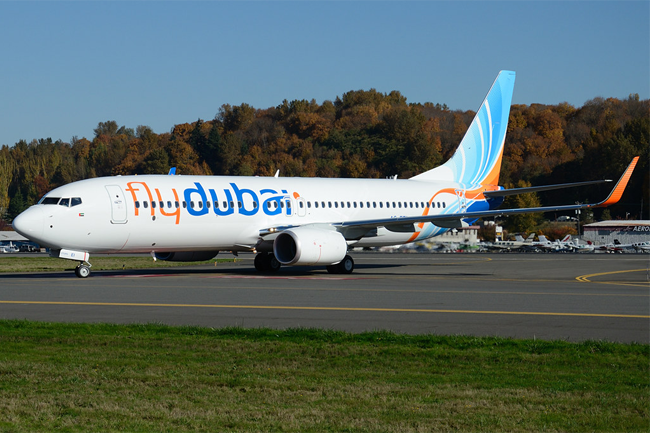
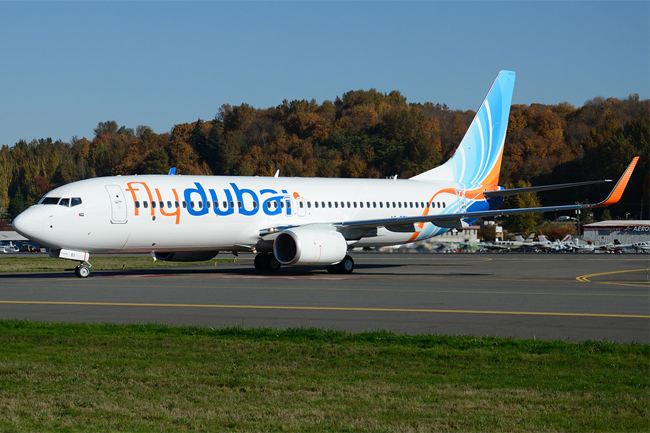
When a story broke on 30 September 2026 about a cockpit incident between an Omani co-pilot and his captain on a Flydubai flight to Tel Aviv with Israeli Prime Minister Benjamin Netanyahu on board, it raised questions about the story's factual reliability.
Sceptics did not include the ABC’s Media Watch, which ran an item critical of an independent news site, Michael West Media, for ‘perpetuating unsubstantiated conspiracy theories’.
Police may eventually confirm the veracity of one of the storylines connected to the aircraft incident as described by Netanyahu and other parties. In the interim, questions raised include those put by a pilot on CNN who suggested the aircraft would have disintegrated if the story detail about a nosedive were true.
Logistical questions also included how passengers could have been walking around if the plane were in a nosedive, and how a non-pilot who had watched aviation television programs could credibly have taken initial control and steadied the aircraft when there were two off-duty pilots on board. A Netflix audience might have trouble buying fictional narrative details of that order.
A procedural question that remains is how an Omani co-pilot could have been cleared to fly an aircraft carrying an Israeli prime minister who had an International Criminal Court arrest order on his head.
A more speculative question is why a Hollywood hero story that required suspension of disbelief and involved the Israeli Prime Minister was surfacing three weeks before an election in Israel, which is looking problematic for the unpopular incumbent?
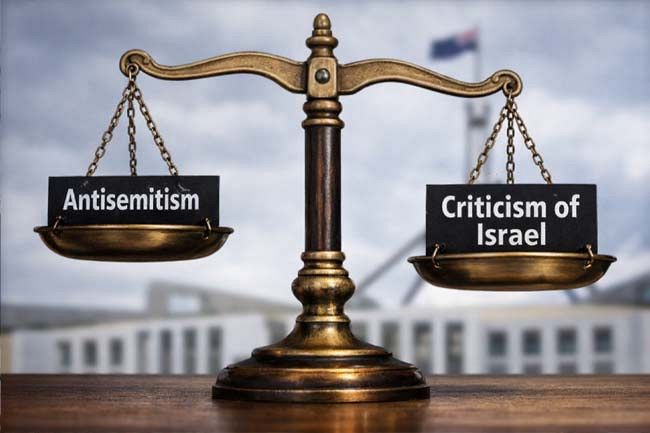
Scepticism is purportedly a core journalistic attribute, but it appears to play second fiddle when leaders in high office confidently recite stories about incidents that touch on antisemitism or terrorism.
Before independent police investigations are completed, causes of such incidents can prematurely become certainties when either probability or improbability are more appropriate responses. And questioning the credibility of such incidents can be characterised as conspiratorial, even by respected television programs like Media Watch.
Michael West put it this way:
‘Let’s say flydubai is not a false flag in a technical sense; that is, a ploy cooked up by the Netanyahu regime in Israel just a few weeks before the election. Let’s just say it was actually a fight between the pilots and a happy ending. The fact that the initial coverage branded the event as a terrorist hijacking demonstrates that the incident was used for political gain.’
Paul Begley is a Melbourne writer who worked for many years in public affairs roles, most recently as general manager of government and media relations with the Australian HR Institute.
 This work is licensed under a Creative Commons Attribution-NonCommercial-NoDerivs 3.0 Australia License
Support independent journalism Subscribe to IA.


Related Articles
- Military machine a foundry for extremism
- Trump and terrorism: The predictable link
- Terrorism: Some lessons for Australia from the New Zealand Royal Commission