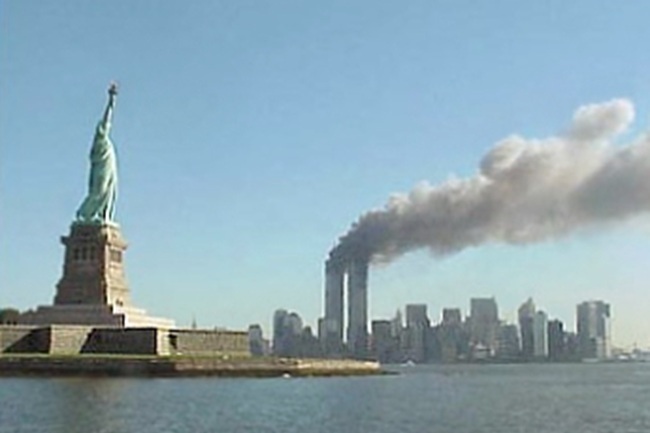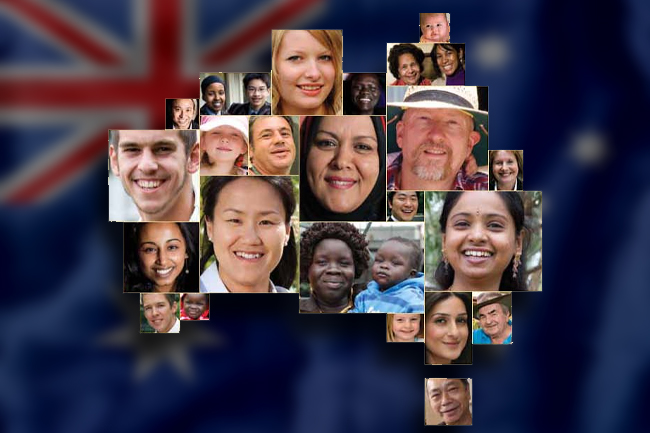
Despite the racist horrors of the past century – wild, thorny shoots from ancient root-stock – our human views do seem to be changing, writes Frances Letters.
I'M BOARDING A CROWDED TRAIN to Sydney. Ticket in hand, I find my booked seat piled high with bags and coats. I stand there: awkward; apologetic.
The woman in the next seat looks up coldly. Clearly she has arranged her belongings there with artful cunning. She deserves that lovely, comfortable space!
"Go back to where you came from!" I can almost hear her snarl.
The first thing the new Australian government did after Federation in 1901 was to bring in the White Australia Policy.
"The doctrine of the equality of man was never intended to apply to the equality of the Englishman and the Chinaman," snorted the new Prime Minister, Edmund Barton.
Greedily we spread out our bags and coats, smearing our warning scent around like dingos or skunks. ‘Australia for the White Man’ bellowed The Bulletin on its front cover, clenched fists at the ready. Right up till 1961, when the new editor, Donald Horne, removed it.
For Aboriginal Australians, this must have seemed bitterly ironic indeed. Occupiers of the whole train for 65,000 years, they’d been brutally thrown out of the carriage into icy darkness.
Wariness about territory can prompt fascinating mental contortions. I was here first! I belong! Craftily, Australians airbrushed out our convict and immigrant origins, as well as the monumental Aboriginal past. We are the true volk of this land! It’s our race that sprang with Wagnerian grandeur from this holy soil; our blood that mingled with the red earth in divinely-ordained lordship!
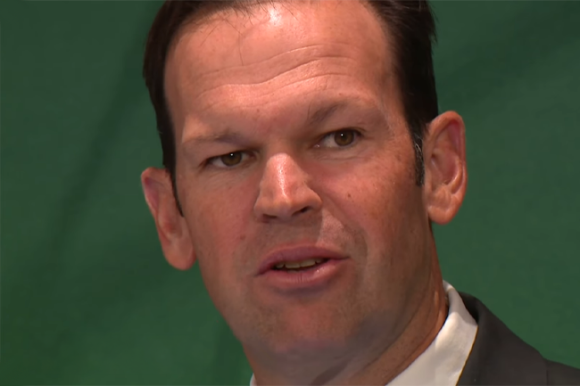
When the White Australia Policy ended in 1973, all our politicians tacitly agreed never to stir up the race demon for political advantage. But gradually, realpolitik sneaked in, with tempting visions of luscious spoils awaiting. All those votes up for grabs!
It was winter 2001 when the Tampa hullabaloo blew up: the watershed moment when that decent agreement shrivelled away.
Arne Rinnan, the Norwegian captain of the Tampa, saves 433 terrified Afghans and Iraqis from drowning. A Federal election is due. Government and opposition alike sniff the wind. Quivering nostrils detect a delicious old nationwide stench: sour tribal racism. Dials of voting figures whirr and spin in shrewd eyes.
Sadly, then-Prime Minister John Howard does not stand in the ruins of a firebombed mosque and rage against the bombers. Nor does he console terrified Muslim schoolchildren whose bus has been pelted with stones, or rage against the smearing of faeces on a mosque door. He even threatens to charge Arne Rinnan with people-smuggling. But, miraculously, he’s a hero overnight!
Nervously the Labor Party leadership caves in — but anyway, too late. Australians are already eagerly switching their votes.
Whipping up an external enemy has saved many a slippery political skin. A shudder of fear, a growl of racism... and suddenly we’re voting, not with our brains and hearts, but with our spleens.
The Tampa affair seems to prove that hostility to outsiders will always triumph. Yet deep down thrums the age-old surge of evolution. We all swim in that irresistible tide. "An eye for an eye" seems barbaric now, but once it was a revolutionary moral leap forward. The rule till then had been "A life for an eye". Poke out my eye, steal my cow — and I’ll kill you! Lust for vengeance must have seemed rooted in our very core.
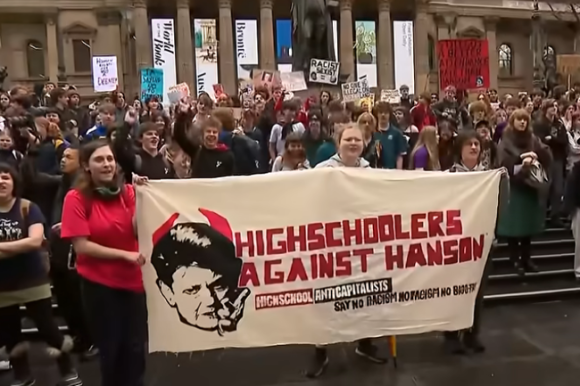
But its time, too, came and went...
The next step, Christ’s urging that we love those who hate us, is still beyond most of us. But who knows? One day, the inexorable evolutionary force of nature could impel us past the primitive stage we’re in now, and on to that unimaginably more humane one.
Of course, the superficial flow of evolution ebbs and flows by trial and error. One branch shoots out fresh growth; another, stunted, dies. Without peace, we may even end up snipping off our own twig completely...
But it’s heartening to see what has stood the test of time. Rarely has it been the narrower, angrier standpoint.
Despite the racist horrors of the past century – wild, thorny shoots from ancient root-stock – our human views do seem to be changing. In my grandfather’s lifetime you could shoot Aborigines with impunity; in the USA, slavery was considered a normal, godly fact of life. Early photos show American families picnicking merrily at lynchings.
In the lifetime of many of us, millions applauded the White Australia Policy and the death penalty; scorned the idea of rights for women, Aborigines, homosexuals; mocked ‘peaceniks’, ‘tree-huggers’, anti-apartheid activists. Talkback radio screeched in disgust against such ridiculous, lefty heresies.
But change happened anyway. We all survived: and adapted — even in small ways. People who never thought twice about tossing rubbish out car windows now automatically recycle. Once-staunch upholders of the White Australia Policy now have their lives saved by Indian or Chinese doctors.
Any day of the week you can see the once-unthinkable: people of all races and nationalities talking and laughing together over lunch in food halls across the nation. And a Treaty with our First Nations people is increasingly seen as inevitable and normal.
How puzzling now seems this 1971 ABC inter-office memo:
‘There are two sides to this apartheid business and it is our duty as ABC journalists to present both of them…Some people are for apartheid, some are against it…’
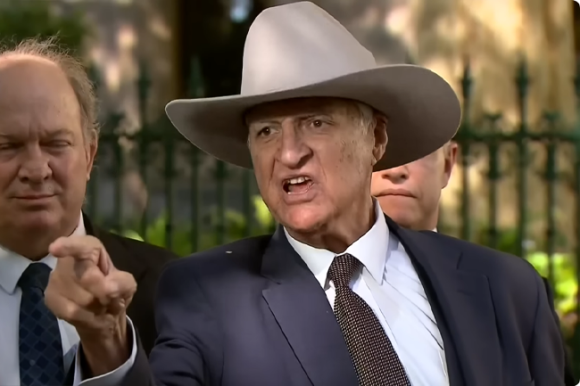
That same year, a former Chief Government Whip and ambassador to Greece, HB Gullet, raged at the decision to end the White Australia Policy.
It was, he said:
"The blackest news since Australia was federated.
It was the most important and dangerous and perhaps terrible step ever taken…to destroy everything that we have ever stood for, everything that makes Australia worth living in…
Coloured people…are people we cannot call brothers."
Such words seem bafflingly silly today. But once again, dark old roots are sprouting worldwide. Some of us still have one foot unsteadily in the pampered limbo of empire, with delusions of grandeur and superiority. Sadly, such myopia shackles our vision to one grey plane of a kaleidoscopic, multi-faceted world.
But when irrational emotion against others surges up to hiss in our hearts, a healing scalpel can help: the cool laser of reason. It’s even more powerful when combined with another tool we all carry: the warm, blazing torch of the imagination.
"Try walking in another’s shoes" is a cliché we obey daily. Identifying with heroes and heroines in millions of books, movies and TV dramas, we gasp when they gasp, laugh when they laugh, run terrified in their shoes when they run. It was to thwart just such identification that Australian navy photographers were forbidden to “personalise or humanise” the Tampa asylum seekers.
So at least some insight into the truths of others can be had from imagining ourselves in their shoes. There’s nothing like an awareness of shared humanity for bringing us back down to earth with a comfortable, soft thud.
Frances Letters is a writer, journalist, meditation teacher and activist.
 This work is licensed under a Creative Commons Attribution-NonCommercial-NoDerivs 3.0 Australia License
Support independent journalism Subscribe to IA.