Marketed as care, the NDIS enables predatory providers to drain funds, safety, and dignity from disabled people, writes Vardit Leizer.
AUSTRALIA'S NATIONAL Disability Insurance Scheme (NDIS) is often described as world‑leading. For some of us, it feels more like sanctioned theft.
Being on the NDIS, sometimes, feels like being robbed. It’s having people come into your home and leave with something of yours — something they never told you they took, but feel entitled to. It feels like being targeted, hunted, by predatory providers who sense vulnerability.
New to the NDIS? You probably don’t yet know the rules — an easy target. Psychosocial disability? Female? Elderly? Living alone? A mark for predatory providers.
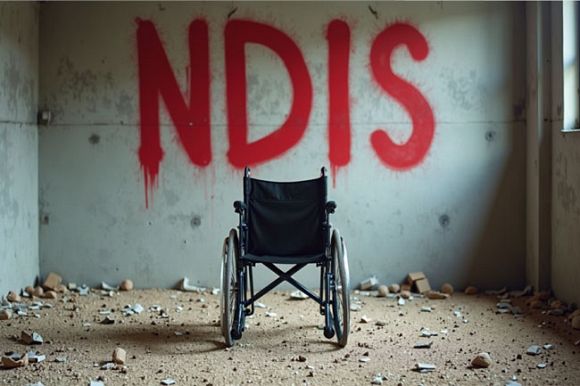
They catch the spots where they can enter, arrive, and take. And take – and will continue to take – until one of two things happens: you figure it out, or the funding stops. Whichever comes first.
Many people are shocked to read what types of supports are being approved under the NDIS. There are people offering “retreats,” “discos” and “watersports”, and there are individuals with no disability qualifications providing these supports as registered providers for tens of thousands of dollars.
I have watched tens of thousands of dollars disappear into “supports” that left me more unwell than when they began.
When these cases hit the news, are investigated and come to light as the fraud is too big to cover up, many are shocked. How could the NDIS approve this? How could it allow it? What has any of this got to do with disability?
But the NDIS exists within its own space – with its own language, jargon, rules and expectations – entirely outside common sense. What is a “recovery coach”? What is “innovative community participation”? What makes an act an expression of a participant’s “choice and control”?
Each of these terms is defined according to the NDIS, in loose and amorphous ways — boundaryless. If a provider documents something in an NDIS‑appropriate way, it becomes NDIS‑appropriate. If a person claims they are “recovery coaching”, then they are. “Choice and control” can even be interpreted as the freedom to hurt oneself or others, if framed that way.
None of this has been meaningfully defined, constrained, or sanctioned to operate in a way that truly makes sense — or that genuinely serves people with disabilities.
For me, being on the NDIS sometimes feels like being robbed because I am required to let people into my home who are unsafe, strange, unregulated and unemployable elsewhere. People who are unable – or unwilling – to find stable work, drifting into disability support between jobs, divorces and mortgage payments.
They have no qualifications. No training. They charge the maximum rates the NDIS allows — and sometimes try to charge more, or double it. They enter my home, know where I live, occupy my space — and fracture my already fragile mental health rather than supporting its recovery.
They always – always – ask for special conditions. They ask me to change my needs to suit them. They want to work in ways that empower them. They want to go to places they enjoy. They suggest employing people they like — their son, their boyfriend, their best friend.
They always see a pathway to a better life for themselves.

My recovery? Irrelevant.
The NDIS feels like being robbed of the little stability I have, the little hope I have and the small corner of life I have carved out for myself — with supportive people I trust, who tell me and others the truth, and who believe in me and my recovery. It allows people who believe in only one currency – cash – to enter as quickly and as easily as possible.
There are remarkable support workers, peer workers, mental health workers and humans who make this space hopeful. But until we address the enormous level of fraud – and the human impact it has – we leave our most vulnerable exposed to highway robbery.
They steal what is most precious to us: our sense of safety to exist. They take our dignity.
Vardit Leizer is a trauma survivor. She likes to write, read and be in nature. She is passionate about mental health reform.
 This work is licensed under a Creative Commons Attribution-NonCommercial-NoDerivs 3.0 Australia License
Support independent journalism Subscribe to IA.


Related Articles
- Slashing support: How the NDIS is leaving the most vulnerable behind
- The truth behind the NDIS scheme: A participant's nightmare
- Robodebt shadow leaves fears NDIS will be next victim of disabling policy
- Parliamentary changes to NDIS making life harder for disabled
- NDIS: Bad help not better than no help at all