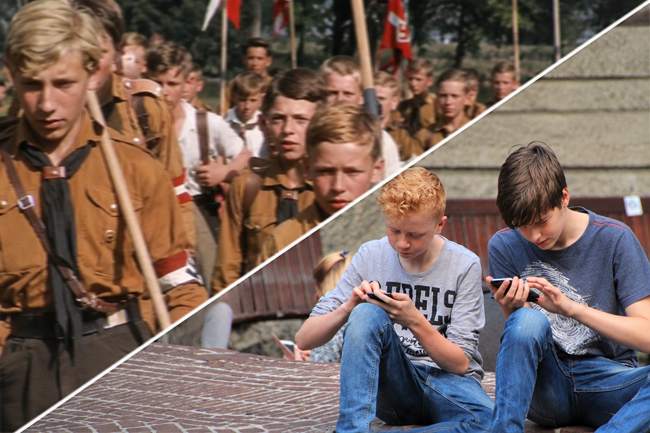
In 1967, a California teacher turned a history class into a movement in five days. Today, the same playbook is pulling young men into the manosphere and away from democracy, and nobody calls time, writes Wayne Hawkins.
IN APRIL 1967, a student in Ron Jones' world history class at Cubberley High School in Palo Alto asked the question every student of the Holocaust eventually asks. How could ordinary Germans say they didn’t know? How could decent people go along with it?
Jones didn’t have a good answer. So instead of telling them, he decided to show them.
On Monday, he introduced ‘Strength through Discipline’: posture drills, crisp rules for answering questions, everyone standing to speak. The class loved it. Marks went up. Quiet kids found their voice.
On Tuesday came ‘Strength through Community’. The group got a name, The Third Wave, along with a motto and a salute. By Wednesday, ‘Strength through Action’, there were membership cards, recruitment drives and a few students quietly tasked with reporting anyone who broke the rules. Others began informing unasked. The movement swelled from about 30 students to more than 200.
On Thursday, Jones told them they were part of a national youth movement and their leader would be revealed on television the next day. On Friday, the hall was packed. The TV was switched on. The screen stayed blank.
Then Jones played footage of Nazi rallies and told them, in essence, that they would have made very good Germans.
Jones wrote up the experiment years later and some of his details have been questioned. But former students confirmed the core story in the 2010 documentary Lesson Plan and several described how easily they were swept along.
What should unsettle us is what Jones never did. He never offered an ideology. There was no enemy race, no manifesto, no grievance. He offered belonging, order, a sense of being special and permission to look down on everyone outside the group.
And he offered it in steps. Each one was small enough to seem reasonable. By the time students were informing on their friends, they had invested days of identity in the group. Walking away meant admitting they had been fooled.
That is how indoctrination usually works. People are rarely argued into extremism. They are welcomed into it, one small concession at a time, by someone who makes them feel seen.
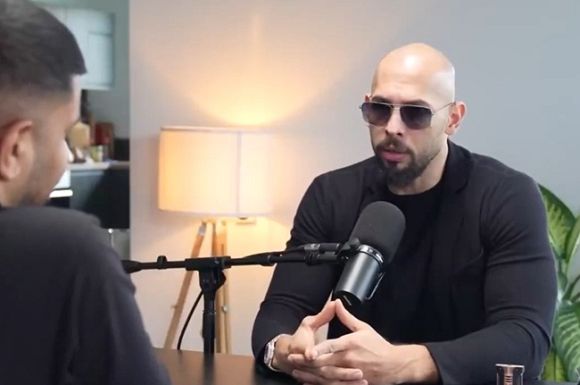
Fifty-nine years later, the same five days run on a loop in the earbuds of young men. It’s called the manosphere and much of it now arrives as a podcast.
Day one is discipline: gym routines, money tips, cold showers, self-improvement. Some of it genuinely helps. Day two is community. Hosts talk for three hours like mates around a barbecue, and listeners pick up the in-jokes, the regular guests and the sense of being among the few who see through it all. The mainstream media lie; we tell you what they won’t.
Day three is action. Fans cut the long episodes into short clips and push them onto TikTok and YouTube Shorts, where they find the next listener. The followers become the recruiters. And like the Third Wave, the movement needs people to stand outside it: feminists, “woke” elites, journalists, experts and increasingly the institutions of democracy itself.

This is no longer a fringe. Pew Research found nearly 40% of Americans under 30 regularly get their news from online influencers. Of those influencers, 63% are men and about a third share their content as podcasts.
Politicians noticed. In 2024, Donald Trump toured the podcasts young men listen to, finishing on The Joe Rogan Experience. Young men who backed Joe Biden by 11 points in 2020 went to Trump by two. Nobody can prove the podcasts did it, but every campaign now treats them as the place to find young men.
What Jones offered in a classroom, the podcast offers on demand: belonging, order, a sense of being chosen and someone to blame.
There is good reason to be careful about blaming the algorithm. A 2023 study of YouTube found the fabled rabbit hole was rare: extremist viewing came mostly from people who already subscribed and went looking.
Short-form video changed that. On TikTok and YouTube Shorts, nobody has to subscribe to anything; the feed chooses for you.
When researchers at Dublin City University set up accounts posing as teenage boys, YouTube Shorts served manosphere content to an 18-year-old’s account within about two minutes and TikTok to a 16-year-old’s in under nine. After two to three hours of watching, 76% of TikTok recommendations and 78% on YouTube Shorts were toxic or problematic, mostly alpha-male and anti-feminist material.
A UCL and University of Kent study of TikTok’s ‘For You’ feed found misogynistic content rose from 13% of recommendations to 56% in five days. The feed opened with loneliness and self-improvement, then turned to anger and blame aimed at women. That is Jones’s lesson plan, written by a machine.
Australia is living with the result. A University of Melbourne survey of 3,429 Australians, published in August, found teenage boys were the group most likely to hold misogynistic attitudes and about one in four agreed feminism should be resisted with violence. Engagement with male influencers was the single strongest predictor of misogyny in the whole dataset. Of 511 teachers surveyed, 62% flagged online misogyny as a classroom concern.

None of this makes boys empty vessels. A U.S. study of 601 boys published in October found those following manosphere figures were no more depressed or isolated than their peers. The strongest predictor of rigid views was what their parents told them about being big and tough. The feed doesn’t plant the seed. It finds it and waters it, at scale, around the clock.
And the harvest is now showing up in attitudes to democracy itself. The latest V-Dem Democracy Report, published in March, found the level of democracy enjoyed by the average person worldwide has fallen back to where it was in 1978. Some 74% of the world’s people now live under autocracy and the United States lost its status as a liberal democracy for the first time in more than 50 years.
Australia is not immune. Three in four Australians still say democracy is preferable to any other kind of government. But the McKinnon Index released this week found support for democracy among men aged 18 to 24 has fallen to 54%. More than 27% of them said “extreme measures” could sometimes be justified to advance a cause, against about one in ten Australians overall.
The Third Wave never held a vote. It had a leader, a salute and a list of people who didn’t belong. That is the political model the feed keeps selling to young men, one clip at a time.
The most important moment of the Third Wave was the Friday: the blank screen, the reveal, the lesson. Jones pulled back the curtain.
Online, nobody pulls back the curtain. There is no Day 5. The movement runs around the clock, tailored to each boy, with a commercial incentive to keep him in the hall.
Australia’s under-16 social media ban keeps younger teens off accounts, but it ends on their sixteenth birthday and the feed will be waiting. So the curtain has to be pulled back elsewhere.
Teach Jones’s experiment in every school, not as history but as a mirror. Give everyone the right to switch off engagement algorithms, as the proposed algorithm opt-out would. Open recommendation systems to independent audit. And give young men what the podcasts sell them, for real: men worth looking up to, a place to belong that doesn’t need an enemy and proof that democracy listens.
As McKinnon’s John Thwaites put it:
“People need to know their voice matters.”
The students at Cubberley High weren’t stupid or evil. They were human. So are the boys scrolling tonight. That was the whole lesson and we keep failing it.
This article was originally published as part of the Independent Australia weekly newsletter. Subscribe to IA to access all our work from as little as $1.15 per week and help power our journalism throughout 2026.
Wayne Hawkins is a product of public schools who dropped out before earning any significant degree. His real political education came later, from more than 25 years of running businesses locally and overseas, seeing inequality up close and turning to history to understand how it got that way.
 This work is licensed under a Creative Commons Attribution-NonCommercial-NoDerivs 3.0 Australia License
Support independent journalism Subscribe to IA.