
New research reveals how Australia's offshore detention system placed health professionals in ethical conflict, discouraging patient advocacy and punishing those who spoke up, writes Dr Kim Elkovich.
AUSTRALIA REQUIRES doctors, nurses, psychologists and social workers to advocate for patients, protect human rights and speak up when care is unsafe.
Yet health professionals who worked in Australia’s offshore processing centre in Nauru described a system in which advocacy could cost them their jobs.
New healthcare systems research examining the healthcare ethics and ethical dilemmas of Australian health professionals working in Nauru's offshore detention system could not be timelier. Its findings coincide with two significant developments: the United Nations' May 2026 recommendations on migration governance and the Australian Senate's July 2026 Inquiry recommendations into offshore processing.
Together, they present an opportunity for open dialogue about whether Australia's offshore detention policies are compatible with the ethical practice expected of its healthcare workforce.

The UN recommendations are particularly relevant because they call on governments to protect human rights defenders and civil society actors who assist migrants affected by migration externalisation; the practice of shifting responsibility for asylum seekers beyond national borders.
At the same time, refugee advocacy organisations have criticised the recent Senate inquiry recommendations for failing to deliver the accountability needed to address longstanding human rights concerns in Australia's offshore detention system.
Where health professionals come in
Health professionals occupy a unique position in this debate. Their professional responsibility extends beyond providing treatment. Australian health professional registration codes of ethics and conduct require them to advocate for patients, protect human rights and speak up when care is compromised. Yet their ability to meet these obligations depends on the systems in which they work.
Interviews with frontline Australian registered doctors, nurses, psychologists and social workers reveal what happens when those systems conflict with their registration requirements.
It’s a complex and comprehensive analysis, so by way of introduction, three primary interconnected findings will be highlighted here.
First, participants described a fundamental conflict between the values underpinning Australian health professional practice and those of the healthcare delivery system operating within Nauru. Second, they experienced profound moral distress when systemic barriers prevented them from providing necessary care. Third, they described a psychologically unsafe workplace where speaking up for patients could result in some form of retribution, including being “kicked off the island”.
Incomparable to Australia
In Nauru, the regulatory framework, central to achieving healthcare outcomes posited to be as near as possible comparable with Australian standards, was imbued with a double standard. Health contractors (employers) in Nauru were self-regulated; however, healthcare professionals remained bound to Australian health professional registration standards.
A system-level rule that contradicted their professional registration codes was the active discouragement of patient advocacy.

One participant recalled
“I was actively told at one point, you are advocating for your client and advocacy is not allowed, you are not allowed to advocate for your client.”
Health professionals needed to find a balance between fulfilling their duty of care and avoiding consequences such as being “kicked off the island”:
“One of the biggest dilemmas was navigating what feels okay to you, managing the systems around it and not getting fired... eventually I got fired.”
In Australia, workplace safety legislation protects employees who report safety issues from dismissal or discrimination. Yet in Nauru, several participants had contracts terminated for client advocacy and speaking up. These accounts also sit uneasily alongside the UN's recommendation for governments to protect those defending the rights of migrants and asylum seekers.
Real-life repercussions
The powerlessness of being unable to effect change while watching one’s client’s health deteriorate resulted in significant moral distress for health professionals. Participants provided examples of “deliberate indifference”, where system-level roadblocks prevented necessary client care such as client transfers for urgent medical assistance, leading to further client deterioration.
One participant noted, with the increased deterioration of children with evasive refusal syndrome, ‘And we knew from their parents that most of those children had already been referred to the OMR [Overseas Medical Referral Committee], and it wasn’t working’.
In this research, deliberate indifference extended beyond negligence or recklessness: health professionals’ examples suggested that authorities consciously chose to ignore the risk of serious harm and possible client death.
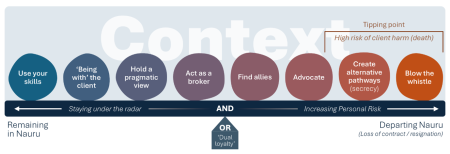
The infographic diagram depicts participant actions as they navigated ethical dilemmas attempting to find a balance between remaining in Nauru and losing their contract. ‘Because if you were asked to leave, you could do less than if you were there.’
What comes next?
Healthcare systems do not operate in isolation. They reflect political choices and policy priorities. If governments expect health professionals to uphold Australian ethical and professional standards, those professionals must be supported by systems that make ethical practice possible. Health professionals are ethically mandated to protect human rights and to do no harm.
The research highlighted a poor ethical climate, revealing a mismatch between the values underpinning Australian health professional practice and those underpinning the offshore detention system. As Australia continues to fund offshore detention amid ongoing scrutiny from the UN over the externalisation of migration governance, alongside multiple inquiries into offshore processing documenting human rights violations, Australian leaders, policy makers, regulators and the public face an important ethical question. What standards should govern Australia’s offshore detention arrangements?
If Australia expects health professionals to uphold the ethical standards of a healthcare system established for Australia yet operating in another sovereign state, reform must extend beyond supporting individual clinicians. It must also address the structural and policy conditions that shape the system in which they are required to practise.
Dr Kim Elkovich is a nationally recognised consultant, academic lecturer, clinical supervisor and dual-qualified health professional with more than 30 years of experience across healthcare.
 This work is licensed under a Creative Commons Attribution-NonCommercial-NoDerivs 3.0 Australia License
Support independent journalism Subscribe to IA.


Related Articles
- Contract bikies and bribed politicians: Australia’s Nauru refugee deal
- Medical evidence steps up campaign to end Nauru
- Taking a stand on media freedom in the Pacific
- 'Worse than death' Nauru: A mother's story
- Nauru manoeuvres